Determine the largest open intervals of the domain over which each function is (c) constant. See Example 9.
Table of contents
- 0. Review of Algebra4h 18m
- 1. Equations & Inequalities3h 18m
- 2. Graphs of Equations1h 43m
- 3. Functions2h 17m
- 4. Polynomial Functions1h 44m
- 5. Rational Functions1h 23m
- 6. Exponential & Logarithmic Functions2h 28m
- 7. Systems of Equations & Matrices4h 5m
- 8. Conic Sections2h 23m
- 9. Sequences, Series, & Induction1h 22m
- 10. Combinatorics & Probability1h 45m
3. Functions
Intro to Functions & Their Graphs
Problem 3
Textbook Question
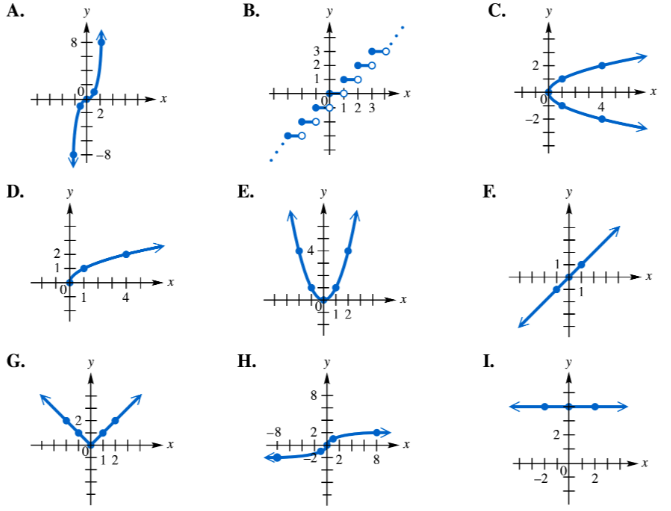
To answer each question, refer to the following basic graphs. Which one is the graph of ƒ(x)=x3? What is its range?
Verified step by step guidance1
Recall the general shape of the graph of the function \(f(x) = x^3\). It is a cubic function with an S-shaped curve that passes through the origin (0,0). The graph increases without bound as \(x\) becomes large positive and decreases without bound as \(x\) becomes large negative.
Compare the given graphs to identify the one that matches this S-shaped cubic curve. The correct graph will have symmetry about the origin and will not be a parabola or linear function.
Once the correct graph is identified, consider the range of the function \(f(x) = x^3\). Since cubic functions are continuous and increase or decrease without bound, the output values cover all real numbers.
Express the range of \(f(x) = x^3\) using interval notation. Because the function can take any real value, the range is all real numbers, which is written as \((-\infty, \infty)\).
Summarize that the graph of \(f(x) = x^3\) is the cubic S-shaped curve passing through the origin, and its range is all real numbers, \((-\infty, \infty)\).
Verified video answer for a similar problem:This video solution was recommended by our tutors as helpful for the problem above
Video duration:
3mPlay a video:
Was this helpful?
Key Concepts
Here are the essential concepts you must grasp in order to answer the question correctly.
Cubic Function and Its Graph
A cubic function is a polynomial of degree three, typically written as f(x) = x³. Its graph is an S-shaped curve that passes through the origin, increasing from negative infinity to positive infinity. Understanding the shape helps identify the correct graph among options.
Recommended video:
Graphs of Logarithmic Functions
Range of a Function
The range of a function is the set of all possible output values (f(x)) it can produce. For f(x) = x³, since the cubic function extends infinitely in both positive and negative directions, its range is all real numbers, denoted as (-∞, ∞).
Recommended video:
Domain & Range of Transformed Functions
Interpreting Graphs of Functions
Interpreting graphs involves recognizing key features like intercepts, end behavior, and symmetry. For f(x) = x³, the graph passes through (0,0), is symmetric about the origin (odd function), and shows continuous growth, which helps distinguish it from other basic graphs.
Recommended video:
Graphs of Logarithmic Functions
Watch next
Master Relations and Functions with a bite sized video explanation from Patrick
Start learningRelated Videos
Related Practice
Textbook Question
521
views