In Exercises 1–26, graph each inequality. (x−2)2+(y+1)2<9
Verified step by step guidance
1
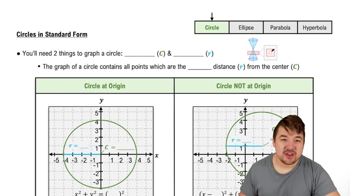
Recognize that the inequality \((x - 2)^2 + (y + 1)^2 < 9\) represents the set of points inside a circle in the coordinate plane.
Identify the center and radius of the circle from the inequality. The center is at \((2, -1)\) and the radius is \(\sqrt{9} = 3\).
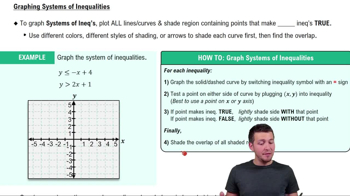
Draw the circle with center \((2, -1)\) and radius 3. Since the inequality is \(< 9\) (not \(\leq\)), the boundary circle should be drawn as a dashed line to indicate points on the circle are not included.
Shade the region inside the circle because the inequality is \(< 9\), meaning all points whose distance from the center is less than 3 satisfy the inequality.
Label the graph clearly with the center point and radius, and ensure the shaded region corresponds to the interior of the circle.
Verified video answer for a similar problem:
This video solution was recommended by our tutors as helpful for the problem above
Video duration:
6m
Play a video:
Was this helpful?
Key Concepts
Here are the essential concepts you must grasp in order to answer the question correctly.
Equation of a Circle
The equation (x−h)^2 + (y−k)^2 = r^2 represents a circle with center (h, k) and radius r. In this problem, (x−2)^2 + (y+1)^2 = 9 describes a circle centered at (2, -1) with radius 3, since 9 is 3 squared.
An inequality like (x−2)^2 + (y+1)^2 < 9 describes all points inside the circle, excluding the boundary. Points satisfying the inequality lie strictly within the circle's radius, while points on the circle satisfy the equation with equality.
To graph an inequality, first draw the boundary curve (here, the circle). Then, determine which side of the boundary satisfies the inequality by testing points. Shade the region representing all solutions, using a dashed boundary if the inequality is strict (< or >).