Identify the inequality given: . This means we are looking for all values of that are less than or equal to -3.
Draw a number line or coordinate plane with the x-axis clearly labeled. Locate the point on the x-axis.
Since the inequality is 'less than or equal to,' draw a solid vertical line at to indicate that points on this line are included in the solution set.
Shade the region to the left of the line because the inequality includes all values less than -3.
Label the graph clearly, showing the shaded region and the solid line at , to represent the solution to the inequality .
Verified video answer for a similar problem:
This video solution was recommended by our tutors as helpful for the problem above
Video duration:
3m
Play a video:
Was this helpful?
Key Concepts
Here are the essential concepts you must grasp in order to answer the question correctly.
Graphing Inequalities on a Number Line
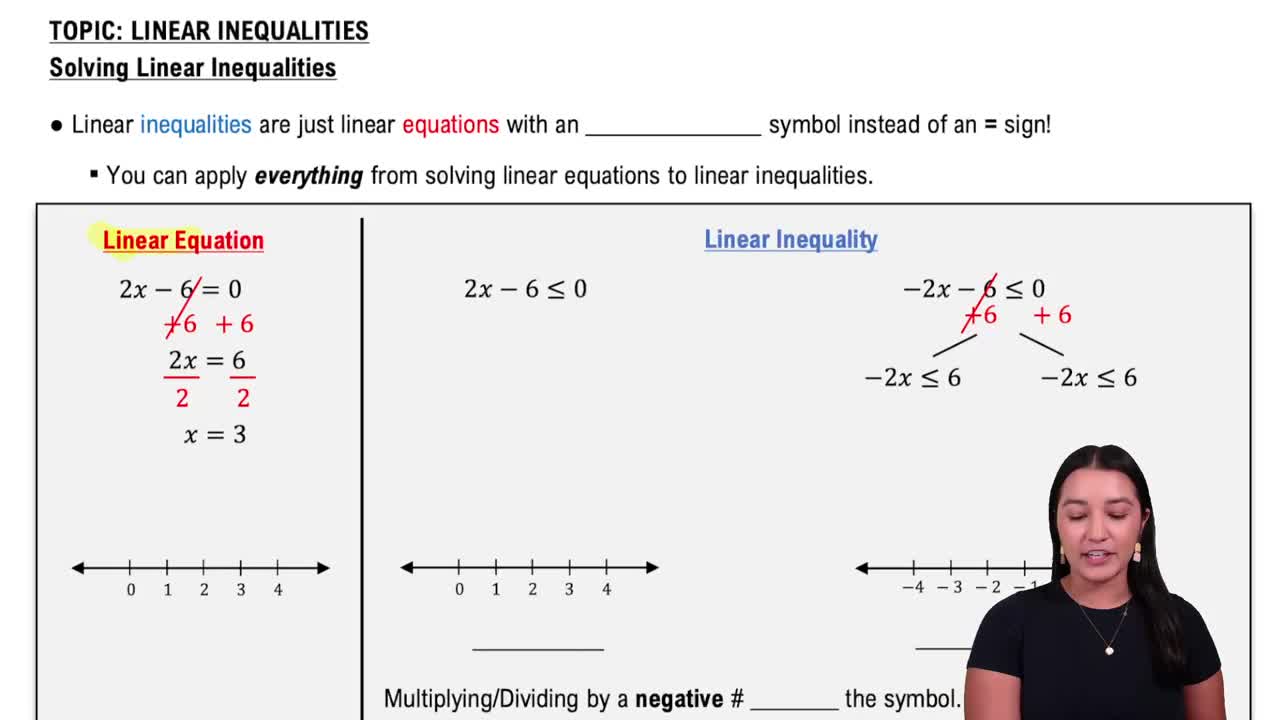
Graphing inequalities involves representing all values that satisfy the inequality on a number line. For example, x ≤ -3 means shading all points to the left of -3, including -3 itself, indicating all values less than or equal to -3.
Inequality symbols like ≤ (less than or equal to) define the range of values included in the solution. The 'less than or equal to' symbol means the solution set includes the boundary point and all values less than it.
When graphing inequalities, a closed circle is used to show that the boundary number is included (≤ or ≥), while an open circle indicates it is not included (< or >). For x ≤ -3, a closed circle is placed at -3.