Given functions f and g, find (a)(ƒ∘g)(x) and its domain, and (b)(g∘ƒ)(x) and its domain. See Examples 6 and 7. ƒ(x)=√x, g(x)=3/(x+6)
Verified step by step guidance
1
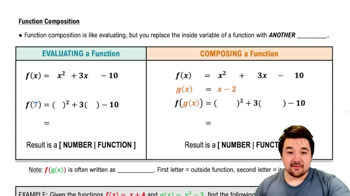
Step 1: Understand the composition of functions. The composition (f∘g)(x) means applying g first and then applying f to the result of g. Similarly, (g∘f)(x) means applying f first and then applying g to the result of f.
Step 2: Find (f∘g)(x). Substitute g(x) into f(x). Since f(x) = \sqrt{x}, replace x in f with g(x) = \frac{3}{x+6}. So, (f∘g)(x) = \sqrt{\frac{3}{x+6}}.
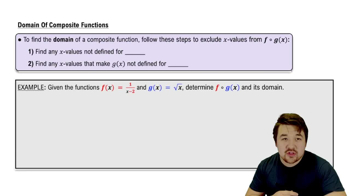
Step 3: Determine the domain of (f∘g)(x). The expression \sqrt{\frac{3}{x+6}} is defined when \frac{3}{x+6} \geq 0 and x+6 \neq 0. Solve these inequalities to find the domain.
Step 4: Find (g∘f)(x). Substitute f(x) into g(x). Since g(x) = \frac{3}{x+6}, replace x in g with f(x) = \sqrt{x}. So, (g∘f)(x) = \frac{3}{\sqrt{x} + 6}.
Step 5: Determine the domain of (g∘f)(x). The expression \frac{3}{\sqrt{x} + 6} is defined when \sqrt{x} is defined (x \geq 0) and \sqrt{x} + 6 \neq 0. Solve these conditions to find the domain.
Verified video answer for a similar problem:
This video solution was recommended by our tutors as helpful for the problem above
Video duration:
5m
Play a video:
Was this helpful?
Key Concepts
Here are the essential concepts you must grasp in order to answer the question correctly.
Function Composition
Function composition involves combining two functions, where the output of one function becomes the input of another. For functions f and g, the composition f∘g means applying g first and then f to the result. This is crucial for solving the problem as it requires evaluating the functions in sequence.
The domain of a function is the set of all possible input values (x) for which the function is defined. When composing functions, it is essential to determine the domain of the resulting function, which may be restricted by the individual domains of f and g, especially when dealing with square roots or rational functions.
Certain mathematical operations impose restrictions on the domain of functions. For example, the square root function requires non-negative inputs, while a rational function cannot have a denominator equal to zero. Understanding these restrictions is vital for accurately determining the domains of the composed functions f∘g and g∘f.