Given functions f and g, find (a)(ƒ∘g)(x) and its domain, and (b)(g∘ƒ)(x) and its domain. ƒ(x)=1/(x+4), g(x)=-(1/x)
Table of contents
- 0. Review of Algebra4h 18m
- 1. Equations & Inequalities3h 18m
- 2. Graphs of Equations1h 43m
- 3. Functions2h 17m
- 4. Polynomial Functions1h 44m
- 5. Rational Functions1h 23m
- 6. Exponential & Logarithmic Functions2h 28m
- 7. Systems of Equations & Matrices4h 5m
- 8. Conic Sections2h 23m
- 9. Sequences, Series, & Induction1h 22m
- 10. Combinatorics & Probability1h 45m
3. Functions
Function Composition
Problem 84
Textbook Question
Given functions f and g, find (a)(ƒ∘g)(x) and its domain, and (b)(g∘ƒ)(x) and its domain. See Examples 6 and 7.
Verified step by step guidance1
Step 1: Understand the composition of functions. For (ƒ∘g)(x), this means ƒ(g(x)), which is the function ƒ applied to the output of g(x). Similarly, for (g∘ƒ)(x), this means g(ƒ(x)).
Step 2: Write the expressions for each composition. For (ƒ∘g)(x), substitute g(x) into ƒ(x):
\[(ƒ∘g)(x) = ƒ(g(x)) = \sqrt{g(x) + 4}\]
Since \(g(x) = -\frac{2}{x}\), this becomes:
\[(ƒ∘g)(x) = \sqrt{-\frac{2}{x} + 4}\]
Step 3: Determine the domain of (ƒ∘g)(x). The domain consists of all x-values for which the expression inside the square root is greater than or equal to zero (because the square root function requires a non-negative input), and where g(x) itself is defined (denominator not zero). So, solve the inequality:
\[-\frac{2}{x} + 4 \geq 0\]
and exclude values where \(x=0\).
Step 4: Write the expression for (g∘ƒ)(x) by substituting ƒ(x) into g(x):
\[(g∘ƒ)(x) = g(ƒ(x)) = -\frac{2}{ƒ(x)} = -\frac{2}{\sqrt{x+4}}\]
Step 5: Determine the domain of (g∘ƒ)(x). The domain includes all x-values where ƒ(x) is defined (inside the square root must be non-negative, so \(x+4 \geq 0\)) and where the denominator in g(ƒ(x)) is not zero (so \(\sqrt{x+4} \neq 0\)). Solve these conditions to find the domain.
Verified video answer for a similar problem:This video solution was recommended by our tutors as helpful for the problem above
Video duration:
5mPlay a video:
Was this helpful?
Key Concepts
Here are the essential concepts you must grasp in order to answer the question correctly.
Function Composition
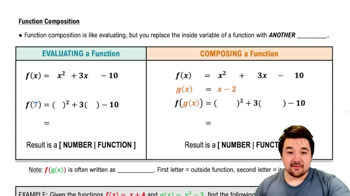
Function composition involves applying one function to the result of another, denoted as (f∘g)(x) = f(g(x)). It requires substituting the entire output of g(x) into f(x), creating a new function that combines both operations.
Recommended video:
Function Composition
Domain of a Function
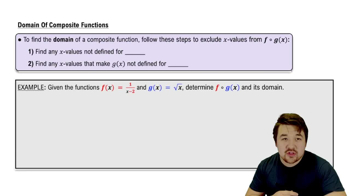
The domain is the set of all input values for which a function is defined. When composing functions, the domain of (f∘g)(x) includes all x-values in the domain of g such that g(x) is in the domain of f.
Recommended video:
Domain Restrictions of Composed Functions
Square Root and Rational Function Restrictions
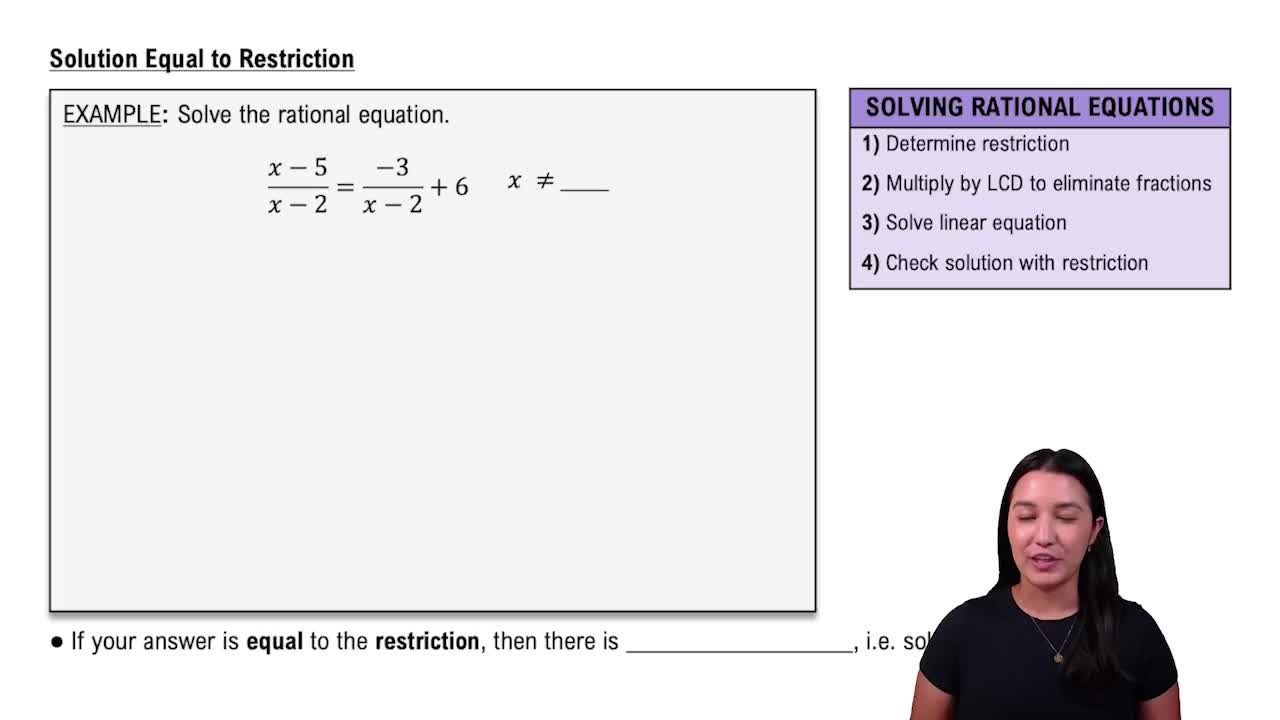
The square root function requires the radicand to be non-negative, so x+4 ≥ 0 for f(x). The rational function g(x) = -2/x is undefined at x=0. These restrictions affect the domains of f, g, and their compositions.
Recommended video:
Restrictions on Rational Equations
Watch next
Master Function Composition with a bite sized video explanation from Patrick
Start learningRelated Videos
Related Practice
Textbook Question
20
views