Recognize that the absolute value expression \(|12 - 9x|\) represents the distance of the quantity \((12 - 9x)\) from zero on the number line, and absolute values are always non-negative (i.e., \(|a| \geq 0\) for any real number \(a\)).
Note that the inequality is \(|12 - 9x| \geq -12\). Since the right side is a negative number, and absolute values are always greater than or equal to zero, this inequality will always be true for all real values of \(x\).
Formally, because \(|12 - 9x| \geq 0\) and \$0 \geq -12\(, the inequality \)|12 - 9x| \geq -12\( holds for every real number \)x$.
Therefore, the solution set is all real numbers, which can be written as \((-\infty, \infty)\).
To summarize, no further algebraic manipulation is needed because the inequality is always true due to the properties of absolute value.
Verified video answer for a similar problem:
This video solution was recommended by our tutors as helpful for the problem above
Video duration:
59s
Play a video:
Was this helpful?
Key Concepts
Here are the essential concepts you must grasp in order to answer the question correctly.
Absolute Value Inequalities
Absolute value inequalities involve expressions where the absolute value of a variable or expression is compared to a number. Since absolute value represents distance from zero, it is always non-negative, which affects how inequalities are solved and interpreted.
The absolute value of a number is its distance from zero on the number line, always non-negative. For any real number x, |x| ≥ 0, and |x| = a implies x = a or x = -a. This property helps in breaking down absolute value inequalities into separate cases.
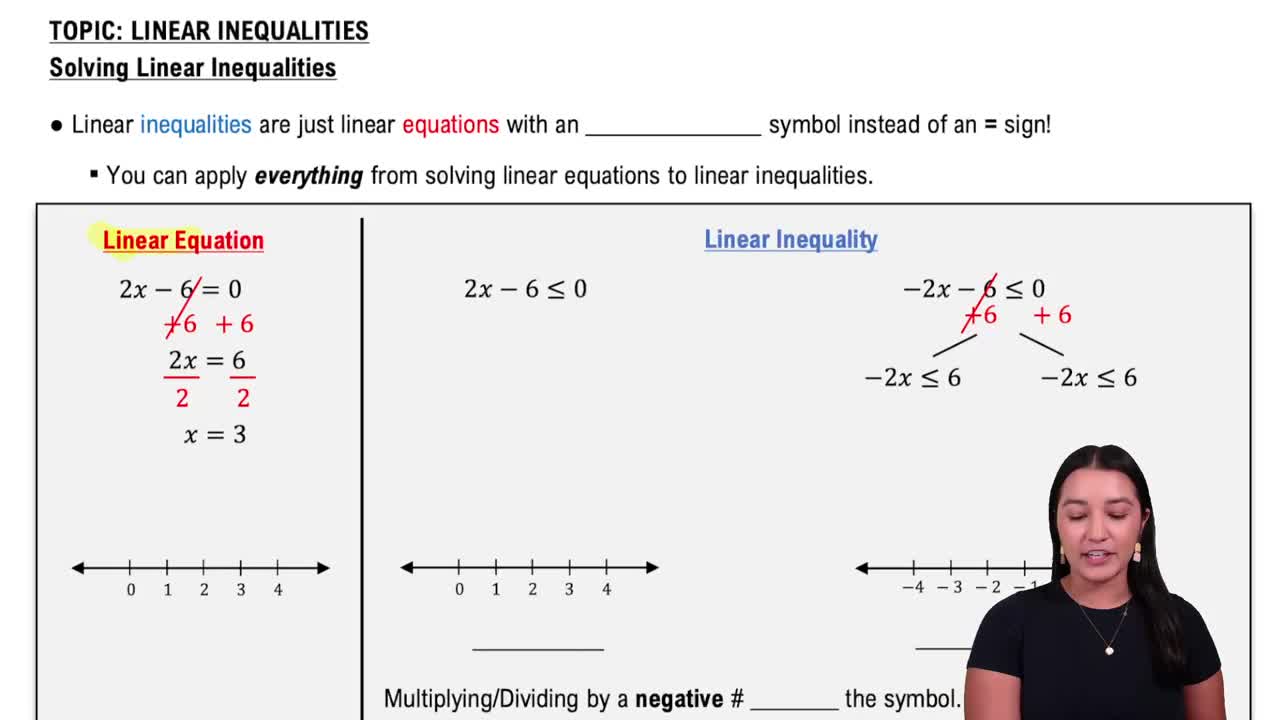
Solving linear inequalities involves isolating the variable and considering the direction of the inequality. When multiplying or dividing by a negative number, the inequality sign reverses. Understanding this is essential when solving inequalities derived from absolute value expressions.