Solve each equation or inequality. | 6- 3x | < -11
Verified step by step guidance
1
Recognize that the expression involves an absolute value inequality: \(|6 - 3x| + 4 < -11\).
Isolate the absolute value term by subtracting 4 from both sides: \(|6 - 3x| < -11 - 4\).
Simplify the right side: \(|6 - 3x| < -15\).
Recall that the absolute value of any real number is always greater than or equal to zero, so it can never be less than a negative number.
Conclude that there is no solution to the inequality because an absolute value expression cannot be less than a negative number.
Verified video answer for a similar problem:
This video solution was recommended by our tutors as helpful for the problem above
Video duration:
44s
Play a video:
Was this helpful?
Key Concepts
Here are the essential concepts you must grasp in order to answer the question correctly.
Absolute Value Inequalities
Absolute value inequalities involve expressions where the absolute value of a variable or expression is compared to a number. Understanding how to interpret and solve inequalities like |A| < B or |A| > B is essential, where the solution depends on whether B is positive, zero, or negative.
The absolute value of a number represents its distance from zero on the number line and is always non-negative. This means |x| ≥ 0 for any real x, and |x| < 0 has no solution. Recognizing this helps determine if an inequality involving absolute values has solutions.
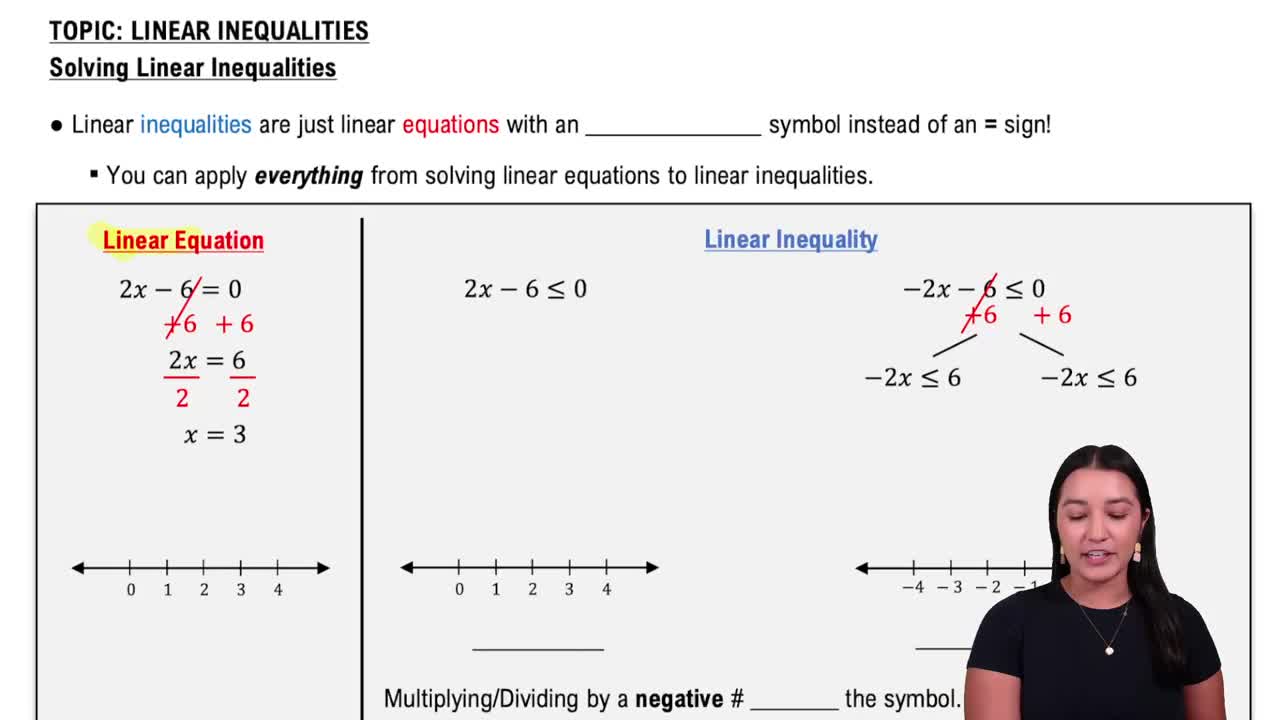
Solving linear inequalities involves isolating the variable and considering inequality rules, such as reversing the inequality sign when multiplying or dividing by a negative number. This skill is necessary after interpreting the absolute value inequality to find the solution set.