In Exercises 51–58, solve each compound inequality. - 11 < 2x - 1 ≤ - 5
Verified step by step guidance
1
Start by writing the compound inequality as two separate inequalities combined: \$11 < 2x - 1\( and \)2x - 1 \leq -5$.
Solve the first inequality \$11 < 2x - 1\( by adding 1 to both sides to isolate the term with \)x\(: \)11 + 1 < 2x\( which simplifies to \)12 < 2x$.
Next, divide both sides of \$12 < 2x\( by 2 to solve for \)x\(: \)\frac{12}{2} < x\( which simplifies to \)6 < x$.
Now solve the second inequality \$2x - 1 \leq -5\( by adding 1 to both sides: \)2x \leq -5 + 1\( which simplifies to \)2x \leq -4$.
Divide both sides of \$2x \leq -4\( by 2 to solve for \)x\(: \)x \leq \frac{-4}{2}\( which simplifies to \)x \leq -2$.
Verified video answer for a similar problem:
This video solution was recommended by our tutors as helpful for the problem above
Video duration:
2m
Play a video:
Was this helpful?
Key Concepts
Here are the essential concepts you must grasp in order to answer the question correctly.
Compound Inequalities
Compound inequalities involve two inequalities combined into one statement, often connected by 'and' or 'or'. Solving them requires finding values that satisfy both inequalities simultaneously, typically represented as a range or union of intervals.
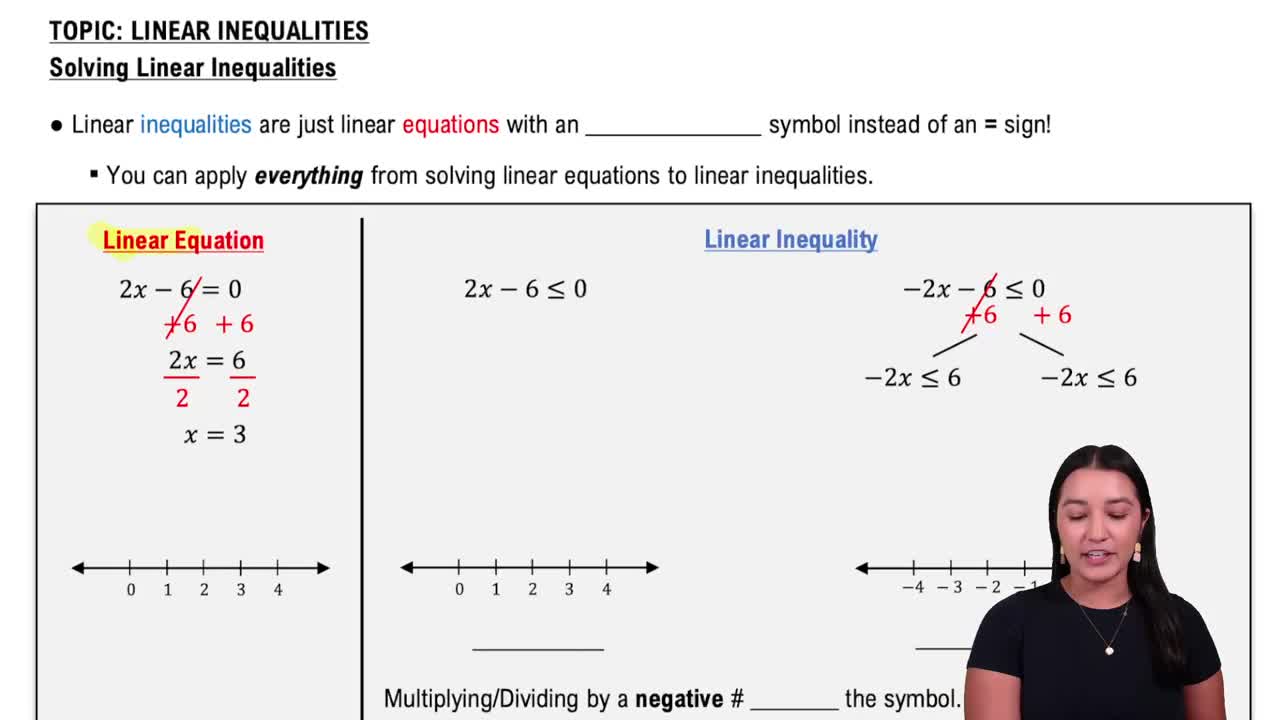
Solving linear inequalities involves isolating the variable on one side by performing inverse operations, similar to solving equations, but remembering to reverse the inequality sign when multiplying or dividing by a negative number.
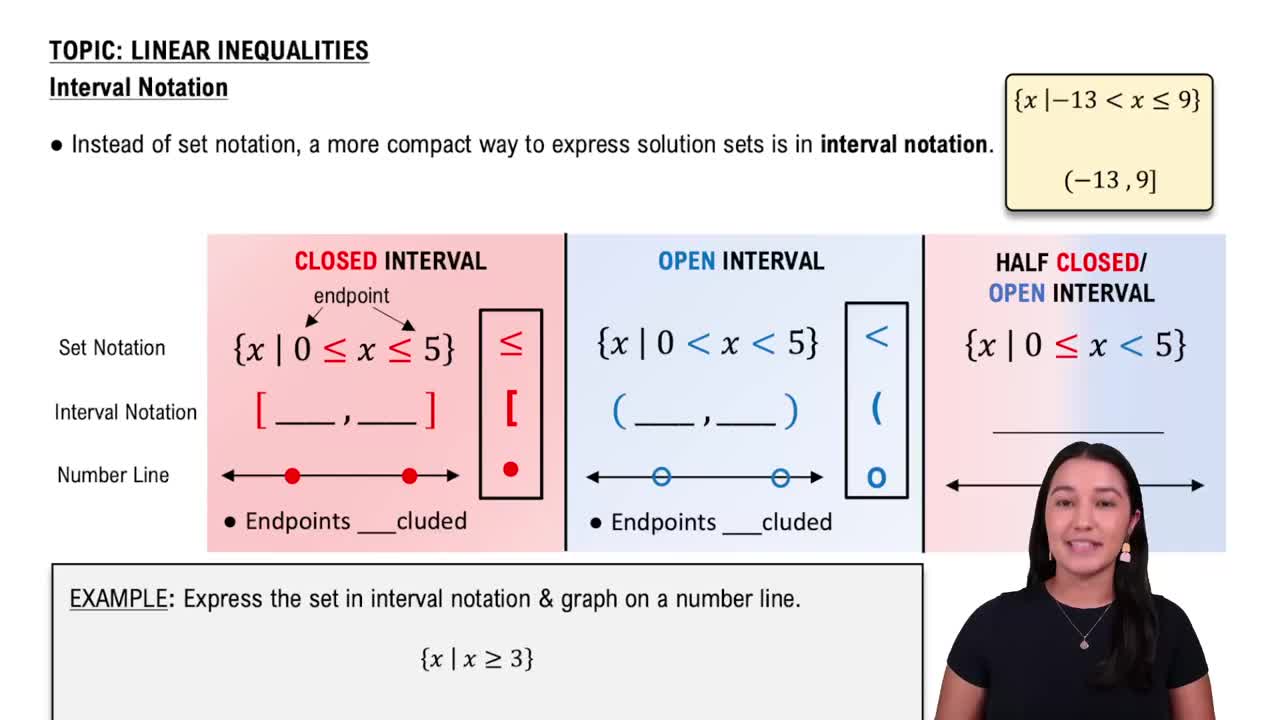
After solving inequalities, solutions are often expressed in interval notation, which concisely describes all values that satisfy the inequality. Graphing these intervals on a number line helps visualize the solution set clearly.