In Exercises 51–58, solve each compound inequality. - 3 ≤ (2/3)x - 5 < - 1
Verified step by step guidance
1
Start by writing the compound inequality clearly: \(-3 \leq \frac{2}{3}x - 5 < -1\).
Add 5 to all three parts of the inequality to isolate the term with \(x\): \(-3 + 5 \leq \frac{2}{3}x - 5 + 5 < -1 + 5\).
Simplify each part: \$2 \leq \frac{2}{3}x < 4$.
Multiply all parts of the inequality by the reciprocal of \(\frac{2}{3}\), which is \(\frac{3}{2}\), to solve for \(x\): \$2 \times \frac{3}{2} \leq x < 4 \times \frac{3}{2}$.
Simplify the multiplication to find the range of \(x\): \$3 \leq x < 6$.
Verified video answer for a similar problem:
This video solution was recommended by our tutors as helpful for the problem above
Video duration:
1m
Play a video:
Was this helpful?
Key Concepts
Here are the essential concepts you must grasp in order to answer the question correctly.
Compound Inequalities
Compound inequalities involve two inequalities joined together, often by 'and' or 'or'. In this problem, the compound inequality uses 'and', meaning the solution must satisfy both inequalities simultaneously. Understanding how to split and solve each part is essential.
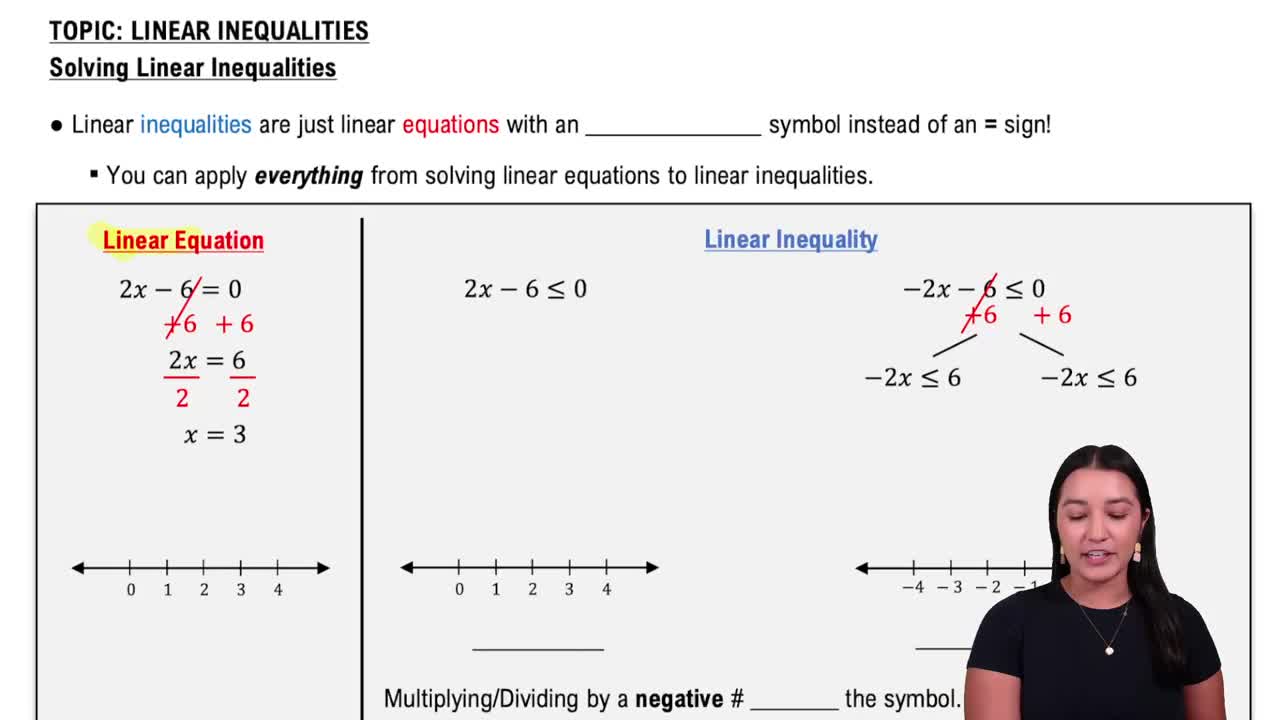
Solving linear inequalities requires isolating the variable by performing inverse operations, similar to solving equations, but with attention to inequality direction. Multiplying or dividing by a negative number reverses the inequality sign, which is crucial to remember.
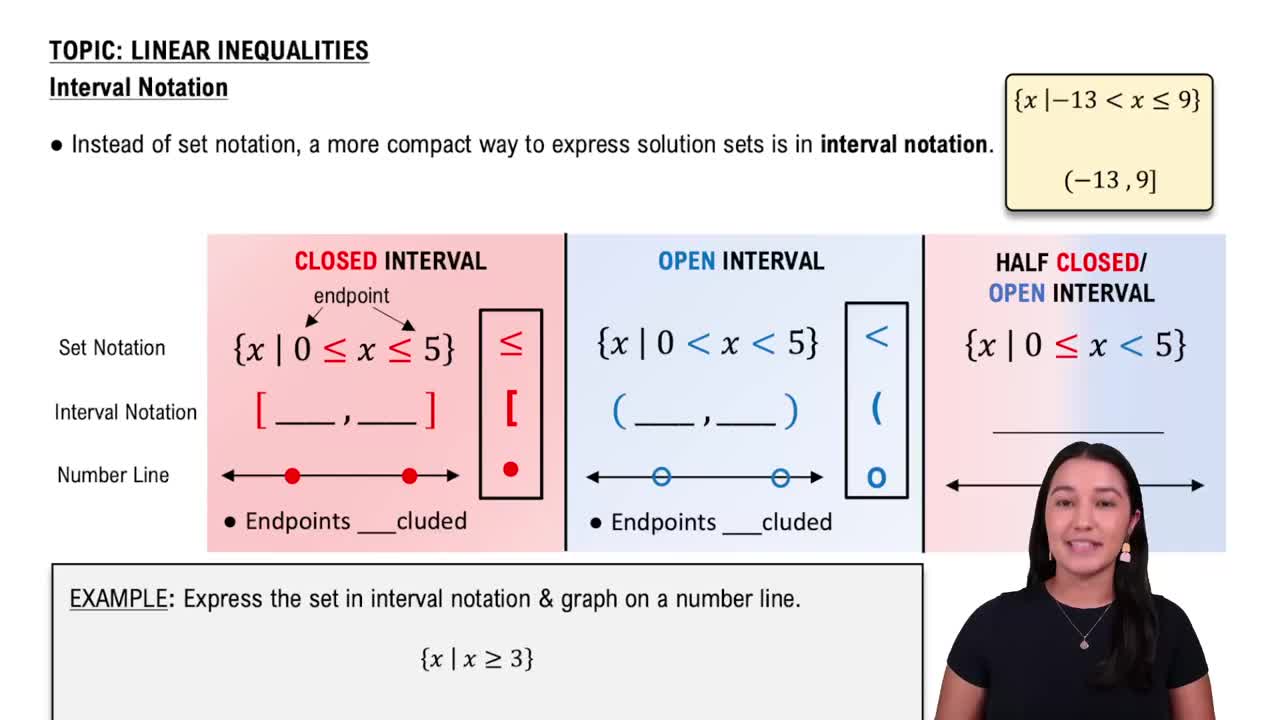
After solving inequalities, expressing the solution set in interval notation helps clearly communicate the range of values that satisfy the inequality. Understanding how to write and interpret intervals is important for representing solutions concisely.