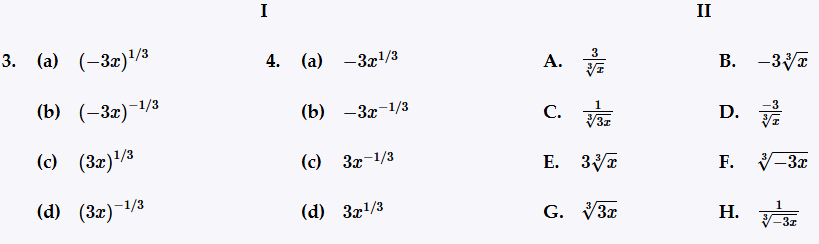
Match the rational exponent expression in Column I with the equivalent radical expression in Column II. Assume that x is not 0. (d) 3x^1/3
Verified step by step guidance
1
Identify the given expression: \(3x^{1/3}\).
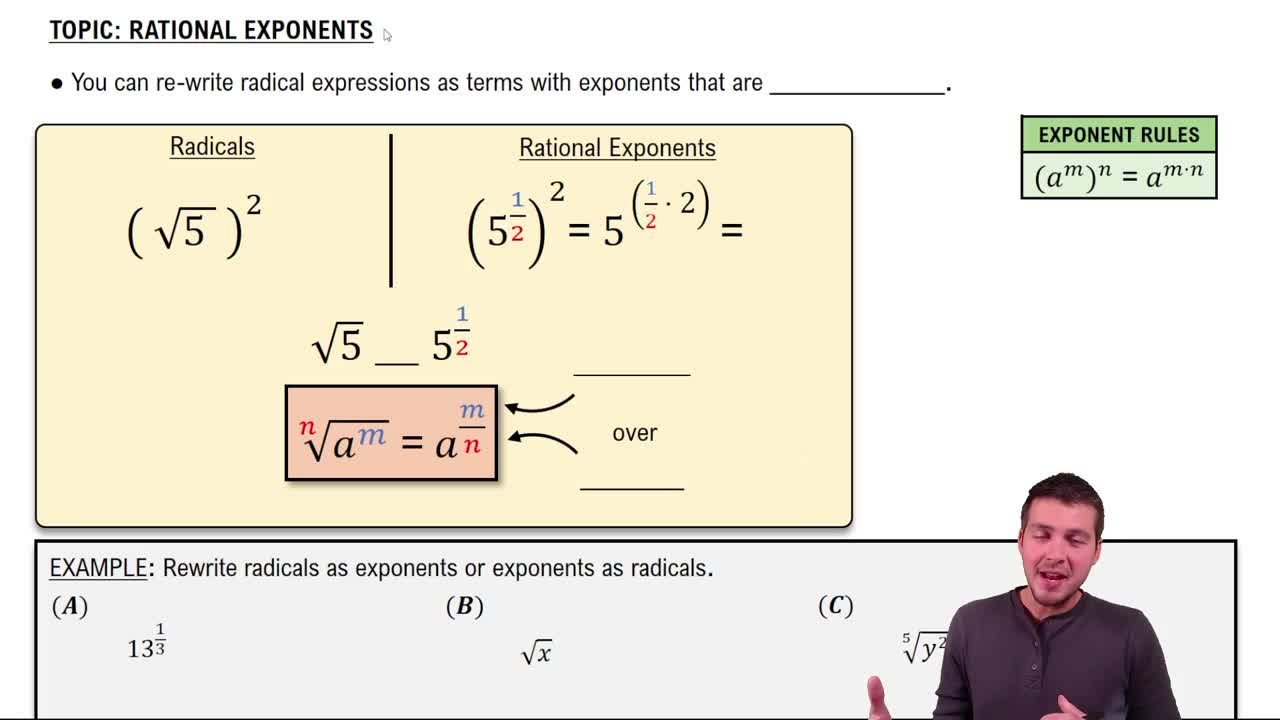
Recall that a rational exponent \(a^{m/n}\) can be rewritten as a radical expression \(\sqrt[n]{a^m}\).
Apply this rule to the expression \(x^{1/3}\), which becomes \(\sqrt[3]{x}\).
Combine the coefficient 3 with the radical expression to get \(3\sqrt[3]{x}\).
Match \(3\sqrt[3]{x}\) with the equivalent expression in Column II.
Verified video answer for a similar problem:
This video solution was recommended by our tutors as helpful for the problem above
Video duration:
1m
Play a video:
Was this helpful?
Key Concepts
Here are the essential concepts you must grasp in order to answer the question correctly.
Rational Exponents
Rational exponents are exponents that can be expressed as a fraction, where the numerator indicates the power and the denominator indicates the root. For example, x^(1/3) means the cube root of x. Understanding rational exponents is crucial for converting between exponential and radical forms.
Radical expressions involve roots, such as square roots or cube roots, and are typically written using the radical symbol (√). The expression √x represents the square root of x, while ∛x represents the cube root. Recognizing how to express rational exponents as radical expressions is essential for solving problems involving these concepts.
The properties of exponents include rules that govern how to manipulate expressions with exponents, such as the product of powers, power of a power, and power of a product. These properties help simplify expressions and are fundamental when working with both rational exponents and radical expressions, ensuring accurate conversions and calculations.