
Textbook Question
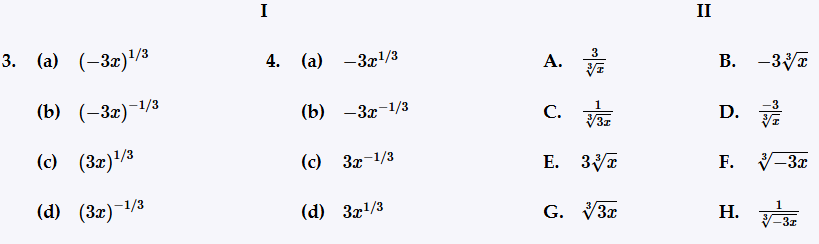
Match the rational exponent expression in Column I with the equivalent radical expression in Column II. Assume that x is not 0. -3x-1/3
577
views

 Verified step by step guidance
 04:06
04:06
 05:45 04:06
Match the rational exponent expression in Column I with the equivalent radical expression in Column II. Assume that x is not 0. -3x-1/3
Fill in the blank to correctly complete each sentence. In the term -6x2y, -6 is the ______.
The reciprocal of 6/2 is 3/1.
Match the rational exponent expression in Column I with the equivalent radical expression in Column II. Assume that x is not 0. 3x-1/3
Match the rational exponent expression in Column I with the equivalent radical expression in Column II. Assume that x is not 0. 3x1/3
Identify the set { 1,1/3, 1/9 ,1/27, ....} as finite or infinite.