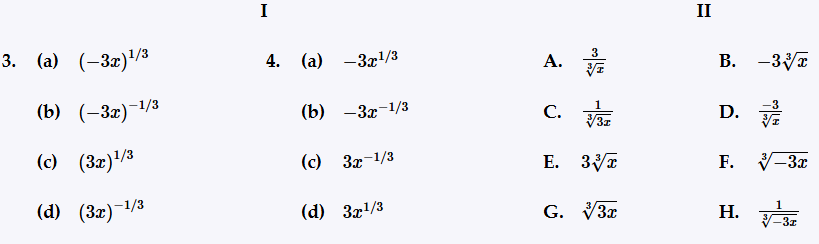
Match the rational exponent expression in Column I with the equivalent radical expression in Column II. Assume that x is not 0. (a) ( -3x )1/3
Verified step by step guidance
1
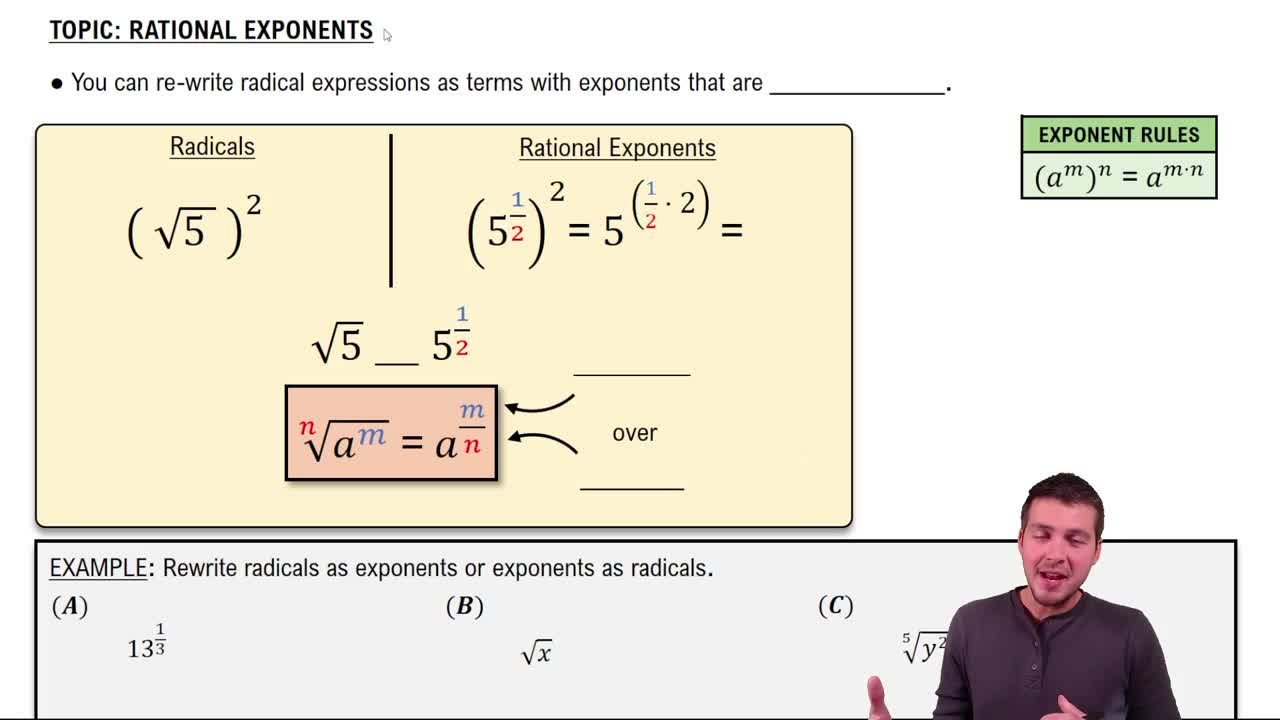
Recall that a rational exponent of the form \(x^{\frac{m}{n}}\) can be rewritten as a radical expression: \(x^{\frac{m}{n}} = \sqrt[n]{x^m}\).
Identify the base and the rational exponent in the expression \(( -3x )^{\frac{1}{3}}\). Here, the base is \(-3x\) and the exponent is \(\frac{1}{3}\).
Since the exponent is \(\frac{1}{3}\), this corresponds to the cube root (because the denominator 3 indicates the root).
Rewrite the expression using the radical notation: \(( -3x )^{\frac{1}{3}} = \sqrt[3]{-3x}\).
This shows the equivalence between the rational exponent expression and the radical expression, assuming \(x \neq 0\).
Verified video answer for a similar problem:
This video solution was recommended by our tutors as helpful for the problem above
Video duration:
2m
Play a video:
Was this helpful?
Key Concepts
Here are the essential concepts you must grasp in order to answer the question correctly.
Rational Exponents
Rational exponents express roots and powers simultaneously. An exponent in the form of a fraction a/b means the b-th root of the base raised to the a-th power, such as x^(1/3) representing the cube root of x.
Radical expressions use root symbols to denote roots of numbers or variables. For example, the cube root of x is written as ∛x, which is equivalent to x raised to the 1/3 power.
When dealing with negative bases and rational exponents, the root must be odd to yield a real number. For instance, (-3x)^(1/3) is valid because the cube root of a negative number is real, unlike even roots which are undefined for negatives in real numbers.