Recognize that the expression ⁶√x^6 represents the sixth root of x raised to the sixth power, which can be written as \(\sqrt[6]{x^6}\).
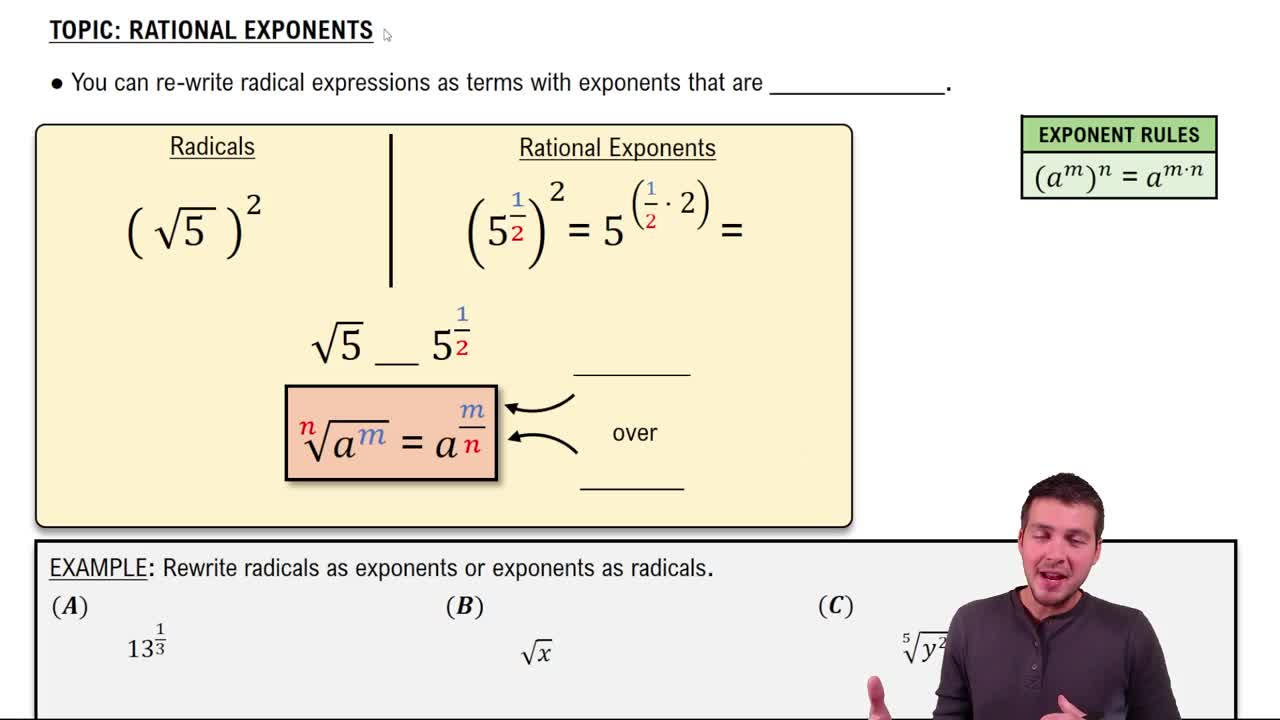
Recall the property of radicals and exponents: \(\sqrt[n]{a^m} = a^{\frac{m}{n}}\). Applying this, rewrite the expression as \(x^{\frac{6}{6}}\).
Simplify the exponent \(\frac{6}{6}\) to 1, so the expression becomes \(x^1\), which is simply \(x\).
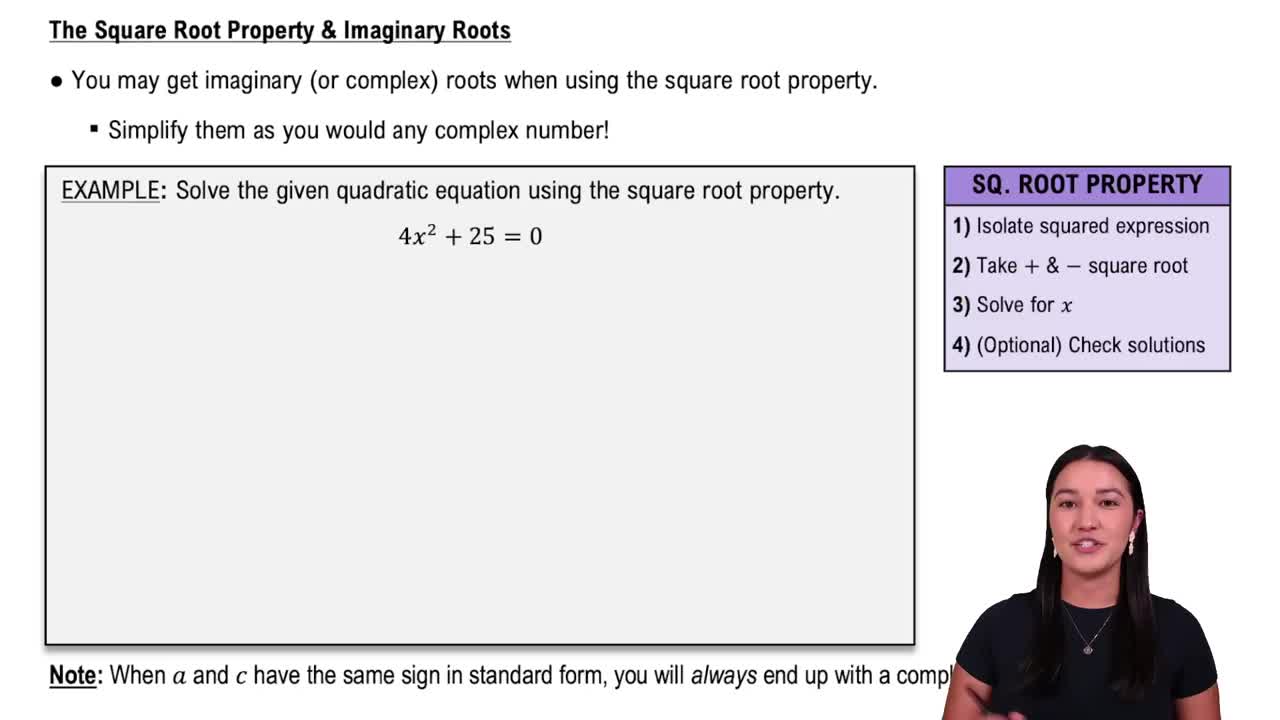
Consider the domain of the original expression. Since the sixth root is an even root, the radicand \(x^6\) is always non-negative for all real \(x\), so the expression is defined for all real numbers.
Therefore, the root of the expression \(\sqrt[6]{x^6}\) simplifies to \(|x|\), the absolute value of \(x\), because even roots return the principal (non-negative) root.
Verified video answer for a similar problem:
This video solution was recommended by our tutors as helpful for the problem above
Video duration:
54s
Play a video:
0 Comments
Key Concepts
Here are the essential concepts you must grasp in order to answer the question correctly.
Nth Roots and Radicals
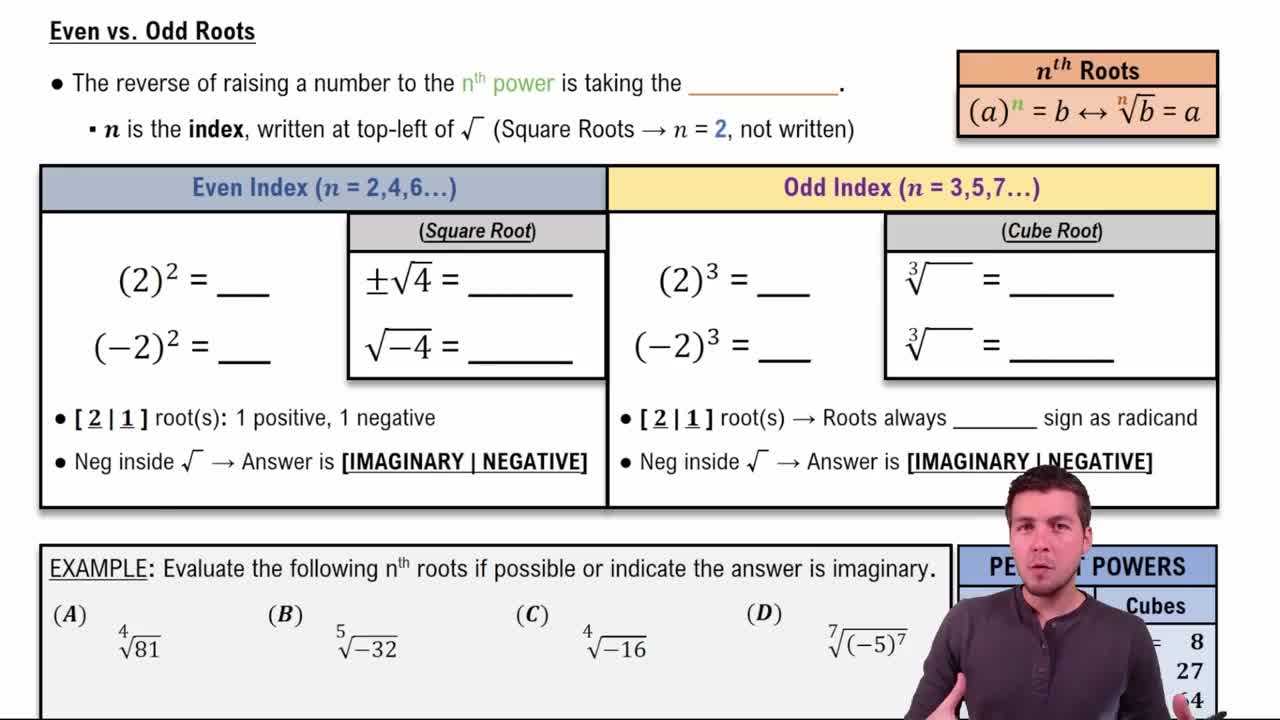
The nth root of a number is a value that, when raised to the power n, gives the original number. For example, the 6th root of x^6 means finding a number which, when raised to the 6th power, equals x^6. Understanding how to simplify and interpret nth roots is essential for solving such expressions.
Exponents represent repeated multiplication, and their properties allow simplification of expressions. Specifically, (x^a)^(b) = x^(a*b). This property helps simplify the expression ⁶√x^6 by rewriting the root as a fractional exponent, enabling easier calculation of the root.
When taking even roots (like square roots or 6th roots) of even powers, the result is the absolute value of the base because even powers eliminate sign information. For example, ⁶√x^6 equals |x|, ensuring the root is non-negative regardless of x's sign.

 0:54 minutes
 Verified step by step guidance
 06:56
06:56