Solve each inequality. Give the solution set in interval notation. See Examples 1 and 2. (2x-5)/-8≤1-x
Verified step by step guidance
1
Multiply both sides of the inequality \( \frac{2x-5}{-8} \leq 1-x \) by -8 to eliminate the fraction, remembering to reverse the inequality sign because you are multiplying by a negative number.
This results in \( 2x - 5 \geq -8(1-x) \).
Distribute the -8 on the right side to get \( 2x - 5 \geq -8 + 8x \).
Rearrange the inequality to get all terms involving \( x \) on one side and constant terms on the other side: \( 2x - 8x \geq -8 + 5 \).
Simplify the inequality to find the solution for \( x \), and express the solution set in interval notation.
Verified video answer for a similar problem:
This video solution was recommended by our tutors as helpful for the problem above
Video duration:
3m
Play a video:
Was this helpful?
Key Concepts
Here are the essential concepts you must grasp in order to answer the question correctly.
Inequalities
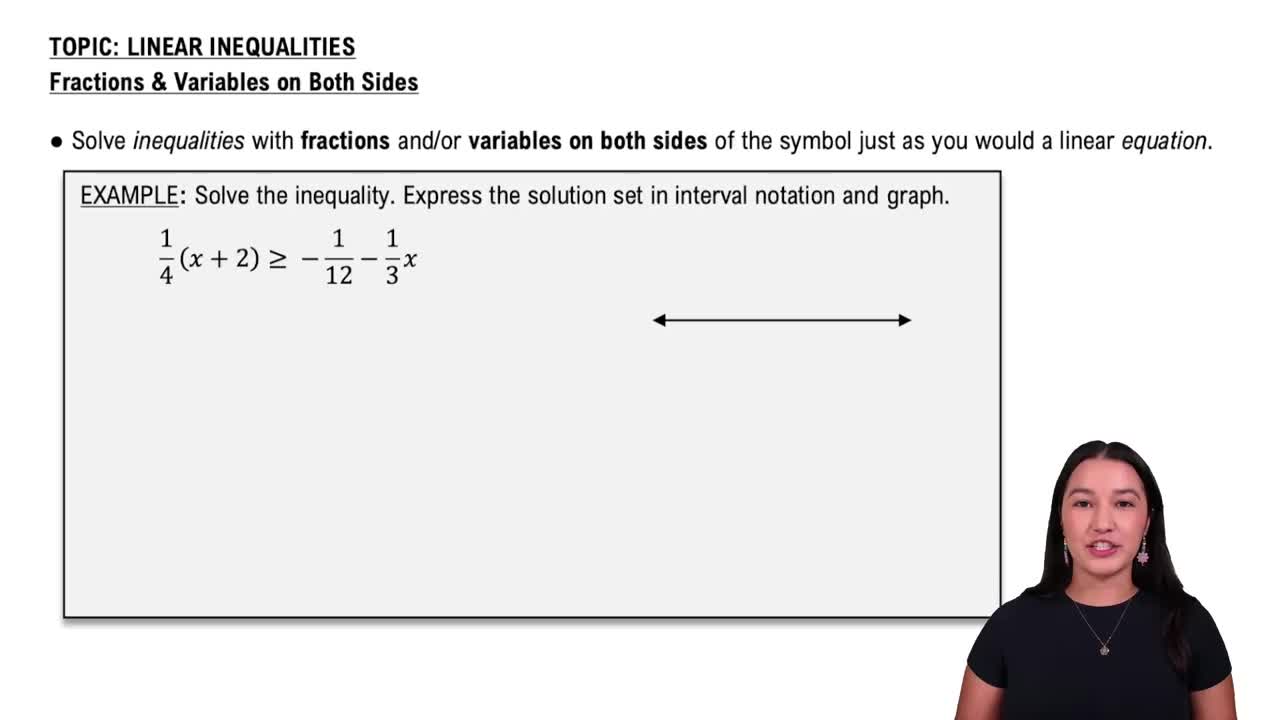
Inequalities are mathematical statements that compare two expressions, indicating that one is less than, greater than, less than or equal to, or greater than or equal to the other. In this case, the inequality involves the expression (2x-5)/-8 and the value 1-x. Understanding how to manipulate and solve inequalities is crucial for finding the solution set.
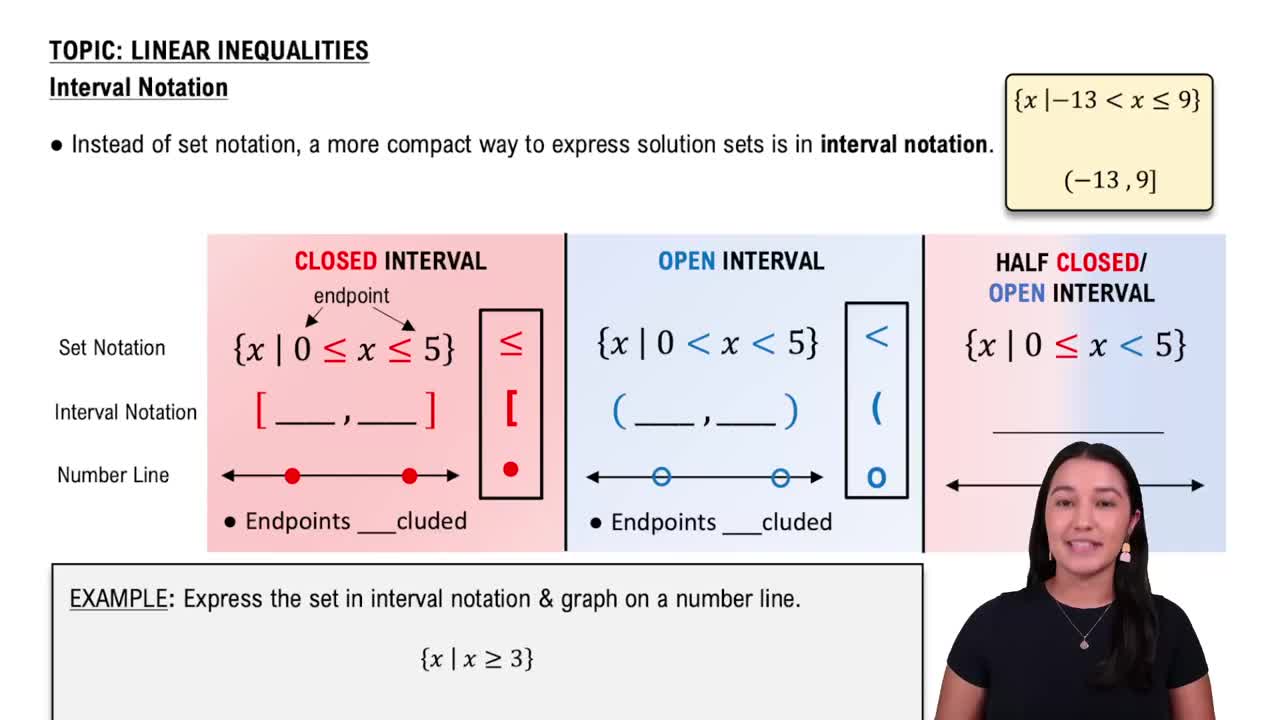
Interval notation is a way of representing a set of numbers between two endpoints. It uses brackets [ ] to include endpoints and parentheses ( ) to exclude them. For example, the interval (2, 5] includes all numbers greater than 2 and up to 5, including 5 but not 2. This notation is essential for expressing the solution set of inequalities clearly.
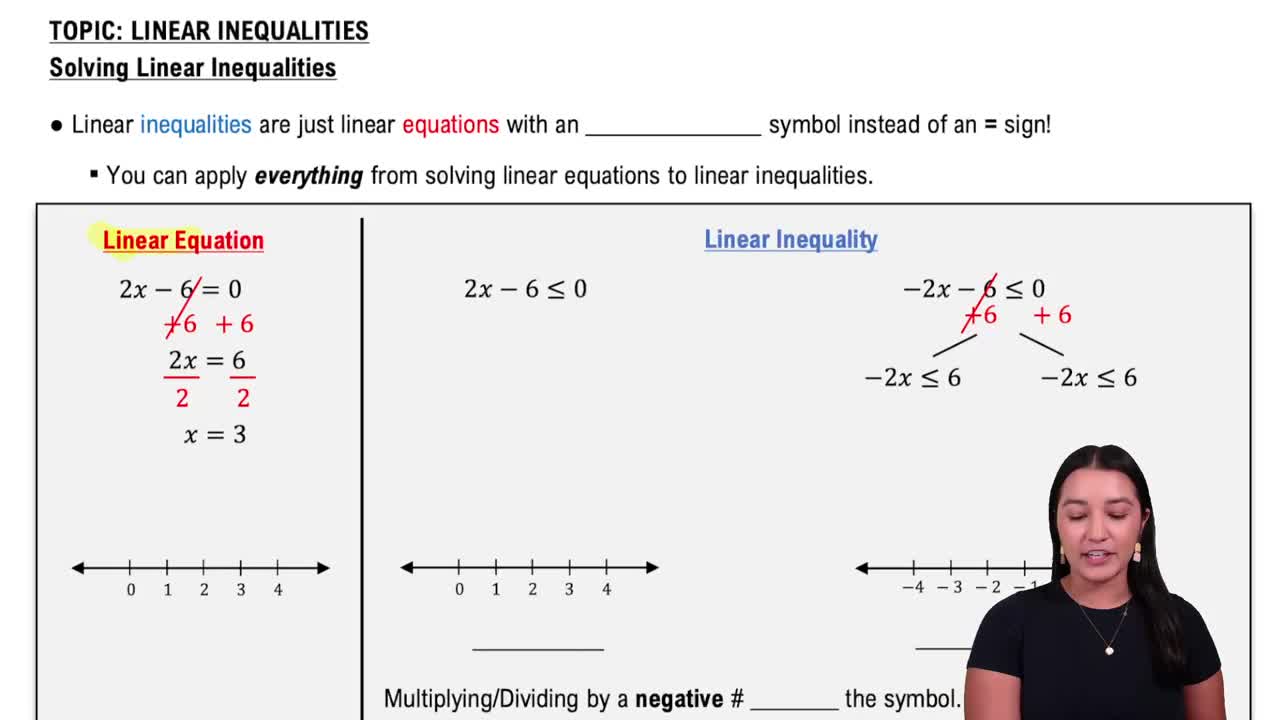
Solving inequalities involves isolating the variable on one side of the inequality sign while maintaining the direction of the inequality. This process may include multiplying or dividing by negative numbers, which reverses the inequality sign. Mastery of this technique is necessary to accurately determine the solution set for the given inequality.