
Textbook Question
Solve each problem. See Example 2. In the Apple Hill Fun Run, Mary runs at 7 mph, Janet at 5 mph. If they start at the same time, how long will it be before they are 1.5 mi apart?
707
views

 Verified step by step guidance
 06:07
06:07
 04:15
04:15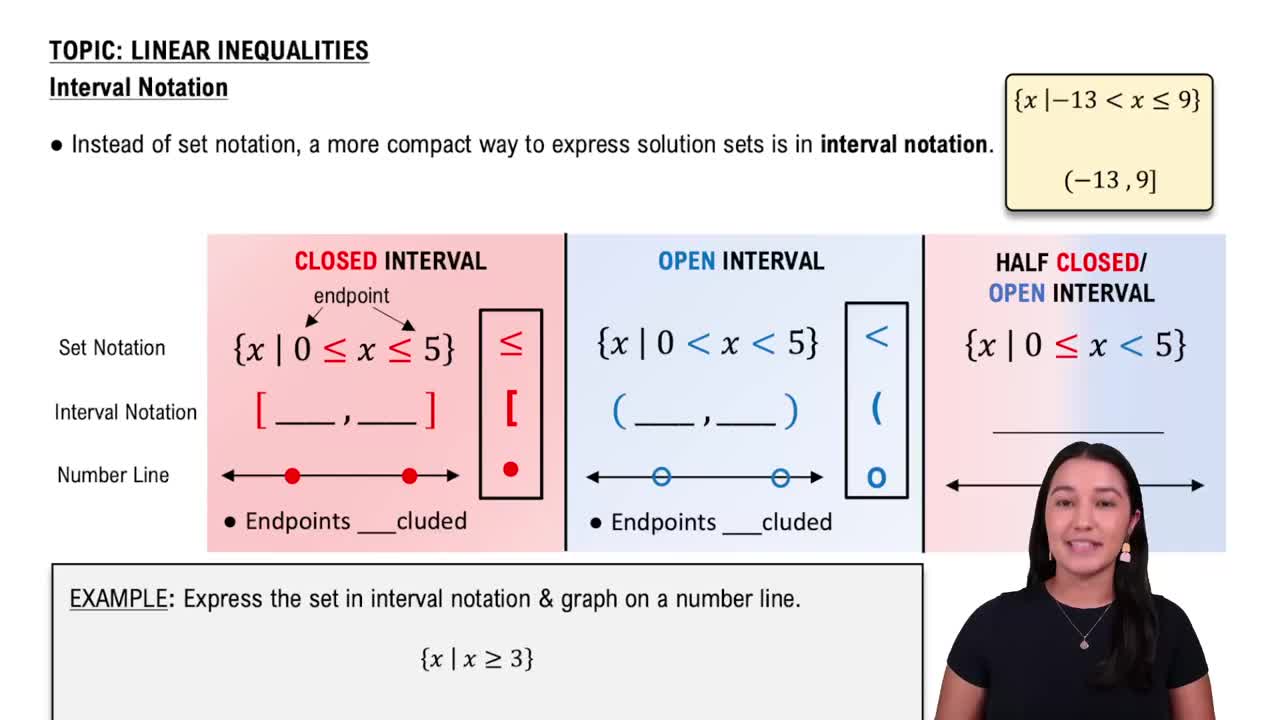 05:18
05:18Solve each problem. See Example 2. In the Apple Hill Fun Run, Mary runs at 7 mph, Janet at 5 mph. If they start at the same time, how long will it be before they are 1.5 mi apart?
Dimensions of a Parking Lot. A parking lot has a rectangular area of 40,000 yd2. The length is 200 yd more than twice the width. Find the dimensions of the lot.
Write each number as the product of a real number and i. √-10
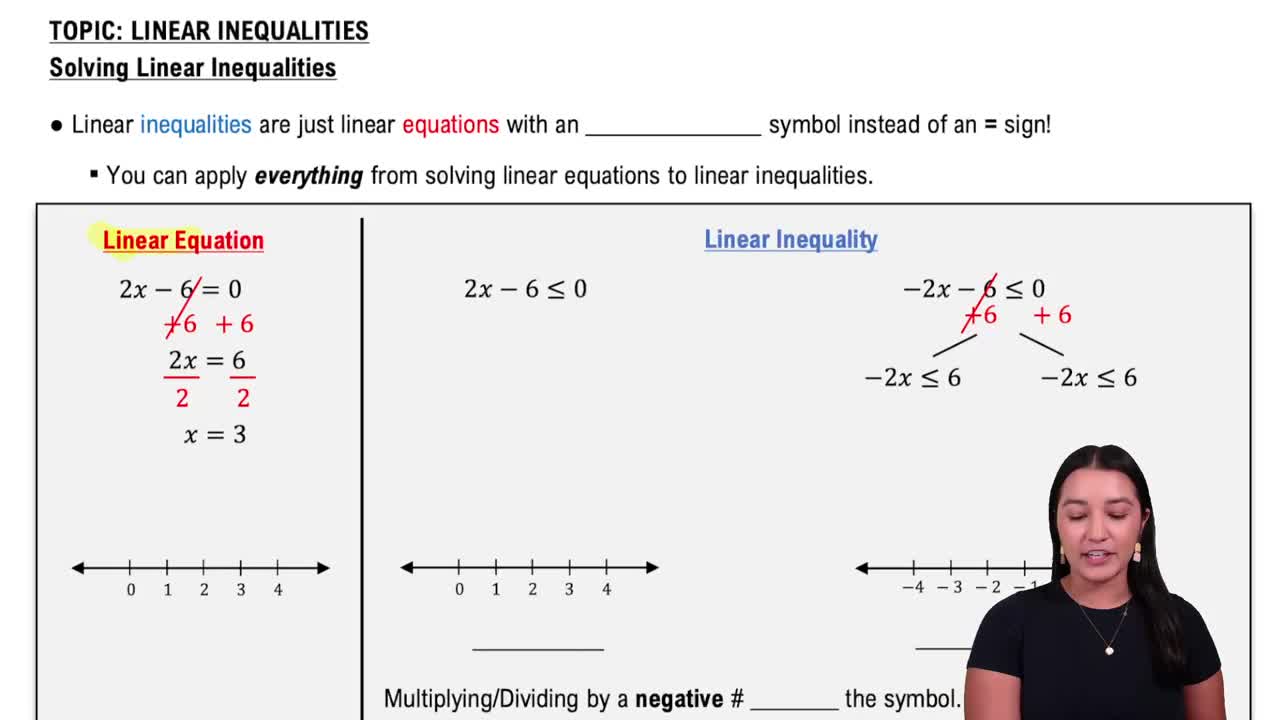
Solve each inequality. Give the solution set in interval notation. -(2/3)x-(1/6)x+(2/3)(x+1)≤4/3
Solve each equation. 0.2x - 0.5 = 0.1x+7
Solve each problem. See Example 2. Two planes leave Los Angeles at the same time. One heads south to San Diego, while the other heads north to San Francisco. The San Diego plane flies 50 mph slower than the San Francisco plane. In 1/2 hr, the planes are 275 mi apart. What are their speeds?