Graph the solution set of each system of inequalities. 4x - 3y ≤ 12 y ≤ x2
Verified step by step guidance
1
Step 1: Identify each inequality and understand the region it represents. The first inequality is \$4y - 2x \leq 15\(. Rearrange it to solve for \)y\( in terms of \)x\(: add \)2x\( to both sides and then divide by 4 to isolate \)y$.
Step 2: After rearranging, the first inequality becomes \(y \leq \frac{2x + 15}{4}\). This represents the region on or below the line \(y = \frac{2x + 15}{4}\).
Step 3: The second inequality is \(y \geq -x^2 + 2\). This represents the region on or above the parabola \(y = -x^2 + 2\).
Step 4: To graph the solution set of the system, first graph the line \(y = \frac{2x + 15}{4}\) and shade the region below it (including the line because of the 'less than or equal to' sign).
Step 5: Next, graph the parabola \(y = -x^2 + 2\) and shade the region above it (including the parabola because of the 'greater than or equal to' sign). The solution set to the system is the intersection of these two shaded regions.
Verified video answer for a similar problem:
This video solution was recommended by our tutors as helpful for the problem above
Video duration:
12m
Play a video:
Was this helpful?
Key Concepts
Here are the essential concepts you must grasp in order to answer the question correctly.
Graphing Linear Inequalities
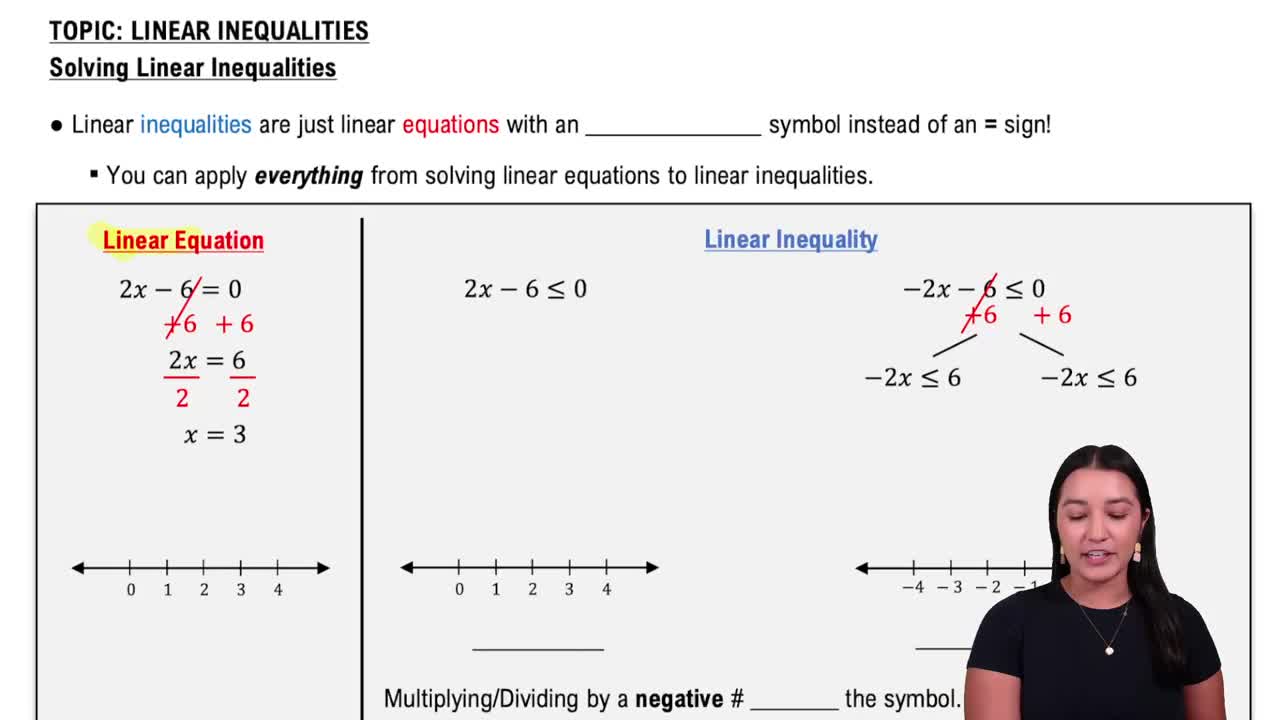
Graphing linear inequalities involves plotting the boundary line given by the corresponding linear equation and then shading the region that satisfies the inequality. The boundary line is solid if the inequality includes equality (≤ or ≥) and dashed if it does not (< or >). Testing a point not on the line helps determine which side to shade.
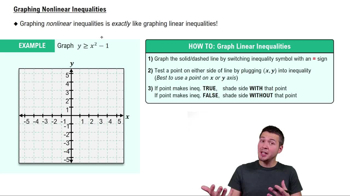
Graphing quadratic inequalities requires first graphing the parabola defined by the quadratic equation y = ax² + bx + c. The inequality sign determines whether to shade inside (above or below) the parabola. For y ≥ or y ≤, the parabola boundary is solid, indicating points on the curve satisfy the inequality.
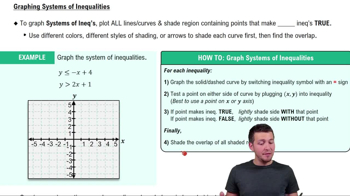
The solution set of a system of inequalities is the region where the shaded areas of all inequalities overlap. It represents all points that satisfy every inequality simultaneously. Identifying this intersection is key to solving and graphing systems of inequalities.