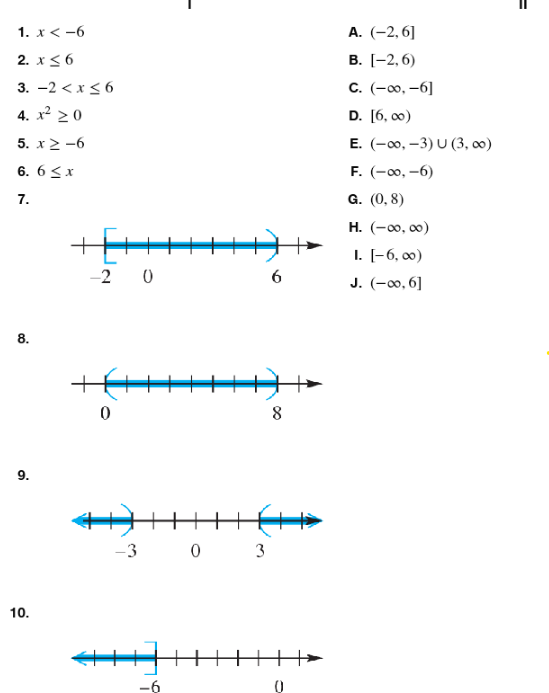
Match the inequality in each exercise in Column I with its equiva-lent interval notation in Column II. -2
Verified step by step guidance
1
Identify the inequality given: \(-2 < x \leq 6\).
Understand that \(-2 < x\) means \(x\) is greater than \(-2\) but not equal to \(-2\).
Understand that \(x \leq 6\) means \(x\) is less than or equal to \(6\).
Combine these two parts to describe the range of \(x\): \(x\) is between \(-2\) and \(6\), not including \(-2\) but including \(6\).
Translate this range into interval notation: \((-2, 6]\).
Verified video answer for a similar problem:
This video solution was recommended by our tutors as helpful for the problem above
Video duration:
1m
Play a video:
Was this helpful?
Key Concepts
Here are the essential concepts you must grasp in order to answer the question correctly.
Inequalities
Inequalities are mathematical expressions that show the relationship between two values when they are not equal. They can be represented using symbols such as <, >, ≤, and ≥. Understanding how to interpret and manipulate inequalities is essential for solving problems that involve ranges of values.
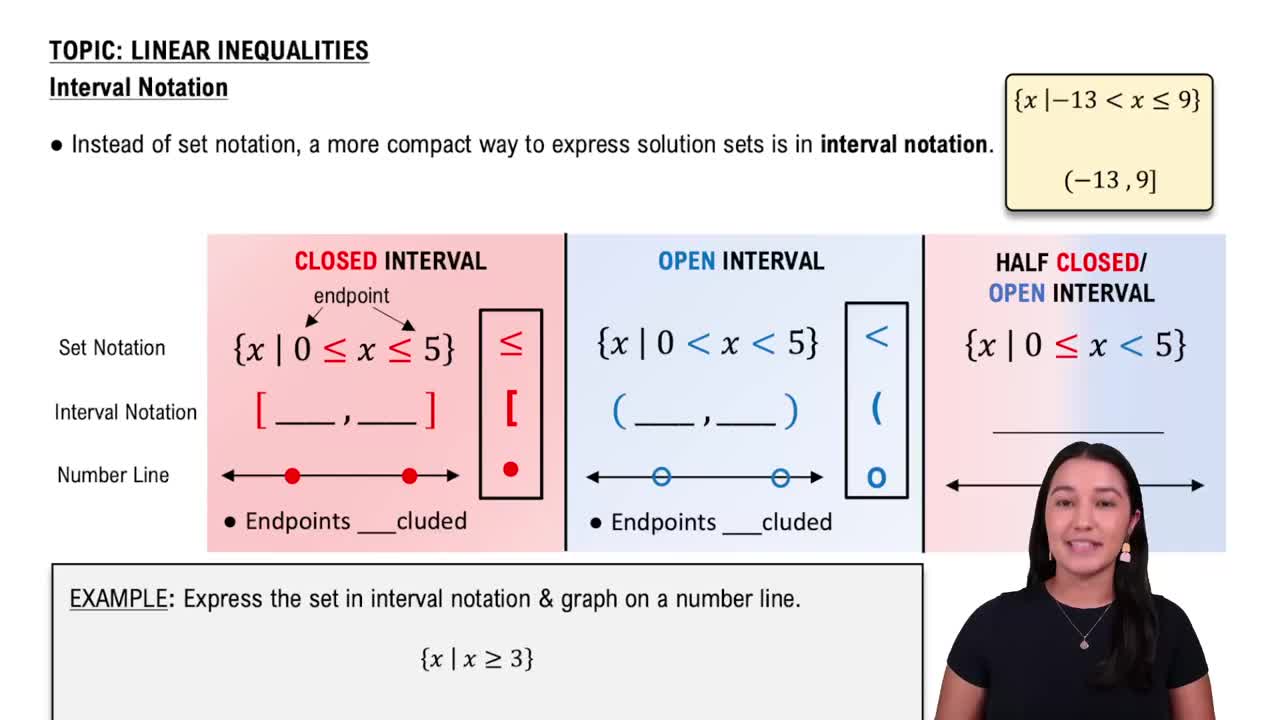
Interval notation is a way of representing a set of numbers between two endpoints. It uses parentheses and brackets to indicate whether the endpoints are included (closed interval) or excluded (open interval). For example, the interval (-2, 6] includes all numbers greater than -2 and up to and including 6.
Graphing inequalities involves representing the solution set of an inequality on a number line. This visual representation helps in understanding the range of values that satisfy the inequality. For the inequality -2 < x ≤ 6, the graph would show an open circle at -2 and a closed circle at 6, indicating the values that x can take.