Use the compound interest formulas A = P (1+ r/n)nt and A =Pert to solve exercises 53-56. Round answers to the nearest cent. Find the accumulated value of an investment of \$10,000 for 5 years at an interest rate of 1.32% if the money is d. compounded continuously.
Table of contents
- 0. Review of Algebra4h 18m
- 1. Equations & Inequalities3h 18m
- 2. Graphs of Equations1h 43m
- 3. Functions2h 17m
- 4. Polynomial Functions1h 44m
- 5. Rational Functions1h 23m
- 6. Exponential & Logarithmic Functions2h 28m
- 7. Systems of Equations & Matrices4h 5m
- 8. Conic Sections2h 23m
- 9. Sequences, Series, & Induction1h 22m
- 10. Combinatorics & Probability1h 45m
6. Exponential & Logarithmic Functions
Introduction to Exponential Functions
Problem 59
Textbook Question
Graph y= 2x and x = 2y in the same rectangular coordinate system.
Verified step by step guidance1
Identify the two functions to be graphed: the first is an exponential function \(y = 2^{x}\), and the second is \(x = 2^{y}\), which can be rewritten to express \(y\) in terms of \(x\) for easier graphing.
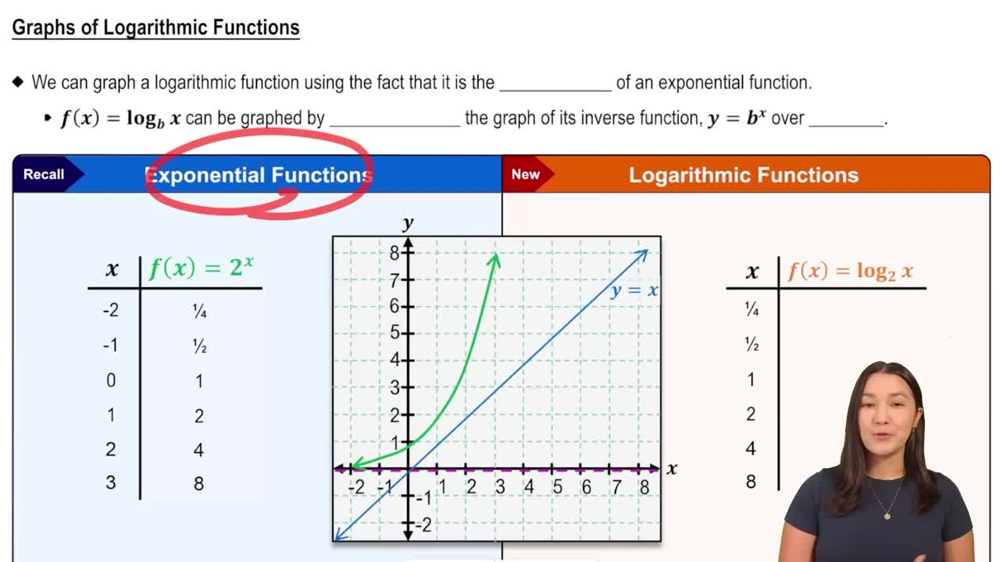
Rewrite the second equation \(x = 2^{y}\) by taking the logarithm base 2 of both sides to solve for \(y\): \(y = \log_{2}(x)\). This shows that the second graph is the logarithmic function, the inverse of the first.
Plot key points for \(y = 2^{x}\) by choosing several values of \(x\) (such as \(-2, -1, 0, 1, 2\)) and calculating the corresponding \(y\) values using \(y = 2^{x}\).
Plot key points for \(y = \log_{2}(x)\) by choosing several positive values of \(x\) (such as \(\frac{1}{4}, \frac{1}{2}, 1, 2, 4\)) and calculating the corresponding \(y\) values using \(y = \log_{2}(x)\).
Draw smooth curves through the plotted points for both functions on the same coordinate system, noting that the graphs are reflections of each other across the line \(y = x\) because they are inverse functions.
Verified video answer for a similar problem:This video solution was recommended by our tutors as helpful for the problem above
Video duration:
5mPlay a video:
Was this helpful?
Key Concepts
Here are the essential concepts you must grasp in order to answer the question correctly.
Exponential Functions
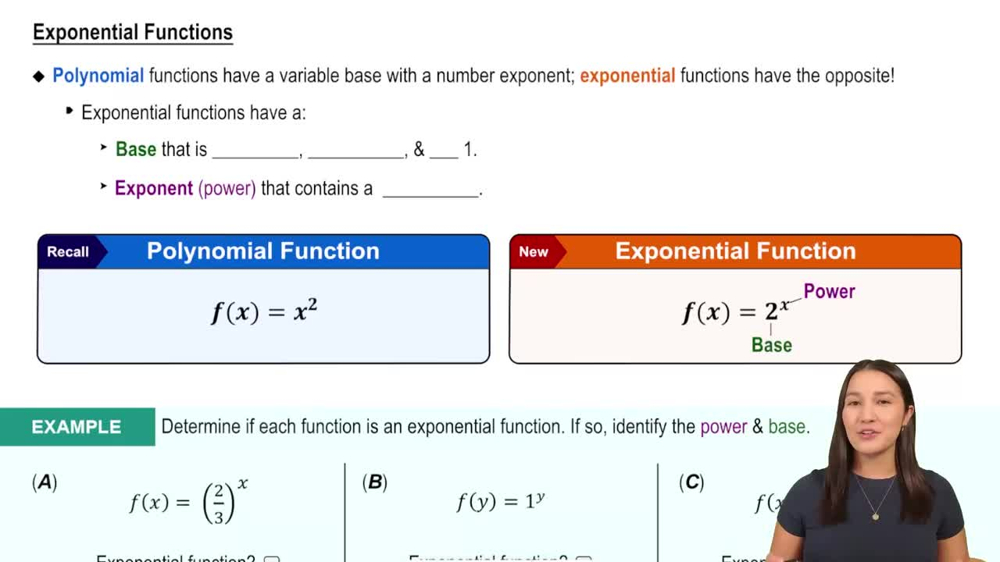
An exponential function has the form y = a^x, where the base a is a positive constant not equal to 1. It models rapid growth or decay, and its graph passes through (0,1) with a smooth curve increasing or decreasing depending on the base. Understanding y = 2^x helps in plotting one of the given functions.
Recommended video:
Exponential Functions
Inverse Functions and Their Graphs
The function x = 2^y can be seen as the inverse of y = 2^x by swapping variables. Inverse functions reflect across the line y = x, so graphing both on the same axes shows this symmetry. Recognizing this relationship aids in understanding the shape and position of both graphs.
Recommended video:
Graphs of Logarithmic Functions
Coordinate System and Plotting Points
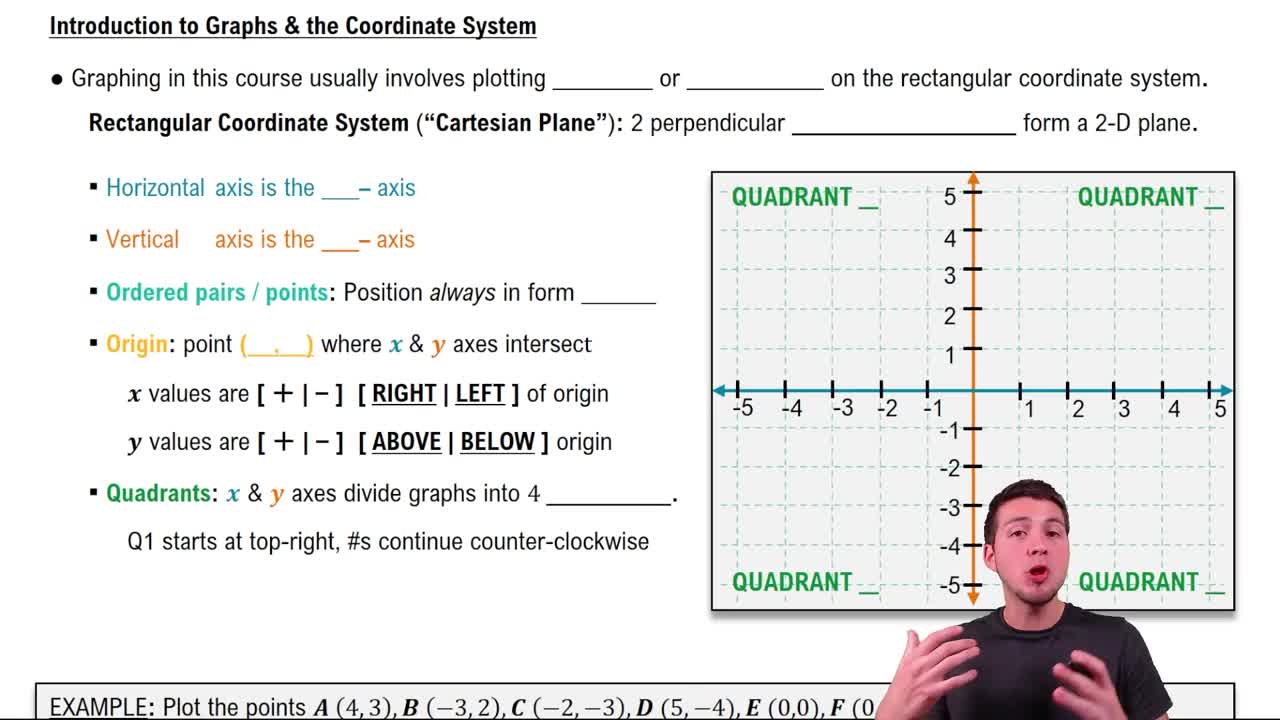
Plotting functions requires understanding the rectangular coordinate system, where each point is defined by (x, y). To graph y = 2^x and x = 2^y, select values for x or y, compute corresponding points, and plot them accurately. This visual representation helps compare and analyze the functions.
Recommended video:
Guided course
Graphs & the Rectangular Coordinate System
Watch next
Master Exponential Functions with a bite sized video explanation from Patrick
Start learningRelated Videos
Related Practice
Textbook Question
2353
views