Determine the largest open interval of the domain (a) over which the function is increasing and (b) over which it is decreasing. ƒ(x) = -2x2 - 8x - 7
Table of contents
- 0. Review of Algebra4h 18m
- 1. Equations & Inequalities3h 18m
- 2. Graphs of Equations1h 43m
- 3. Functions2h 17m
- 4. Polynomial Functions1h 44m
- 5. Rational Functions1h 23m
- 6. Exponential & Logarithmic Functions2h 28m
- 7. Systems of Equations & Matrices4h 5m
- 8. Conic Sections2h 23m
- 9. Sequences, Series, & Induction1h 22m
- 10. Combinatorics & Probability1h 45m
4. Polynomial Functions
Understanding Polynomial Functions
Problem 45
Textbook Question
If the given term is the dominating term of a polynomial function, what can we conclude about each of the following features of the graph of the function? (a) domain (b) range (c) end behavior (d) number of zeros (e) number of turning points 10x7
Verified step by step guidance1
Identify the dominating term of the polynomial function, which is given as \$10x^{7}\(. This term determines the overall behavior of the polynomial for very large or very small values of \)x$.
For (a) domain: Recall that polynomial functions are defined for all real numbers, so the domain is all real numbers, \((-\infty, \infty)\), regardless of the dominating term.
For (b) range: Since the dominating term is \$10x^{7}\(, an odd-degree term with a positive leading coefficient, the range will be all real numbers, \)(-\infty, \infty)\(, because the function will take on very large positive and negative values as \)x$ becomes large in magnitude.
For (c) end behavior: Analyze the dominating term \$10x^{7}\(. Because the degree is odd and the leading coefficient is positive, as \)x \to \infty\(, \)f(x) \to \infty\(, and as \)x \to -\infty\(, \)f(x) \to -\infty$. This describes the end behavior of the polynomial.
For (d) number of zeros and (e) number of turning points: The maximum number of real zeros is equal to the degree of the polynomial, which is 7. The maximum number of turning points is one less than the degree, so up to 6 turning points. The dominating term sets these maximum possible values, but the actual number depends on the specific polynomial.
Verified video answer for a similar problem:This video solution was recommended by our tutors as helpful for the problem above
Video duration:
9mPlay a video:
Was this helpful?
Key Concepts
Here are the essential concepts you must grasp in order to answer the question correctly.
Dominating Term of a Polynomial
The dominating term of a polynomial is the term with the highest degree, which determines the overall shape and behavior of the graph for large values of x. In this case, 10x⁷ is the dominating term, meaning the polynomial behaves like 10x⁷ as x approaches infinity or negative infinity.
Recommended video:
Guided course
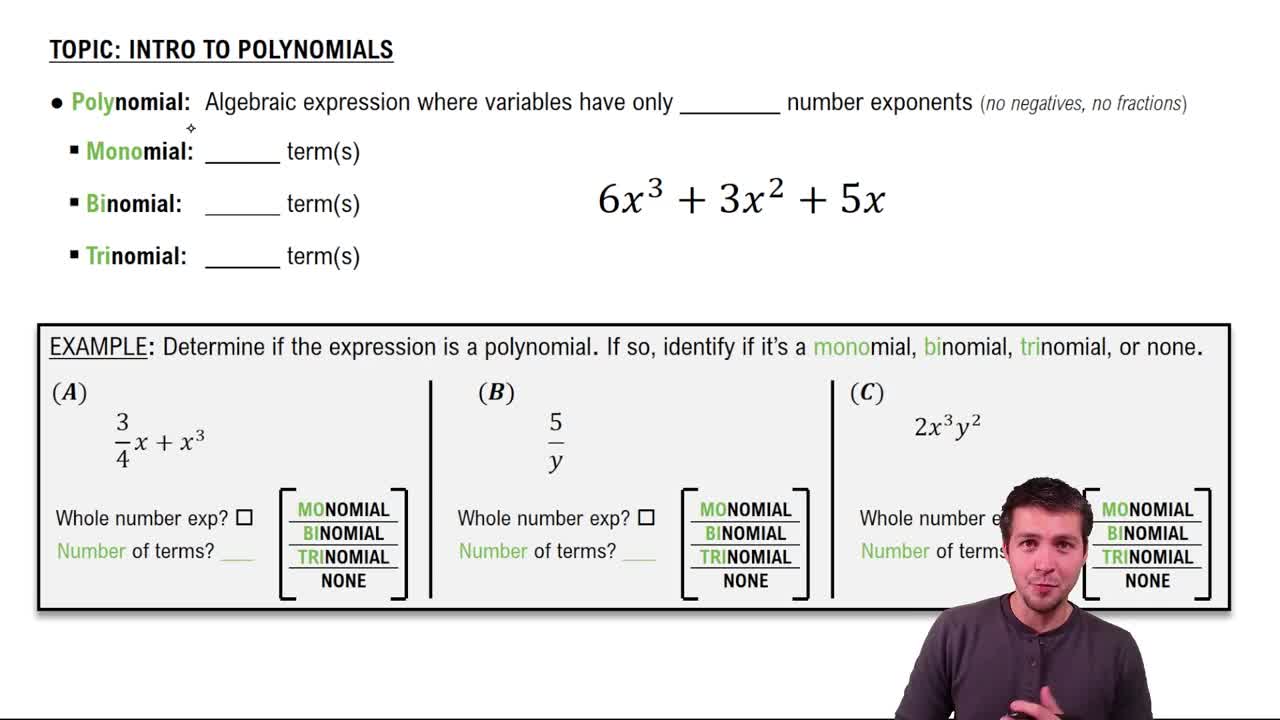
Introduction to Polynomials
Domain and Range of Polynomial Functions
The domain of any polynomial function is all real numbers since polynomials are defined everywhere. The range depends on the degree and leading coefficient; for odd-degree polynomials like x⁷, the range is all real numbers because the graph extends infinitely in both positive and negative directions.
Recommended video:
Domain & Range of Transformed Functions
End Behavior, Zeros, and Turning Points
The end behavior of a polynomial is determined by the leading term: for 10x⁷, as x → ∞, f(x) → ∞, and as x → -∞, f(x) → -∞. The maximum number of zeros is equal to the degree (7), and the maximum number of turning points is one less than the degree (6), reflecting the possible changes in direction of the graph.
Recommended video:
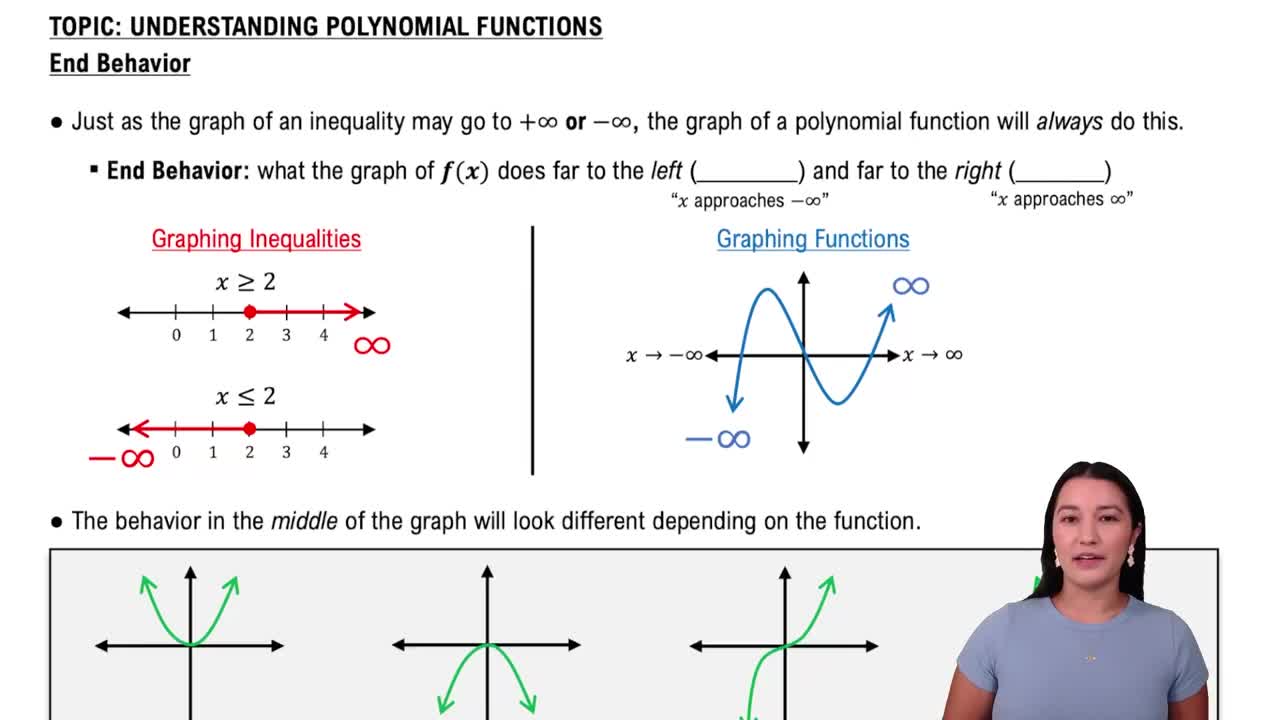
End Behavior of Polynomial Functions
Watch next
Master Introduction to Polynomial Functions with a bite sized video explanation from Patrick
Start learningRelated Videos
Related Practice
Textbook Question
1366
views