
Textbook Question
Graph the solution set of each system of inequalities or indicate that the system has no solution.
579
views

 Verified step by step guidance
 06:07
06:07
 02:35
02:35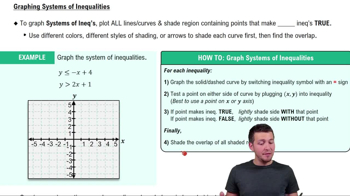 6:19
6:19Graph the solution set of each system of inequalities or indicate that the system has no solution.
In Exercises 31–42, solve by the method of your choice. Identify systems with no solution and systems with infinitely many solutions, using set notation to express their solution sets. x/4 - y/4 = −1 x + 4y = -9
In Exercises 31–42, solve by the method of your choice. Identify systems with no solution and systems with infinitely many solutions, using set notation to express their solution sets. x + 3y = 2 3x + 9y = 6
In Exercises 39–45, graph each inequality. 3x - 4y > 12
Write the partial fraction decomposition of each rational expression.
In Exercises 29–42, solve each system by the method of your choice.