In Exercises 1–26, graph each inequality. y≥log2(x+1)
Table of contents
- 0. Review of Algebra4h 18m
- 1. Equations & Inequalities3h 18m
- 2. Graphs of Equations1h 43m
- 3. Functions2h 17m
- 4. Polynomial Functions1h 44m
- 5. Rational Functions1h 23m
- 6. Exponential & Logarithmic Functions2h 28m
- 7. Systems of Equations & Matrices4h 5m
- 8. Conic Sections2h 23m
- 9. Sequences, Series, & Induction1h 22m
- 10. Combinatorics & Probability1h 45m
7. Systems of Equations & Matrices
Graphing Systems of Inequalities
Problem 33
Textbook Question
In Exercises 27–62, graph the solution set of each system of inequalities or indicate that the system has no solution. x+2y≤4, y≥x−3

Verified step by step guidance1
Step 1: Identify each inequality in the system. The first inequality is , and the second inequality is .
Step 2: Graph the boundary lines for each inequality. For the first inequality, graph the line . For the second inequality, graph the line . Use a solid line for both because the inequalities include equal to (≤ and ≥).
Step 3: Determine the shading region for each inequality. For 8, choose a test point not on the line (like (0,0)) and check if it satisfies the inequality. If it does, shade the side containing that point; if not, shade the opposite side. Repeat this for the second inequality .
Step 4: Identify the solution set as the region where the shaded areas of both inequalities overlap. This overlapping region represents all points (x,y) that satisfy both inequalities simultaneously.
Step 5: Label the graph clearly, including the boundary lines and shaded regions, to visually represent the solution set of the system of inequalities.
Verified video answer for a similar problem:This video solution was recommended by our tutors as helpful for the problem above
Video duration:
1mPlay a video:
Was this helpful?
Key Concepts
Here are the essential concepts you must grasp in order to answer the question correctly.
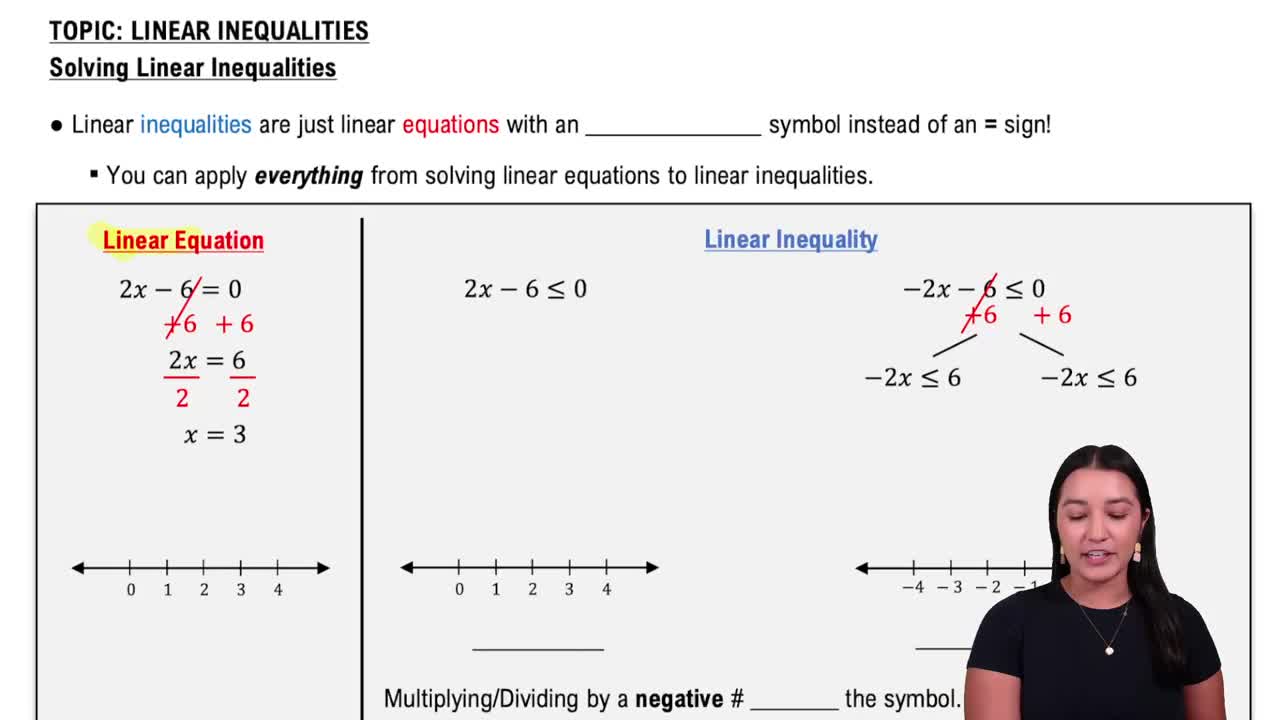
Graphing Linear Inequalities
Graphing linear inequalities involves shading the region of the coordinate plane that satisfies the inequality. The boundary line, given by the corresponding equation, is drawn solid if the inequality includes equality (≤ or ≥) and dashed if it does not (< or >). This visual representation helps identify all possible solutions.
Recommended video:
Linear Inequalities
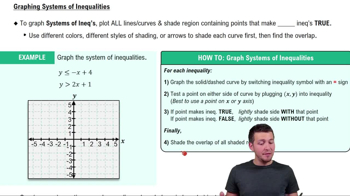
System of Inequalities
A system of inequalities consists of two or more inequalities considered simultaneously. The solution set is the intersection of the individual solution regions, representing all points that satisfy every inequality in the system. Graphing helps visualize this common solution area.
Recommended video:
Guided course
Systems of Inequalities
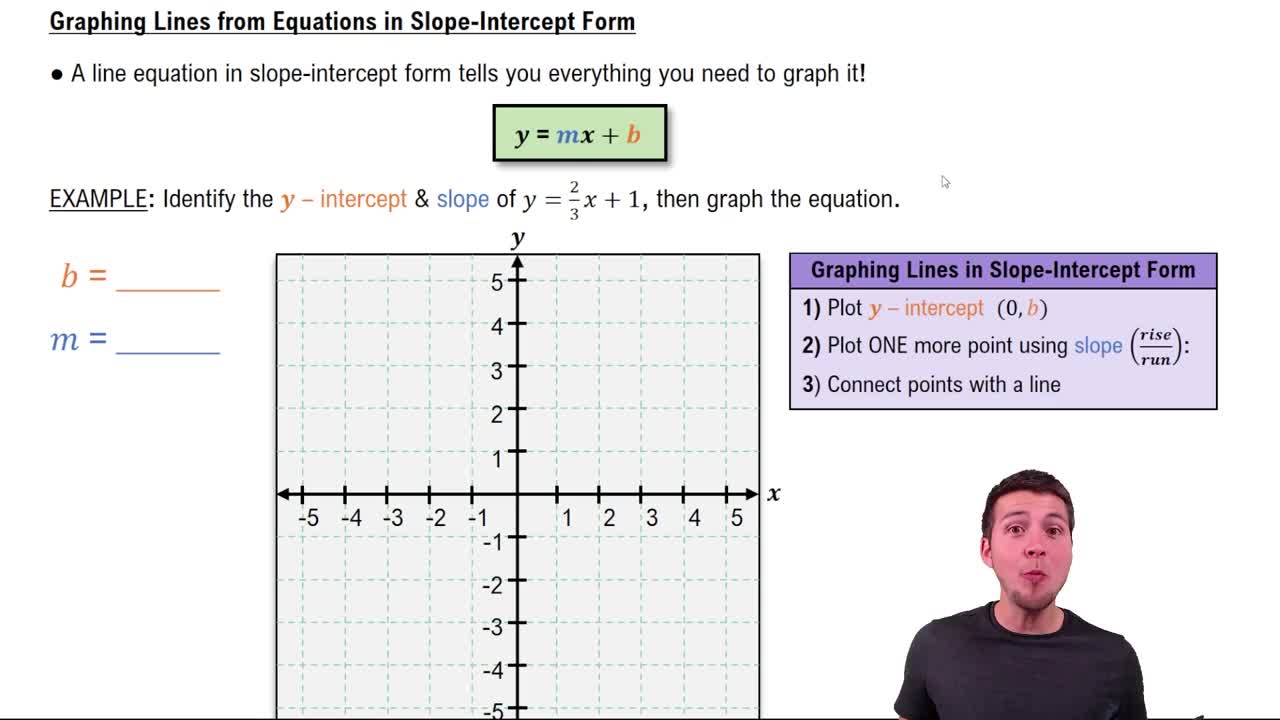
Slope-Intercept Form and Boundary Lines
Converting inequalities to slope-intercept form (y = mx + b) simplifies graphing by identifying the slope and y-intercept of the boundary line. For example, y ≥ x - 6 has slope 1 and y-intercept -6, guiding the drawing of the boundary and shading above it for solutions.
Recommended video:
Guided course
Graphing Lines in Slope-Intercept Form
Related Videos
Related Practice
Textbook Question
385
views