In Exercises 1–26, graph each inequality. y≥x2−9
Table of contents
- 0. Review of Algebra4h 18m
- 1. Equations & Inequalities3h 18m
- 2. Graphs of Equations1h 43m
- 3. Functions2h 17m
- 4. Polynomial Functions1h 44m
- 5. Rational Functions1h 23m
- 6. Exponential & Logarithmic Functions2h 28m
- 7. Systems of Equations & Matrices4h 5m
- 8. Conic Sections2h 23m
- 9. Sequences, Series, & Induction1h 22m
- 10. Combinatorics & Probability1h 45m
7. Systems of Equations & Matrices
Graphing Systems of Inequalities
Problem 31
Textbook Question
In Exercises 27–62, graph the solution set of each system of inequalities or indicate that the system has no solution. y>2x−3, y<−x+6

Verified step by step guidance1
Step 1: Identify the inequalities in the system: and .
Step 2: Graph the boundary lines for each inequality. For , draw a line with slope 4 and y-intercept -2. For , draw a line with slope -3 and y-intercept 9.
Step 3: Determine the shading for each inequality. For , shade the region above the line. For , shade the region below the line.
Step 4: Find the intersection of the two shaded regions. This overlapping area represents the solution set to the system of inequalities.
Step 5: Optionally, find the intersection point of the two boundary lines by solving the system of equations and to better understand the boundaries of the solution region.
Verified video answer for a similar problem:This video solution was recommended by our tutors as helpful for the problem above
Video duration:
1mPlay a video:
Was this helpful?
Key Concepts
Here are the essential concepts you must grasp in order to answer the question correctly.
Graphing Linear Inequalities
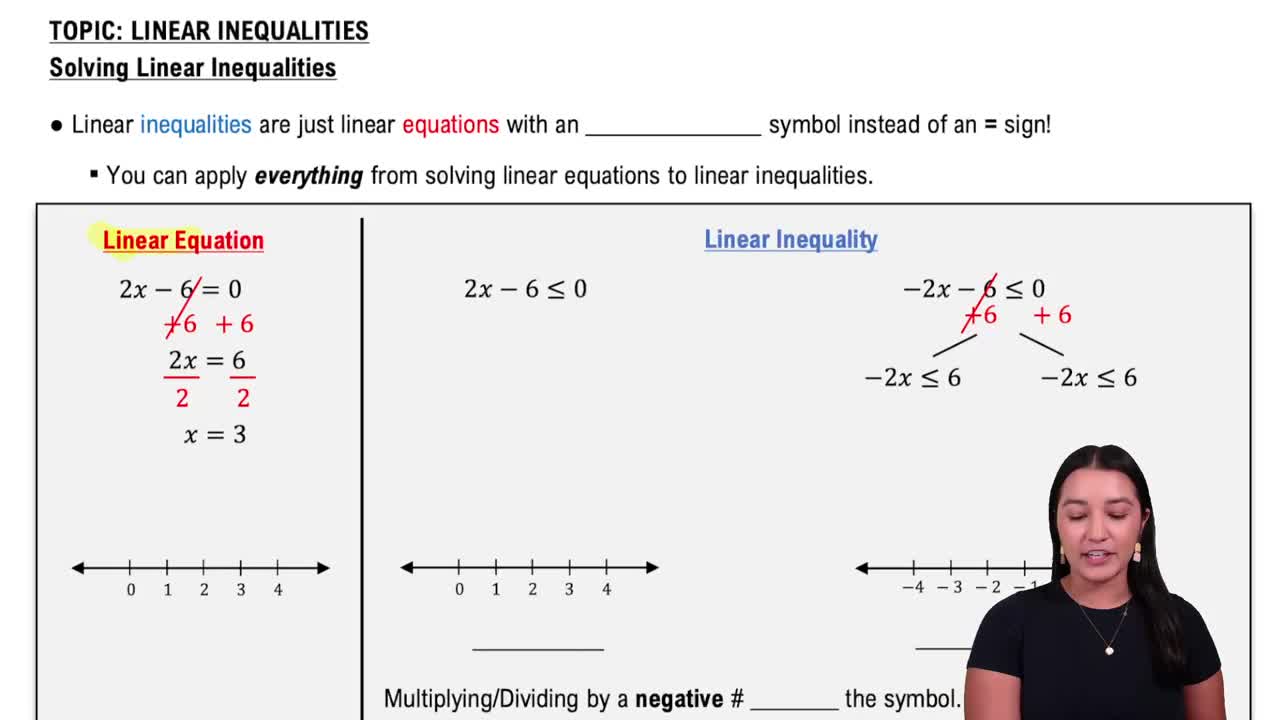
Graphing linear inequalities involves plotting the boundary line of the corresponding linear equation and then shading the region that satisfies the inequality. For '>', the boundary line is dashed, indicating points on the line are not included. The shaded area represents all points where the inequality holds true.
Recommended video:
Linear Inequalities
Slope-Intercept Form
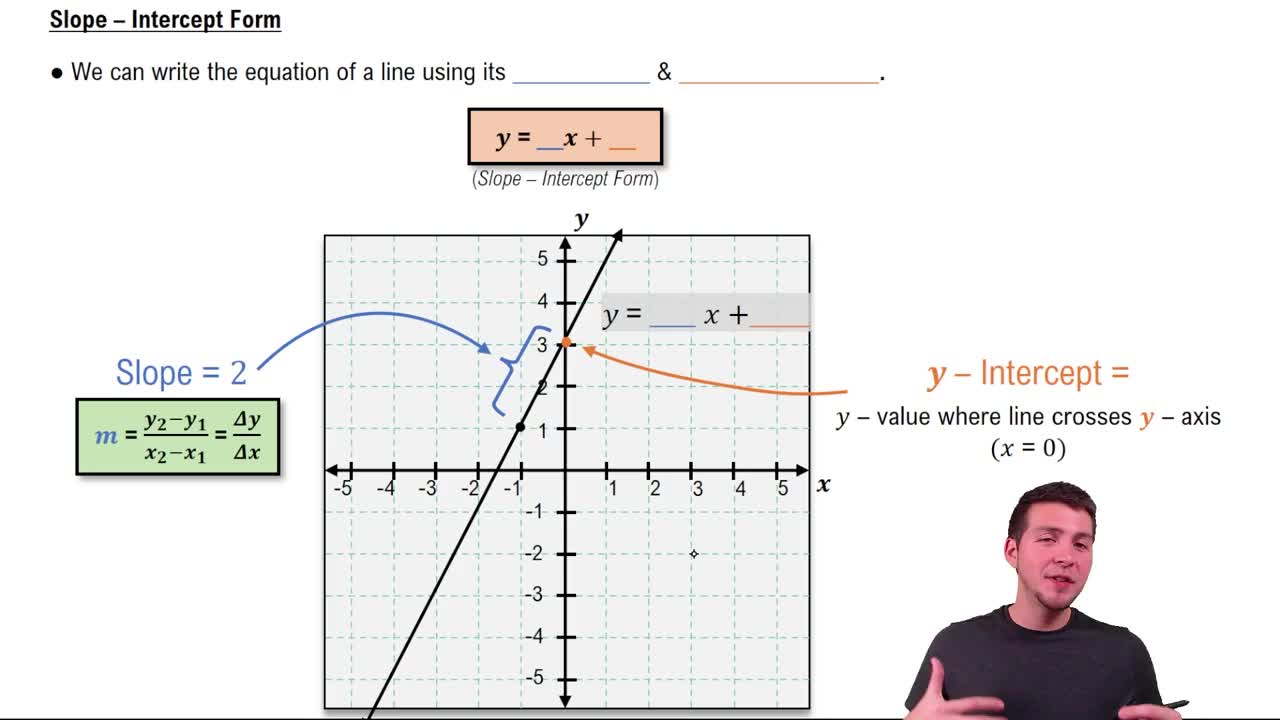
The slope-intercept form of a linear equation is y = mx + b, where m is the slope and b is the y-intercept. This form helps quickly graph the line by starting at (0, b) and using the slope to find other points. Understanding this form is essential for accurately drawing the boundary lines of inequalities.
Recommended video:
Guided course
Slope-Intercept Form
Solution Set of a System of Inequalities
The solution set of a system of inequalities is the region where the shaded areas of all inequalities overlap. It represents all points that satisfy every inequality simultaneously. If no such region exists, the system has no solution.
Recommended video:
Guided course
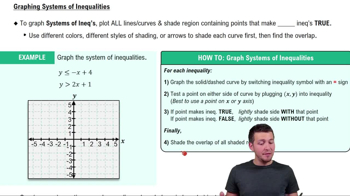
Systems of Inequalities
Related Videos
Related Practice
Textbook Question
403
views