In Exercises 27–62, graph the solution set of each system of inequalities or indicate that the system has no solution. x−y≤1, x≥2
Verified step by step guidance
1
Step 1: Identify the inequalities in the system: .
Step 2: Graph the boundary line for the first inequality . To do this, find the intercepts: set to find the x-intercept, and set to find the y-intercept.
Step 3: Determine which side of the line satisfies the inequality . You can test a point not on the line, such as , by substituting into the inequality.
Step 4: Graph the vertical line and shade the region where , which is to the right of this line.
Step 5: The solution set to the system is the intersection of the shaded regions from both inequalities. Identify and shade this overlapping region on the graph.
Verified video answer for a similar problem:
This video solution was recommended by our tutors as helpful for the problem above
Video duration:
1m
Play a video:
Was this helpful?
Key Concepts
Here are the essential concepts you must grasp in order to answer the question correctly.
Graphing Linear Inequalities
Graphing linear inequalities involves plotting the boundary line of the corresponding equation and shading the region that satisfies the inequality. For '≤' or '≥', the boundary line is solid, indicating points on the line are included. The shaded area represents all solutions that make the inequality true.
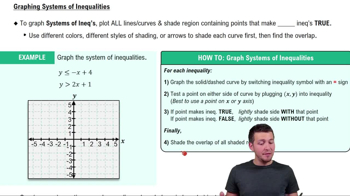
A system of inequalities consists of two or more inequalities considered simultaneously. The solution set is the intersection of the regions satisfying each inequality. Graphing the system helps visualize where these regions overlap, representing all possible solutions.
Interpreting Boundary Lines and Inequality Directions
Understanding the direction of inequalities is crucial for shading the correct region. For example, 'x ≥ 5' means shading all points to the right of the vertical line x = 5, including the line itself. Similarly, for '2x - 3y ≤ 6', the region below or on the line is shaded.