Identify the given 2x2 matrix as \( A = \begin{bmatrix} a & b \\ c & d \end{bmatrix} \).
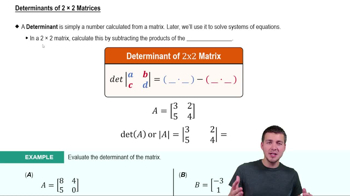
Calculate the determinant of matrix \( A \) using the formula \( \det(A) = ad - bc \).
Check if the determinant \( \det(A) \) is nonzero. If it is zero, the inverse does not exist.
If the determinant is nonzero, find the inverse matrix using the formula \( A^{-1} = \frac{1}{\det(A)} \begin{bmatrix} d & -b \\ -c & a \end{bmatrix} \).
Write the inverse matrix explicitly by substituting the values of \( a, b, c, d \) and the determinant into the formula.
Verified video answer for a similar problem:
This video solution was recommended by our tutors as helpful for the problem above
Video duration:
2m
Play a video:
Was this helpful?
Key Concepts
Here are the essential concepts you must grasp in order to answer the question correctly.
Matrix Inverse
The inverse of a matrix A is another matrix, denoted A⁻¹, such that when multiplied together, they yield the identity matrix. Only square matrices with nonzero determinants have inverses. Finding the inverse is essential for solving matrix equations and understanding linear transformations.
The determinant of a 2x2 matrix [[a, b], [c, d]] is calculated as ad - bc. It indicates whether the matrix is invertible; if the determinant is zero, the matrix has no inverse. The determinant also provides information about the matrix's scaling and orientation effects.
For a 2x2 matrix [[a, b], [c, d]] with nonzero determinant, the inverse is (1/det) times the matrix [[d, -b], [-c, a]]. This formula swaps the diagonal elements, changes the signs of the off-diagonal elements, and scales by the reciprocal of the determinant.