Answer the following. Why can 3 not be in the solution set of 14x+9 / x-3 < 0? (Do not solve the inequality.)
Verified step by step guidance
1
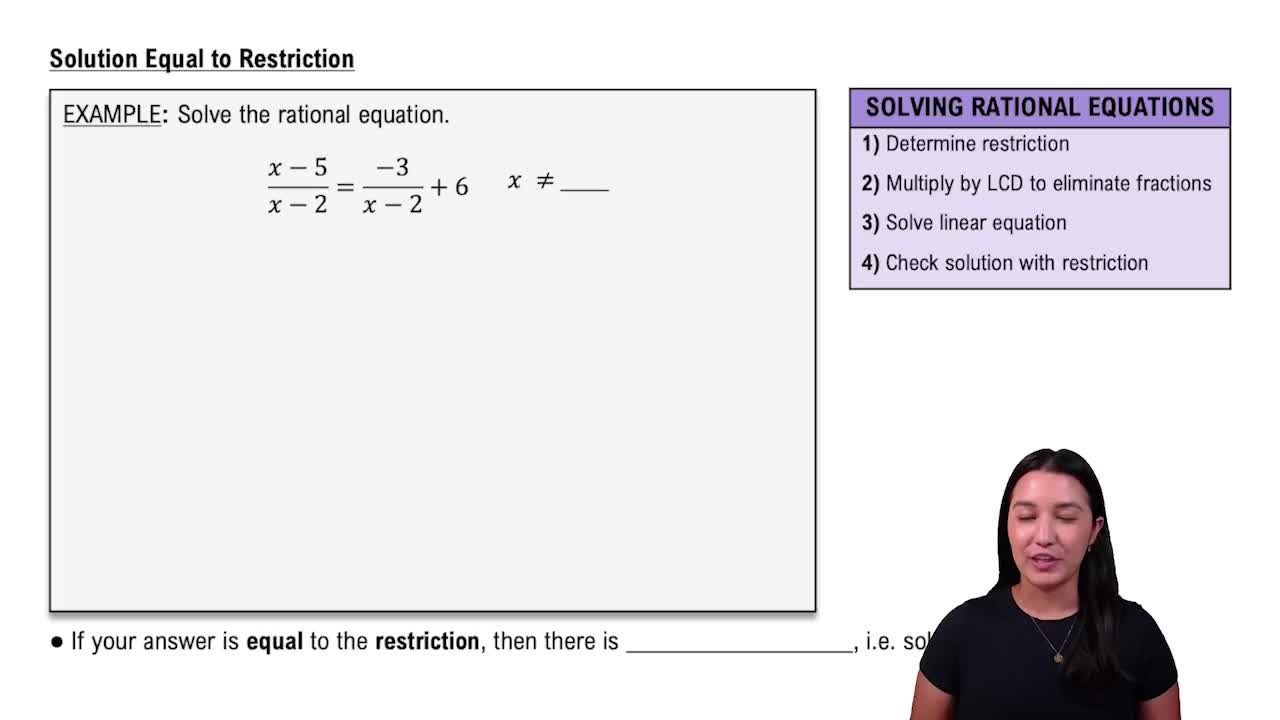
The expression \( \frac{14x + 9}{x - 3} \) is a rational function.
A rational function is undefined when its denominator is zero.
Set the denominator equal to zero to find the values that make the function undefined: \( x - 3 = 0 \).
Solve for \( x \) to find the value that makes the denominator zero: \( x = 3 \).
Since \( x = 3 \) makes the denominator zero, the expression is undefined at \( x = 3 \), so 3 cannot be in the solution set.
Verified video answer for a similar problem:
This video solution was recommended by our tutors as helpful for the problem above
Video duration:
1m
Play a video:
Was this helpful?
Key Concepts
Here are the essential concepts you must grasp in order to answer the question correctly.
Inequalities
Inequalities express a relationship where one side is not equal to the other, often using symbols like <, >, ≤, or ≥. In this case, the inequality 14x + 9 / (x - 3) < 0 indicates that the expression must be negative. Understanding how to analyze inequalities is crucial for determining valid solution sets.
An expression is undefined when it involves division by zero. In the given inequality, if x equals 3, the denominator (x - 3) becomes zero, making the entire expression undefined. This is a critical point to consider when identifying values that cannot be included in the solution set.
The solution set of an inequality includes all values of the variable that satisfy the inequality. In this context, since x = 3 makes the expression undefined, it cannot be part of the solution set. Recognizing which values are valid or invalid is essential for correctly interpreting the results of inequalities.