Solve each problem. See Example 7. Velocity of an Object The velocity of an object, v, after t seconds is given by v=3t^2-18t+24.Find the interval where the velocity is negative.
Set the velocity function less than zero to find where it is negative: \( 3t^2 - 18t + 24 < 0 \).
Solve the inequality \( 3t^2 - 18t + 24 < 0 \) by first finding the roots of the equation \( 3t^2 - 18t + 24 = 0 \).
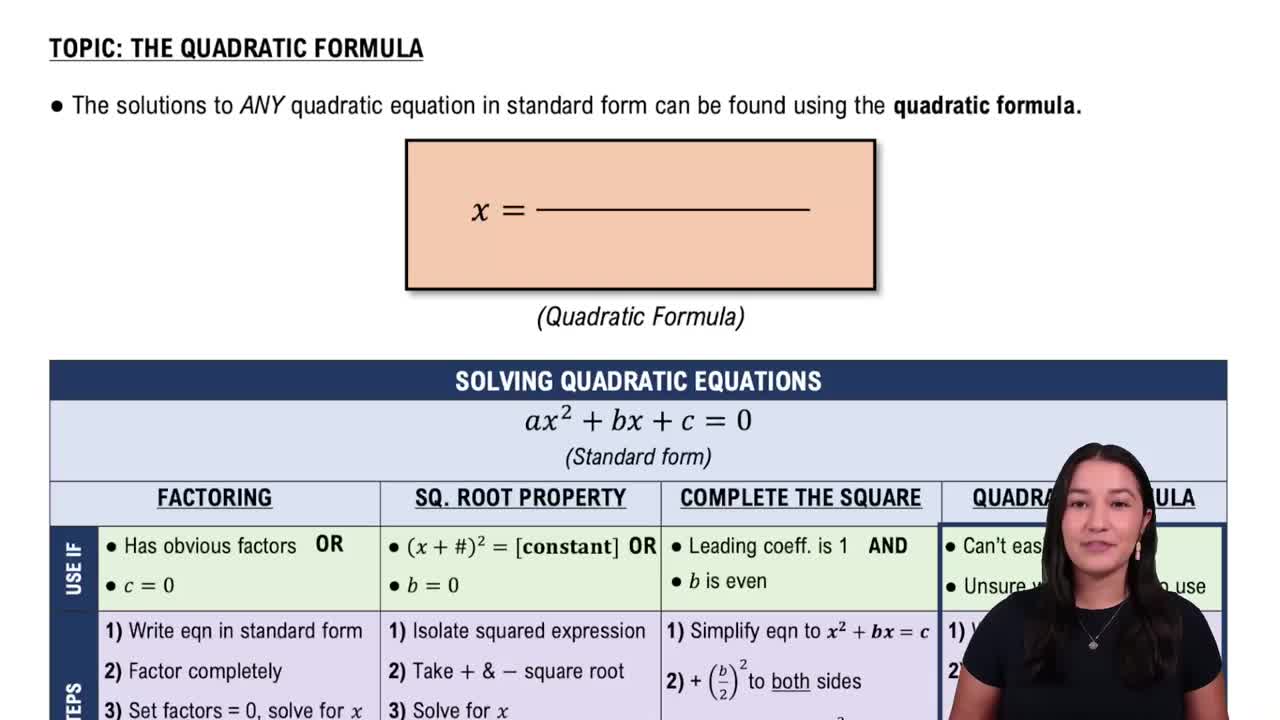
Factor the quadratic equation or use the quadratic formula to find the roots.
Use the roots to determine the intervals on the number line and test values within each interval to find where the inequality holds true.
Verified video answer for a similar problem:
This video solution was recommended by our tutors as helpful for the problem above
Video duration:
6m
Play a video:
Was this helpful?
Key Concepts
Here are the essential concepts you must grasp in order to answer the question correctly.
Quadratic Functions
A quadratic function is a polynomial function of degree two, typically expressed in the form f(t) = at^2 + bt + c. In this case, the velocity function v(t) = 3t^2 - 18t + 24 is a quadratic function. Understanding its shape, which is a parabola, is crucial for determining where the function is negative.
Solving Quadratic Equations Using The Quadratic Formula
Finding Roots
Finding the roots of a quadratic function involves determining the values of t for which v(t) = 0. This can be done using the quadratic formula, factoring, or completing the square. The roots indicate the points where the velocity changes from positive to negative or vice versa, which is essential for identifying the intervals of negative velocity.
Interval notation is a mathematical notation used to represent a range of values. It indicates the set of numbers between two endpoints, which can be open (not including the endpoints) or closed (including the endpoints). Understanding how to express intervals where the velocity is negative is important for clearly communicating the solution to the problem.