Solve each rational inequality. Give the solution set in interval notation. (5-3x)2/(2x-5)3>0
Table of contents
- 0. Review of Algebra4h 18m
- 1. Equations & Inequalities3h 18m
- 2. Graphs of Equations1h 43m
- 3. Functions2h 17m
- 4. Polynomial Functions1h 44m
- 5. Rational Functions1h 23m
- 6. Exponential & Logarithmic Functions2h 28m
- 7. Systems of Equations & Matrices4h 5m
- 8. Conic Sections2h 23m
- 9. Sequences, Series, & Induction1h 22m
- 10. Combinatorics & Probability1h 45m
1. Equations & Inequalities
Linear Inequalities
Problem 91
Textbook Question
Solve each problem. A baseball is hit so that its height, s, in feet after t seconds is s=-16t2+44t+4. For what time period is the ball at least 32 ft above the ground?
Verified step by step guidance1
Start with the given height function: \(s = -16t^2 + 44t + 4\). We want to find the time period when the height \(s\) is at least 32 feet, so set up the inequality: \(-16t^2 + 44t + 4 \geq 32\).
Subtract 32 from both sides to bring all terms to one side: \(-16t^2 + 44t + 4 - 32 \geq 0\), which simplifies to \(-16t^2 + 44t - 28 \geq 0\).
To make the inequality easier to work with, multiply the entire inequality by \(-1\) (remember to reverse the inequality sign when multiplying by a negative): \$16t^2 - 44t + 28 \leq 0$.
Solve the quadratic inequality \$16t^2 - 44t + 28 \leq 0\( by first finding the roots of the quadratic equation \)16t^2 - 44t + 28 = 0\(. Use the quadratic formula: \)t = \frac{-b \pm \sqrt{b^2 - 4ac}}{2a}\(, where \)a=16\(, \)b=-44\(, and \)c=28$.
Once you find the roots, determine the intervals where the quadratic expression is less than or equal to zero. These intervals represent the time period(s) when the ball's height is at least 32 feet.
Verified video answer for a similar problem:This video solution was recommended by our tutors as helpful for the problem above
Video duration:
8mPlay a video:
Was this helpful?
Key Concepts
Here are the essential concepts you must grasp in order to answer the question correctly.
Quadratic Functions and Their Graphs
A quadratic function is a polynomial of degree two, typically written as s = at^2 + bt + c. Its graph is a parabola, which opens upward if a > 0 and downward if a < 0. Understanding the shape helps determine intervals where the function meets certain conditions, such as being above a specific value.
Recommended video:
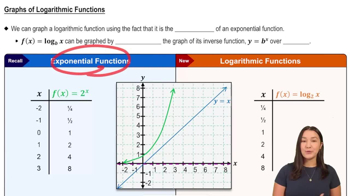
Graphs of Logarithmic Functions
Solving Quadratic Inequalities
To find when a quadratic function is greater than or equal to a value, set up an inequality and solve it by finding the roots of the related quadratic equation. These roots divide the number line into intervals, and testing these intervals shows where the inequality holds true.
Recommended video:
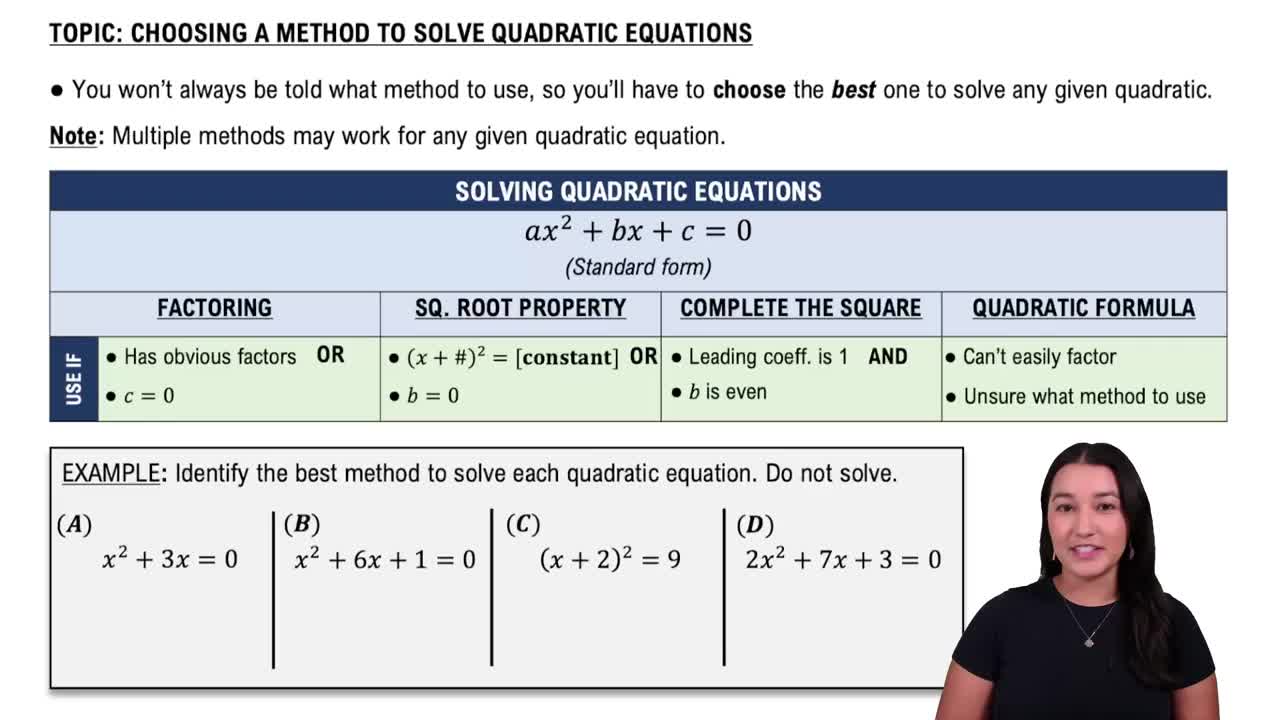
Choosing a Method to Solve Quadratics
Interpreting Real-World Contexts in Algebra
Translating a real-world problem into algebraic terms involves understanding what variables represent and applying mathematical solutions back to the context. Here, time t and height s relate to the baseball's flight, so solutions must be realistic (e.g., non-negative time) and meaningful within the scenario.
Recommended video:
Guided course
Introduction to Algebraic Expressions
Related Videos
Related Practice
Textbook Question
437
views