The figure shows the graph of f(x) = log x. In Exercises 59–64, use transformations of this graph to graph each function. Graph and give equations of the asymptotes. Use the graphs to determine each function's domain and range. h(x) = log x − 1
Table of contents
- 0. Review of Algebra4h 18m
- 1. Equations & Inequalities3h 18m
- 2. Graphs of Equations1h 43m
- 3. Functions2h 17m
- 4. Polynomial Functions1h 44m
- 5. Rational Functions1h 23m
- 6. Exponential & Logarithmic Functions2h 28m
- 7. Systems of Equations & Matrices4h 5m
- 8. Conic Sections2h 23m
- 9. Sequences, Series, & Induction1h 22m
- 10. Combinatorics & Probability1h 45m
6. Exponential & Logarithmic Functions
Introduction to Logarithms
Problem 63
Textbook Question
Graph each function. Give the domain and range. ƒ(x) = log1/2 (x-2)
Verified step by step guidance1
Identify the base of the logarithm function, which is \( \frac{1}{2} \), and note that since \( 0 < \frac{1}{2} < 1 \), the logarithmic function is decreasing.
Determine the domain by setting the argument of the logarithm greater than zero: \( x - 2 > 0 \). Solve this inequality to find \( x > 2 \). So, the domain is \( (2, \infty) \).
Understand that the range of any logarithmic function is all real numbers, so the range is \( (-\infty, \infty) \).
Find key points to plot the graph, such as the vertical asymptote at \( x = 2 \) and the point where the argument equals 1, i.e., \( x - 2 = 1 \) which gives \( x = 3 \). At this point, \( f(3) = \log_{\frac{1}{2}}(1) = 0 \).
Sketch the graph showing the vertical asymptote at \( x = 2 \), the point \( (3, 0) \), and the decreasing nature of the function as \( x \) increases beyond 2.
Verified video answer for a similar problem:This video solution was recommended by our tutors as helpful for the problem above
Video duration:
9mPlay a video:
Was this helpful?
Key Concepts
Here are the essential concepts you must grasp in order to answer the question correctly.
Logarithmic Functions
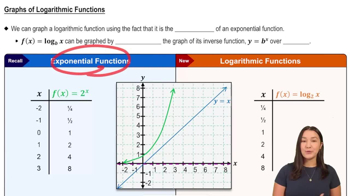
A logarithmic function is the inverse of an exponential function and is written as f(x) = log_b(x), where b is the base. It answers the question: to what power must the base be raised to get x? Understanding how the base affects the graph's shape and behavior is essential, especially when the base is between 0 and 1, which causes the graph to decrease.
Recommended video:
Graphs of Logarithmic Functions
Domain of Logarithmic Functions
The domain of a logarithmic function includes all x-values for which the argument inside the log is positive. For f(x) = log_b(x - 2), the expression x - 2 must be greater than 0, so the domain is x > 2. Recognizing this restriction is crucial for correctly graphing the function and determining valid input values.
Recommended video:
Graphs of Logarithmic Functions
Range of Logarithmic Functions
The range of any logarithmic function is all real numbers, since logarithms can produce any real output as the input approaches positive infinity or values close to zero from the right. This means the graph extends infinitely in the vertical direction, which is important when describing the function's behavior and sketching its graph.
Recommended video:
Graphs of Logarithmic Functions
Watch next
Master Logarithms Introduction with a bite sized video explanation from Patrick
Start learningRelated Videos
Related Practice
Textbook Question
484
views