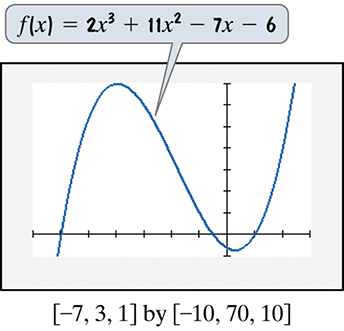
In Exercises 71–72, use the graph of the polynomial function to solve each inequality.
2x^3 + 11x^2 ≥ 7x + 6
Verified step by step guidance
1
Rewrite the given inequality \$2x^3 + 11x^2 \geq 7x + 6\( by bringing all terms to one side to set the inequality to zero: \)2x^3 + 11x^2 - 7x - 6 \geq 0$.
Recognize that the expression on the left side is the polynomial function \(f(x) = 2x^3 + 11x^2 - 7x - 6\) whose graph is provided.
Identify the x-values where \(f(x) = 0\) by looking at the points where the graph crosses the x-axis. These are the roots of the polynomial and critical points for the inequality.
Determine the intervals on the x-axis where the graph of \(f(x)\) is above or on the x-axis (i.e., where \(f(x) \geq 0\)). These intervals satisfy the inequality.
Express the solution set as the union of intervals where \(f(x) \geq 0\), based on the x-intercepts and the behavior of the graph between these points.
Verified video answer for a similar problem:
This video solution was recommended by our tutors as helpful for the problem above
Video duration:
4m
Play a video:
Was this helpful?
Key Concepts
Here are the essential concepts you must grasp in order to answer the question correctly.
Polynomial Functions and Their Graphs
A polynomial function is an expression involving variables raised to whole-number exponents and their coefficients. The graph of a polynomial function shows its behavior, including where it crosses the x-axis (roots) and its general shape. Understanding the graph helps in visualizing solutions to inequalities involving the polynomial.
To solve inequalities like f(x) ≥ 0 using a graph, identify where the graph lies above or on the x-axis. The x-values corresponding to these regions satisfy the inequality. The points where the graph touches or crosses the x-axis are critical points that divide the number line into intervals to test.
Roots or zeros of a polynomial are the x-values where the function equals zero, i.e., where the graph crosses the x-axis. These roots are essential for solving inequalities because they mark boundaries between positive and negative values of the function. They can be found algebraically or estimated from the graph.