Graph the solution set of each system of inequalities. y ≥ x2 + 4x + 4 y < -x2
Verified step by step guidance
1
Step 1: Identify the two inequalities in the system: \(y \geq x^{2} + 8x + 19\) and \(y < -(x - 1)^{2}\).
Step 2: Recognize that the first inequality represents the region on or above the parabola \(y = x^{2} + 8x + 19\), which opens upward.
Step 3: Recognize that the second inequality represents the region below the parabola \(y = -(x - 1)^{2}\), which opens downward and is shifted right by 1 unit.
Step 4: To graph the solution set, first sketch both parabolas: the upward-opening parabola \(y = x^{2} + 8x + 19\) and the downward-opening parabola \(y = -(x - 1)^{2}\).
Step 5: Shade the region on or above the first parabola and below the second parabola. The solution set is the intersection of these two shaded regions.
Verified video answer for a similar problem:
This video solution was recommended by our tutors as helpful for the problem above
Video duration:
16m
Play a video:
Was this helpful?
Key Concepts
Here are the essential concepts you must grasp in order to answer the question correctly.
Graphing Quadratic Inequalities
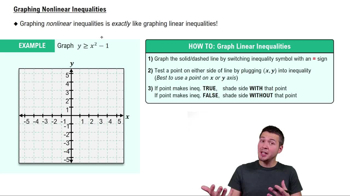
Graphing quadratic inequalities involves plotting the parabola defined by the quadratic equation and then shading the region that satisfies the inequality. For 'y ≥ f(x)', shade above or on the parabola, and for 'y < f(x)', shade below the parabola. The boundary line is solid if the inequality includes equality (≥ or ≤) and dashed if it does not (> or <).
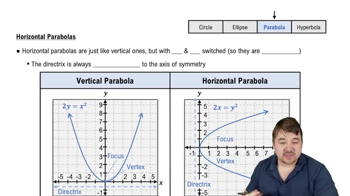
The vertex form of a quadratic function, y = a(x - h)² + k, helps identify the vertex (h, k) and the direction the parabola opens. This is crucial for graphing and understanding the shape. For example, y < -(x - 1)² has a vertex at (1, 0) and opens downward, while y ≥ x² + 8x + 19 can be rewritten in vertex form to find its vertex and orientation.
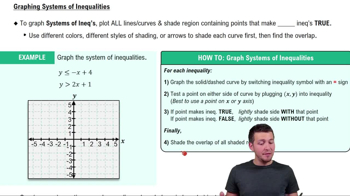
The solution set of a system of inequalities is the region where the shaded areas of all inequalities overlap. To find this, graph each inequality separately, then identify the common region that satisfies all conditions simultaneously. This intersection represents all points that make every inequality true.