Graph the solution set of each system of inequalities. y ≥ (x - 2)2 + 3 y ≤ -(x - 1)2 + 6
Verified step by step guidance
1
Identify the two inequalities given: \(y \geq (x - 3)^2 - 5\) and \(y \leq -(x - 4)^2 + 3\).
Recognize that \(y = (x - 3)^2 - 5\) is a parabola opening upwards with vertex at \((3, -5)\), and the inequality \(y \geq (x - 3)^2 - 5\) means the solution includes the region on or above this parabola.
Recognize that \(y = -(x - 4)^2 + 3\) is a parabola opening downwards with vertex at \((4, 3)\), and the inequality \(y \leq -(x - 4)^2 + 3\) means the solution includes the region on or below this parabola.
Graph both parabolas on the coordinate plane, marking the vertices and the direction each parabola opens.
Shade the region that satisfies both inequalities simultaneously, which is the overlap of the area above the first parabola and below the second parabola.
Verified video answer for a similar problem:
This video solution was recommended by our tutors as helpful for the problem above
Video duration:
13m
Play a video:
Was this helpful?
Key Concepts
Here are the essential concepts you must grasp in order to answer the question correctly.
Graphing Quadratic Inequalities
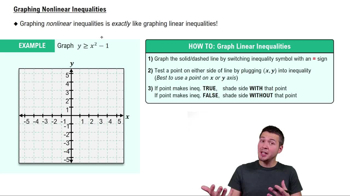
Graphing quadratic inequalities involves plotting the boundary curves defined by quadratic equations and then shading the region that satisfies the inequality. The boundary is given by the quadratic equation with equality, and the inequality sign determines whether to shade above or below the curve.
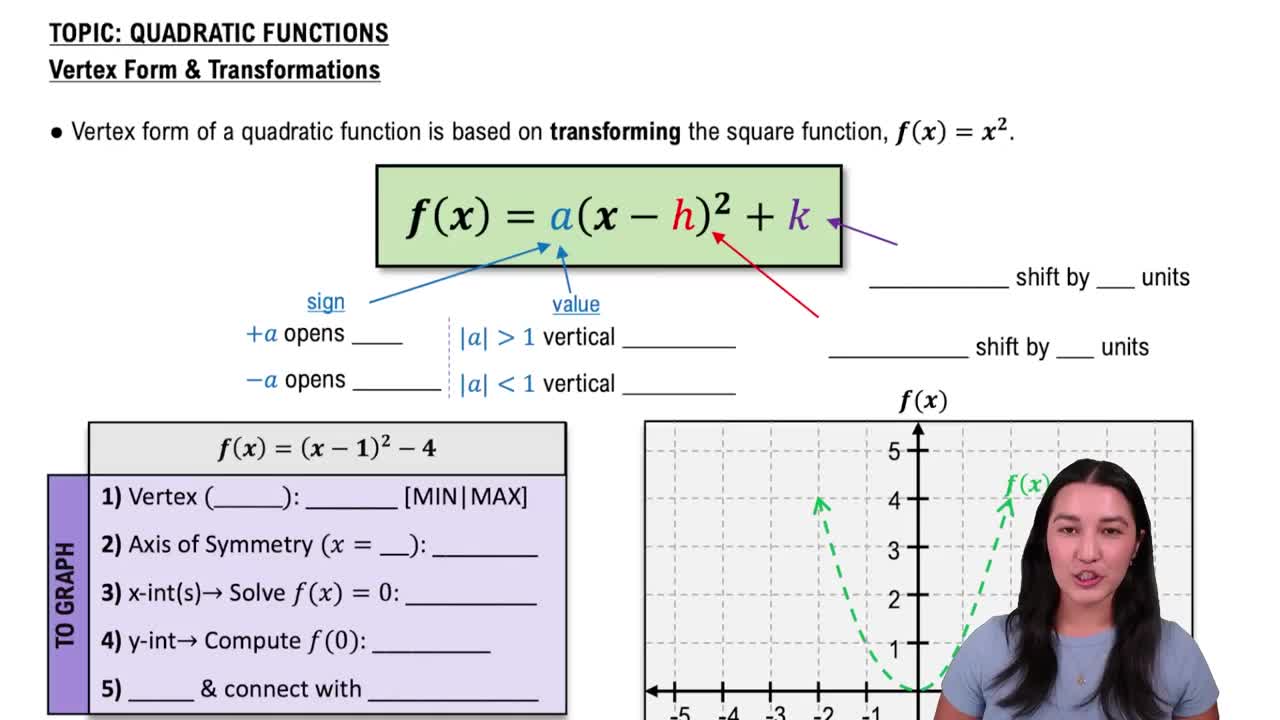
A parabola is the graph of a quadratic function, typically in the form y = a(x - h)^2 + k, where (h, k) is the vertex. The sign of 'a' determines if the parabola opens upward (a > 0) or downward (a < 0). Understanding vertex form helps in quickly sketching the parabola and identifying its key features.
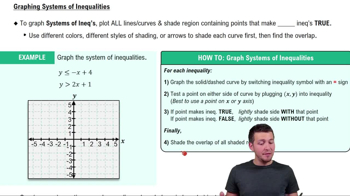
The solution set of a system of inequalities is the intersection of the regions that satisfy each inequality individually. For two quadratic inequalities, this means finding the overlapping shaded area on the graph where both conditions hold true simultaneously.