Graph the solution set of each system of inequalities. x≤4
x≥0y≥0 x+2y≥2
Verified step by step guidance
1
Start by identifying the region for the inequality \( x \leq 4 \). This represents all points to the left of the vertical line \( x = 4 \) on the coordinate plane, including the line itself.
Next, consider the inequality \( x \geq 0 \). This represents all points to the right of the vertical line \( x = 0 \), including the line itself. The solution for \( x \) is the intersection of \( x \leq 4 \) and \( x \geq 0 \), which is the region between and including the lines \( x = 0 \) and \( x = 4 \).
Now, examine the inequality \( y \geq 0 \). This represents all points above the horizontal line \( y = 0 \), including the line itself. This means we are considering the upper half of the coordinate plane.
For the inequality \( x + 2y \geq 2 \), first rewrite it in slope-intercept form: \( y \geq -\frac{1}{2}x + 1 \). This represents the region above the line \( y = -\frac{1}{2}x + 1 \).
Finally, graph the solution set by shading the region that satisfies all the inequalities: \( x \leq 4 \), \( x \geq 0 \), \( y \geq 0 \), and \( y \geq -\frac{1}{2}x + 1 \). The solution set is the intersection of these regions on the coordinate plane.
Verified video answer for a similar problem:
This video solution was recommended by our tutors as helpful for the problem above
Video duration:
8m
Play a video:
Was this helpful?
Key Concepts
Here are the essential concepts you must grasp in order to answer the question correctly.
Inequalities
Inequalities are mathematical expressions that show the relationship between two values when they are not equal. They can be represented using symbols such as ≤ (less than or equal to), ≥ (greater than or equal to), < (less than), and > (greater than). Understanding how to interpret and manipulate inequalities is crucial for solving systems of inequalities.
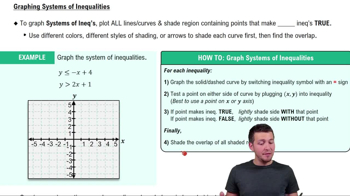
Graphing linear inequalities involves representing the solutions of an inequality on a coordinate plane. The boundary line is drawn based on the corresponding equation, and the region that satisfies the inequality is shaded. For example, for x ≤ 4, the line x = 4 is drawn, and the area to the left is shaded to indicate all values of x that are less than or equal to 4.
A system of inequalities consists of two or more inequalities that are considered simultaneously. The solution set is the region where the shaded areas of all inequalities overlap on the graph. Analyzing systems of inequalities requires understanding how to find the intersection of the solution sets for each individual inequality.