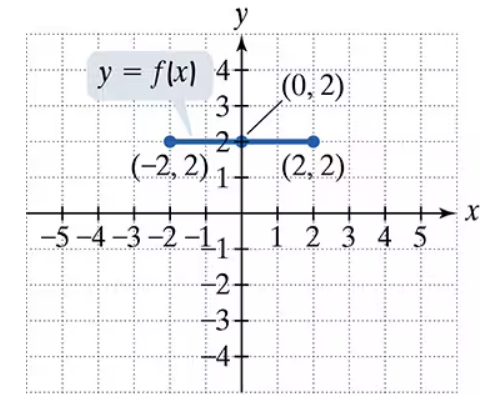
Use the graph of y = f(x) to graph each function g. g(x) = f(-x)
Verified step by step guidance
1
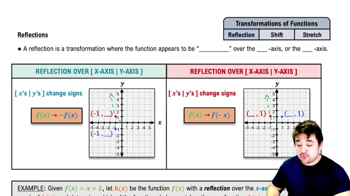
Step 1: Understand the transformation g(x) = f(-x). This transformation reflects the graph of f(x) across the y-axis. For every point (x, y) on the graph of f(x), the corresponding point on g(x) will be (-x, y).
Step 2: Identify the key points on the graph of f(x). From the image, the graph of f(x) is a horizontal line segment from (1, -3) to (4, -3).
Step 3: Apply the reflection transformation to each key point. Reflect (1, -3) across the y-axis to get (-1, -3). Reflect (4, -3) across the y-axis to get (-4, -3).
Step 4: Draw the new graph of g(x). The graph of g(x) will be a horizontal line segment from (-4, -3) to (-1, -3), maintaining the same y-value of -3.
Step 5: Verify the transformation by checking that the graph of g(x) is symmetric to the graph of f(x) with respect to the y-axis.
Verified video answer for a similar problem:
This video solution was recommended by our tutors as helpful for the problem above
Video duration:
1m
Play a video:
Was this helpful?
Key Concepts
Here are the essential concepts you must grasp in order to answer the question correctly.
Function Reflection
Function reflection involves flipping a graph over a specific axis. For the function g(x) = f(-x), the graph of f(x) is reflected over the y-axis. This means that for every point (a, b) on the graph of f(x), there will be a corresponding point (-a, b) on the graph of g(x). Understanding this concept is crucial for accurately graphing the transformed function.
The graph of a horizontal line, such as y = f(x) in this case, indicates that the output value (y) remains constant across a range of input values (x). In the provided graph, y = f(x) is a horizontal line at y = -3 from x = 1 to x = 4. Recognizing this characteristic helps in visualizing how the graph will change when applying transformations like reflection.
The domain of a function refers to all possible input values (x-values), while the range refers to all possible output values (y-values). For the function f(x) shown in the graph, the domain is [1, 4] and the range is {-3}. When reflecting the function to create g(x) = f(-x), it is important to consider how the domain and range will change, particularly how the x-values will be affected by the reflection.