In Exercises 81–85, use a calculator's factorial key to evaluate each expression.
Table of contents
- 0. Review of Algebra4h 18m
- 1. Equations & Inequalities3h 18m
- 2. Graphs of Equations1h 43m
- 3. Functions2h 17m
- 4. Polynomial Functions1h 44m
- 5. Rational Functions1h 23m
- 6. Exponential & Logarithmic Functions2h 28m
- 7. Systems of Equations & Matrices4h 5m
- 8. Conic Sections2h 23m
- 9. Sequences, Series, & Induction1h 22m
- 10. Combinatorics & Probability1h 45m
9. Sequences, Series, & Induction
Sequences
Problem 19
Textbook Question
In Exercises 11–24, use mathematical induction to prove that each statement is true for every positive integer n. 2 + 4 + 8 + ... + 2n = 2n+1 - 2
Verified step by step guidance1
Step 1: Understand the statement to prove by induction. We want to prove that for every positive integer , the sum equals .
Step 2: Base Case - Verify the statement for . Calculate the left side: . Calculate the right side: . Since both sides are equal, the base case holds.
Step 3: Inductive Hypothesis - Assume the statement is true for some positive integer , that is, .
Step 4: Inductive Step - Prove the statement for . Start with the left side for : . Using the inductive hypothesis, replace the sum up to with , so the expression becomes .
Step 5: Simplify the expression from Step 4: . This matches the right side of the statement for , completing the inductive step and proving the statement for all positive integers .
Verified video answer for a similar problem:This video solution was recommended by our tutors as helpful for the problem above
Video duration:
7mPlay a video:
Was this helpful?
Key Concepts
Here are the essential concepts you must grasp in order to answer the question correctly.
Mathematical Induction
Mathematical induction is a proof technique used to establish that a statement holds for all positive integers. It involves two steps: proving the base case (usually n=1) is true, and then proving that if the statement holds for an arbitrary integer k, it also holds for k+1. This creates a chain of truth for all n.
Recommended video:
Guided course
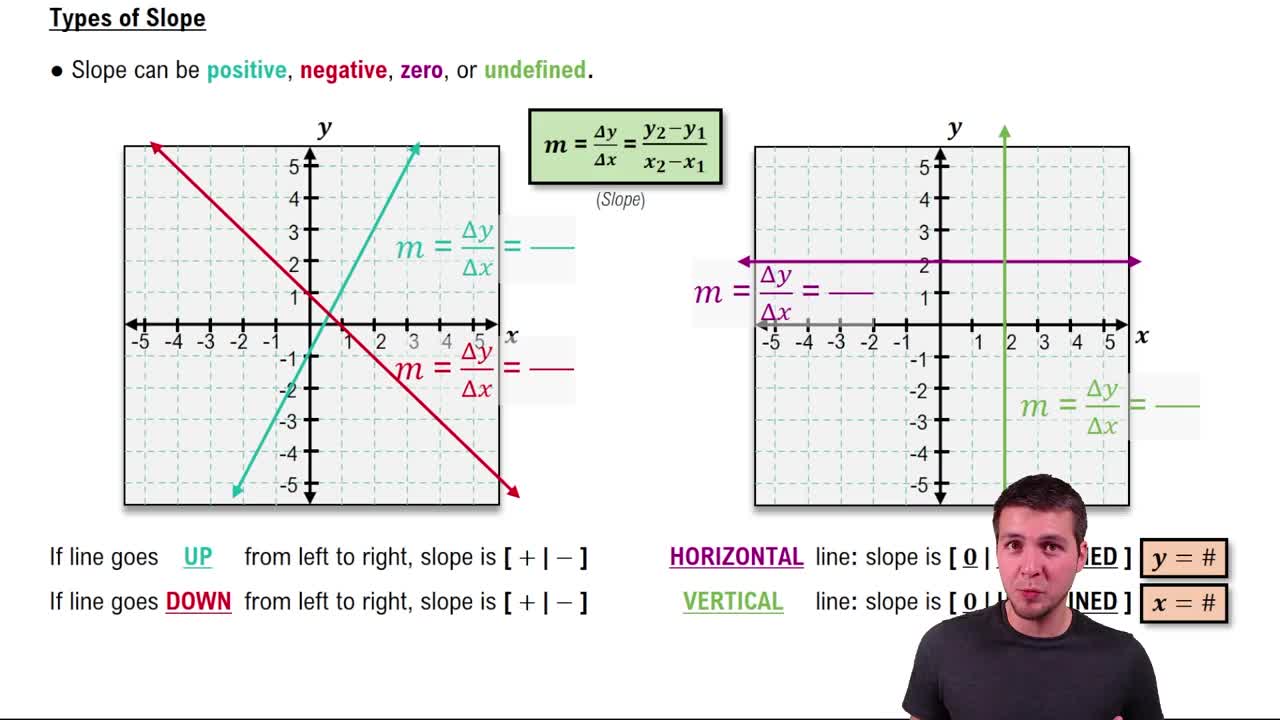
Types of Slope
Geometric Series
A geometric series is a sum of terms where each term is found by multiplying the previous term by a constant ratio. In this problem, the series 2 + 4 + 8 + ... + 2^n is geometric with ratio 2. Understanding the formula for the sum of a geometric series helps in verifying the closed-form expression.
Recommended video:
Guided course
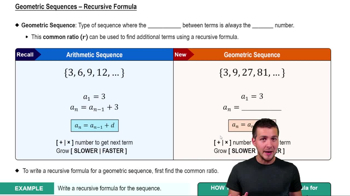
Geometric Sequences - Recursive Formula
Exponents and Powers of Two
Exponents represent repeated multiplication of a base number. Powers of two, like 2^n, grow exponentially and are fundamental in this problem. Recognizing how to manipulate and simplify expressions involving powers of two is essential for proving the given equality.
Recommended video:
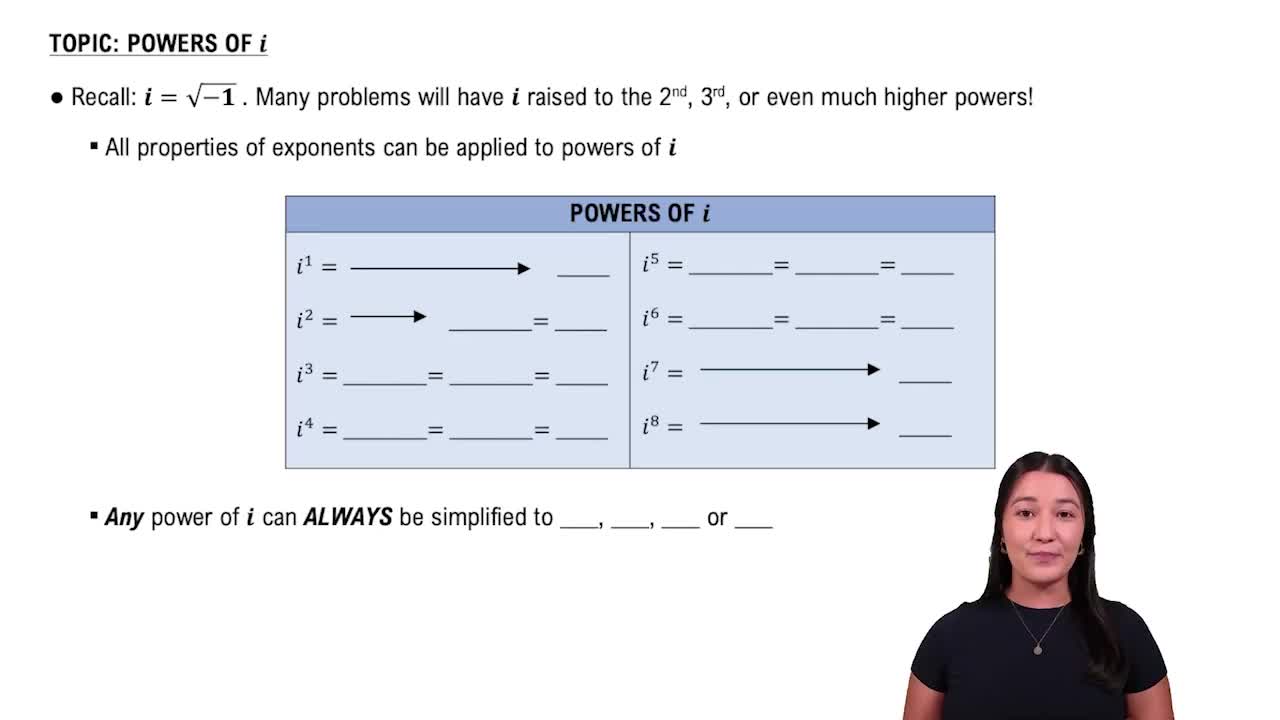
Powers of i
Watch next
Master Introduction to Sequences with a bite sized video explanation from Patrick
Start learningRelated Videos
Related Practice
Textbook Question
719
views