Solve each problem. If y varies inversely as x, and y=10 when x=3, find y when x=20.
Table of contents
- 0. Review of Algebra4h 18m
- 1. Equations & Inequalities3h 18m
- 2. Graphs of Equations1h 43m
- 3. Functions2h 17m
- 4. Polynomial Functions1h 44m
- 5. Rational Functions1h 23m
- 6. Exponential & Logarithmic Functions2h 28m
- 7. Systems of Equations & Matrices4h 5m
- 8. Conic Sections2h 23m
- 9. Sequences, Series, & Induction1h 22m
- 10. Combinatorics & Probability1h 45m
1. Equations & Inequalities
Rational Equations
Problem 19
Textbook Question
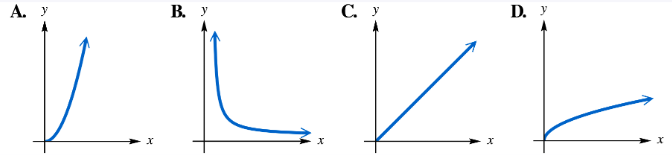
Match each statement with its corresponding graph in choices A–D. In each case, k > 0. y varies directly as the second power of x. (y=kx^2)
Verified step by step guidance1
Identify the type of variation described: y varies directly as the second power of x means the equation can be written as \(y = kx^{2}\), where \(k > 0\).
Recognize the shape of the graph for \(y = kx^{2}\): since \(k\) is positive and the power of \(x\) is 2, the graph is a parabola opening upwards.
Recall that the graph of \(y = kx^{2}\) is symmetric about the y-axis because the exponent on \(x\) is even.
Eliminate any graphs that do not show a parabola opening upwards or are not symmetric about the y-axis.
Match the statement to the graph that shows a parabola opening upwards with vertex at the origin, which corresponds to the equation \(y = kx^{2}\) with \(k > 0\).
Verified video answer for a similar problem:This video solution was recommended by our tutors as helpful for the problem above
Video duration:
2mPlay a video:
Was this helpful?
Key Concepts
Here are the essential concepts you must grasp in order to answer the question correctly.
Direct Variation
Direct variation describes a relationship where one variable is equal to a constant multiplied by another variable raised to a power. In this case, y varies directly as x squared, meaning y = kx², where k is a positive constant. This implies that as x increases, y changes proportionally to the square of x.
Recommended video:
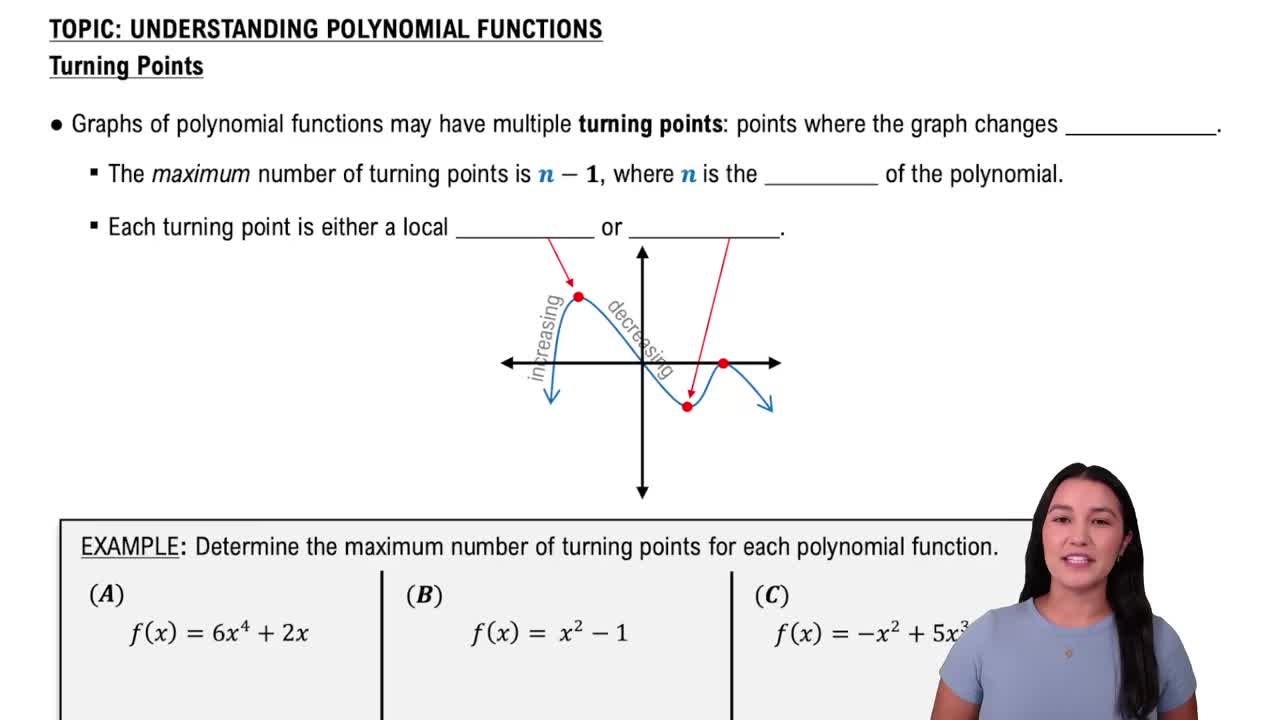
Maximum Turning Points of a Polynomial Function
Quadratic Functions and Their Graphs
A quadratic function has the form y = ax² + bx + c, and its graph is a parabola. When y = kx² with k > 0, the parabola opens upward and is symmetric about the y-axis. The shape and steepness depend on the value of k, with larger k values making the parabola narrower.
Recommended video:
Graphs of Logarithmic Functions
Interpreting Graphs of Power Functions
Graphs of power functions y = kx^n show how y changes with x raised to a power n. For n = 2, the graph is a parabola. Understanding how the exponent affects the curve helps match equations to their graphs, especially recognizing the shape and direction based on the sign and magnitude of k.
Recommended video:
Powers of i
Watch next
Master Introduction to Rational Equations with a bite sized video explanation from Patrick
Start learningRelated Videos
Related Practice
Textbook Question
473
views