Solve each problem. Let a be directly proportional to m and n^2, and inversely proportional to y^3. If a=9when m=4, n=9, and y=3, find a when m=6, n=2, and y=5.
Table of contents
- 0. Review of Algebra4h 18m
- 1. Equations & Inequalities3h 18m
- 2. Graphs of Equations1h 43m
- 3. Functions2h 17m
- 4. Polynomial Functions1h 44m
- 5. Rational Functions1h 23m
- 6. Exponential & Logarithmic Functions2h 28m
- 7. Systems of Equations & Matrices4h 5m
- 8. Conic Sections2h 23m
- 9. Sequences, Series, & Induction1h 22m
- 10. Combinatorics & Probability1h 45m
1. Equations & Inequalities
Rational Equations
Problem 35
Textbook Question
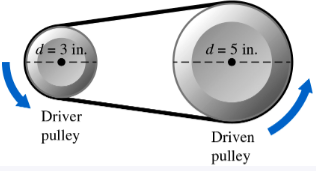
Solve each problem. The speed of a pulley varies inversely as its diameter. One kind of pulley, with diameter 3 in., turns at 150 revolutions per minute. Find the speed of a similar pulley with diameter 5 in.
Verified step by step guidance1
Identify the type of variation described: the speed \( S \) varies inversely as the diameter \( D \). This means the relationship can be written as \( S = \frac{k}{D} \), where \( k \) is a constant.
Use the given values to find the constant \( k \). Substitute \( S = 150 \) revolutions per minute and \( D = 3 \) inches into the equation \( 150 = \frac{k}{3} \).
Solve for \( k \) by multiplying both sides of the equation by 3, giving \( k = 150 \times 3 \).
Write the general formula for speed using the constant \( k \): \( S = \frac{k}{D} \).
Find the speed of the pulley with diameter 5 inches by substituting \( D = 5 \) and the value of \( k \) into the formula: \( S = \frac{k}{5} \).
Verified video answer for a similar problem:This video solution was recommended by our tutors as helpful for the problem above
Video duration:
4mPlay a video:
Was this helpful?
Key Concepts
Here are the essential concepts you must grasp in order to answer the question correctly.
Inverse Variation
Inverse variation describes a relationship where one quantity increases as the other decreases, such that their product is constant. In this problem, speed varies inversely with diameter, meaning speed × diameter = constant.
Recommended video:
Graphing Logarithmic Functions
Setting Up the Variation Equation
To solve inverse variation problems, express the relationship as speed × diameter = k, where k is a constant. Use known values to find k, then apply it to find the unknown speed for the new diameter.
Recommended video:
Categorizing Linear Equations
Solving for Unknowns in Variation Problems
After determining the constant of variation, substitute the new diameter into the equation and solve for the unknown speed. This step involves basic algebraic manipulation to isolate and calculate the desired variable.
Recommended video:
Guided course
Cramer's Rule - 2 Equations with 2 Unknowns
Watch next
Master Introduction to Rational Equations with a bite sized video explanation from Patrick
Start learningRelated Videos
Related Practice
Textbook Question
431
views