Match each statement with its corresponding graph in choices A–D. In each case, k > 0. y varies directly as the second power of x. (y=kx^2)
Table of contents
- 0. Review of Algebra4h 18m
- 1. Equations & Inequalities3h 18m
- 2. Graphs of Equations1h 43m
- 3. Functions2h 17m
- 4. Polynomial Functions1h 44m
- 5. Rational Functions1h 23m
- 6. Exponential & Logarithmic Functions2h 28m
- 7. Systems of Equations & Matrices4h 5m
- 8. Conic Sections2h 23m
- 9. Sequences, Series, & Induction1h 22m
- 10. Combinatorics & Probability1h 45m
1. Equations & Inequalities
Rational Equations
Problem 37
Textbook Question
Solve each problem. Current FlowIn electric current flow, it is found that the resistance offered by a fixed length of wire of a given material varies inversely as the square of the diameter of the wire. If a wire 0.01 in. in diameter has a resistance of 0.4 ohm, what is the resistance of a wire of the same length and material with diameter 0.03 in., to the nearest ten-thousandth of an ohm?
Verified step by step guidance1
Identify the relationship given: resistance \(R\) varies inversely as the square of the diameter \(d\). This means we can write the equation as \(R = \frac{k}{d^2}\), where \(k\) is a constant.
Use the given values to find the constant \(k\). Substitute \(R = 0.4\) ohms and \(d = 0.01\) inches into the equation: \$0.4 = \frac{k}{(0.01)^2}$.
Solve for \(k\) by multiplying both sides of the equation by \((0.01)^2\): \(k = 0.4 \times (0.01)^2\).
Now, use the constant \(k\) to find the resistance for the wire with diameter \$0.03\( inches by substituting into the formula: \)R = \frac{k}{(0.03)^2}$.
Calculate the value of \(R\) using the expression from step 4, and round the result to the nearest ten-thousandth of an ohm.
Verified video answer for a similar problem:This video solution was recommended by our tutors as helpful for the problem above
Video duration:
2mPlay a video:
Was this helpful?
Key Concepts
Here are the essential concepts you must grasp in order to answer the question correctly.
Inverse Variation
Inverse variation describes a relationship where one quantity increases as another decreases, such that their product is constant. In this problem, resistance varies inversely as the square of the diameter, meaning resistance × (diameter)^2 = constant.
Recommended video:
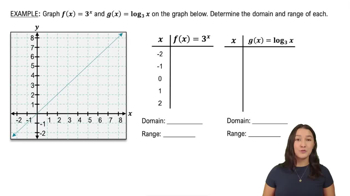
Graphing Logarithmic Functions
Formulating and Solving Equations
To solve the problem, set up an equation using the given values and the inverse variation relationship. Substitute known values to find the constant, then use it to calculate the unknown resistance for the new diameter.
Recommended video:
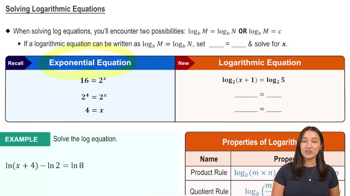
Solving Logarithmic Equations
Precision and Rounding
After calculating the resistance, round the result to the specified precision—in this case, to the nearest ten-thousandth of an ohm. Proper rounding ensures the answer meets the problem's accuracy requirements.
Recommended video:
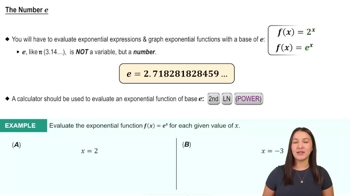
The Number e
Watch next
Master Introduction to Rational Equations with a bite sized video explanation from Patrick
Start learningRelated Videos
Related Practice
Textbook Question
502
views