Write each expression without negative exponents, and evaluate if possible. Assume all variables represent nonzero real numbers. -5-4
Verified step by step guidance
1
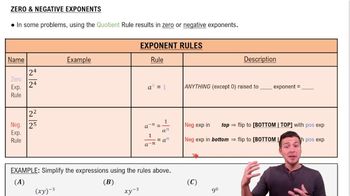
Recall the rule for negative exponents: \(a^{-n} = \frac{1}{a^n}\), where \(a\) is a nonzero number and \(n\) is a positive integer.
Apply this rule to the expression \(-5^{-4}\). Since the negative exponent applies only to the base 5, rewrite it as \(-\frac{1}{5^4}\).
Rewrite the expression without the negative exponent: \(-\frac{1}{5^4}\).
Evaluate \$5^4$ by multiplying 5 by itself four times: \(5 \times 5 \times 5 \times 5\).
Substitute the value of \$5^4$ back into the expression to get the simplified form without negative exponents.
Verified video answer for a similar problem:
This video solution was recommended by our tutors as helpful for the problem above
Video duration:
1m
Play a video:
0 Comments
Key Concepts
Here are the essential concepts you must grasp in order to answer the question correctly.
Negative Exponents
A negative exponent indicates the reciprocal of the base raised to the corresponding positive exponent. For example, a⁻ⁿ = 1/aⁿ, where a ≠ 0. This rule allows rewriting expressions without negative exponents by moving the base to the denominator.
Evaluating powers involves multiplying the base by itself as many times as indicated by the exponent. For negative exponents, after rewriting as a reciprocal, calculate the positive power. For instance, 5⁴ = 5 × 5 × 5 × 5 = 625.
Understanding that variables represent nonzero real numbers ensures that division by zero does not occur when rewriting negative exponents. This assumption is crucial for the validity of reciprocal operations and evaluating expressions safely.

 1:40 minutes
 Verified step by step guidance
 6:37
6:37