Graph each function. See Examples 1 and 2. h(x)=√(4x)
Table of contents
- 0. Review of Algebra4h 18m
- 1. Equations & Inequalities3h 18m
- 2. Graphs of Equations1h 43m
- 3. Functions2h 17m
- 4. Polynomial Functions1h 44m
- 5. Rational Functions1h 23m
- 6. Exponential & Logarithmic Functions2h 28m
- 7. Systems of Equations & Matrices4h 5m
- 8. Conic Sections2h 23m
- 9. Sequences, Series, & Induction1h 22m
- 10. Combinatorics & Probability1h 45m
3. Functions
Transformations
Problem 39
Textbook Question
Plot each point, and then plot the points that are symmetric to the given point with respect to the (a) x-axis, (b) y-axis, and (c) origin. (5, -3)
Verified step by step guidance1
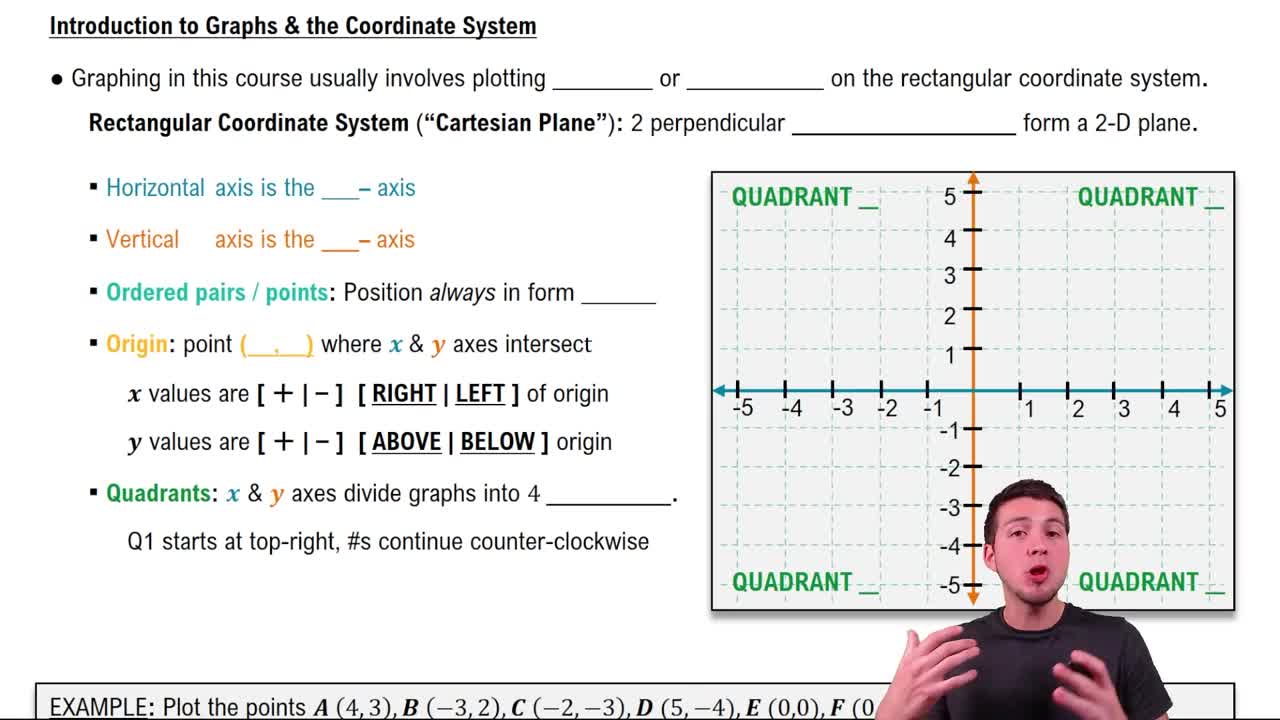
Identify the given point as \( (5, -3) \). This means the point is located 5 units to the right of the origin along the x-axis and 3 units down along the y-axis.
To find the point symmetric with respect to the x-axis, keep the x-coordinate the same and change the sign of the y-coordinate. The symmetric point will be \( (5, 3) \).
To find the point symmetric with respect to the y-axis, keep the y-coordinate the same and change the sign of the x-coordinate. The symmetric point will be \( (-5, -3) \).
To find the point symmetric with respect to the origin, change the signs of both the x- and y-coordinates. The symmetric point will be \( (-5, 3) \).
Plot all points on the coordinate plane: the original point \( (5, -3) \), the x-axis symmetric point \( (5, 3) \), the y-axis symmetric point \( (-5, -3) \), and the origin symmetric point \( (-5, 3) \).
Verified video answer for a similar problem:This video solution was recommended by our tutors as helpful for the problem above
Video duration:
5mPlay a video:
Was this helpful?
Key Concepts
Here are the essential concepts you must grasp in order to answer the question correctly.
Coordinate Plane and Plotting Points
The coordinate plane consists of two perpendicular number lines called the x-axis and y-axis. Points are plotted using ordered pairs (x, y), where x indicates horizontal position and y indicates vertical position. Understanding how to locate and plot points is fundamental for visualizing symmetry.
Recommended video:
Guided course
Graphs & the Rectangular Coordinate System
Symmetry with Respect to the Axes
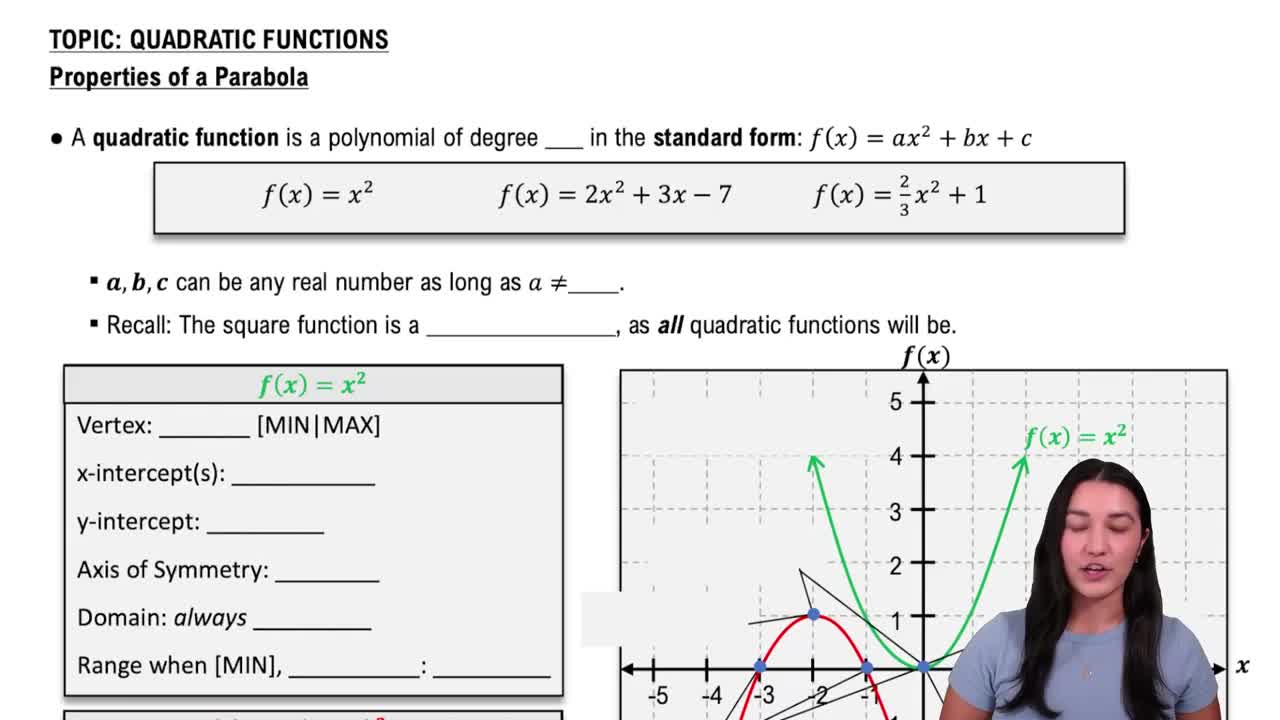
Symmetry about the x-axis means reflecting a point across the x-axis, changing the sign of the y-coordinate while keeping x the same. Symmetry about the y-axis involves changing the sign of the x-coordinate while keeping y the same. These reflections produce mirror images of the original point.
Recommended video:
Properties of Parabolas
Symmetry with Respect to the Origin
Symmetry about the origin reflects a point through the origin, changing the signs of both coordinates. For a point (x, y), its symmetric point with respect to the origin is (-x, -y). This transformation is equivalent to a 180-degree rotation around the origin.
Recommended video:
Graph Hyperbolas NOT at the Origin
Watch next
Master Intro to Transformations with a bite sized video explanation from Patrick
Start learningRelated Videos
Related Practice
Textbook Question
609
views