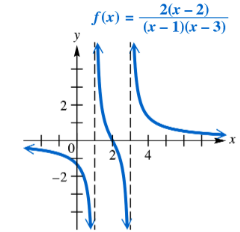
Use the graph to solve each equation or inequality. Use interval notation where appropriate. 7x(x - 1)(x - 2) = 0
Table of contents
- 0. Review of Algebra4h 18m
- 1. Equations & Inequalities3h 18m
- 2. Graphs of Equations1h 43m
- 3. Functions2h 17m
- 4. Polynomial Functions1h 44m
- 5. Rational Functions1h 23m
- 6. Exponential & Logarithmic Functions2h 28m
- 7. Systems of Equations & Matrices4h 5m
- 8. Conic Sections2h 23m
- 9. Sequences, Series, & Induction1h 22m
- 10. Combinatorics & Probability1h 45m
1. Equations & Inequalities
Linear Inequalities
Problem 7
Textbook Question
Use the graph to solve each equation or inequality. Use interval notation where appropriate. 2(x-2) / {(x-1)(x-3)} = 0

Verified step by step guidance1
Identify the given rational function: \(\frac{2(X-2)}{(X-1)(X-3)} = 0\).
Recall that a rational function equals zero when its numerator equals zero (and the denominator is not zero). So, set the numerator equal to zero: \$2(X-2) = 0$.
Solve the numerator equation: \$2(X-2) = 0\( implies \)X-2 = 0\(, so \)X = 2$.
Check the denominator at \(X=2\) to ensure it is not zero: \((2-1)(2-3) = 1 \times (-1) = -1 \neq 0\), so \(X=2\) is a valid solution.
Use the graph to confirm that the function crosses the x-axis at \(X=2\), which matches the solution found algebraically.
Verified video answer for a similar problem:This video solution was recommended by our tutors as helpful for the problem above
Video duration:
2mPlay a video:
Was this helpful?
Key Concepts
Here are the essential concepts you must grasp in order to answer the question correctly.
Rational Functions and Their Graphs
A rational function is a ratio of two polynomials. Its graph can have vertical asymptotes where the denominator is zero and horizontal or oblique asymptotes based on the degrees of numerator and denominator. Understanding these features helps interpret the behavior of the function and solve related equations.
Recommended video:
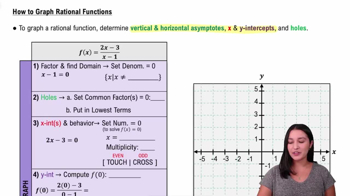
How to Graph Rational Functions
Solving Rational Equations
To solve rational equations like 2(x-2)/((x-1)(x-3)) = 0, set the numerator equal to zero and ensure the denominator is not zero. The solutions are the x-values that make the numerator zero but do not make the denominator zero, as those points are undefined.
Recommended video:
Introduction to Rational Equations
Interval Notation and Inequalities
Interval notation expresses the set of solutions for inequalities or equations on the number line. When solving inequalities involving rational functions, consider where the function is positive, negative, or zero, and exclude points where the function is undefined, using parentheses or brackets accordingly.
Recommended video:
Interval Notation
Related Videos
Related Practice
Textbook Question
442
views