Find a. (fog) (x) b. (go f) (x) f(x) = 4-x, g(x) = 2x² +x+5
Table of contents
- 0. Review of Algebra4h 18m
- 1. Equations & Inequalities3h 18m
- 2. Graphs of Equations1h 43m
- 3. Functions2h 17m
- 4. Polynomial Functions1h 44m
- 5. Rational Functions1h 23m
- 6. Exponential & Logarithmic Functions2h 28m
- 7. Systems of Equations & Matrices4h 5m
- 8. Conic Sections2h 23m
- 9. Sequences, Series, & Induction1h 22m
- 10. Combinatorics & Probability1h 45m
3. Functions
Intro to Functions & Their Graphs
Problem 67
Textbook Question
In Exercises 67-74, find a. (fog) (x) b. the domain of f o g. f(x) = 2/(x+3), g(x) = 1/x
Verified step by step guidance1
Step 1: Understand the composition of functions. The notation (fog)(x) represents the composition of f and g, meaning f(g(x)). To find this, substitute g(x) into f(x).
Step 2: Substitute g(x) = 1/x into f(x) = 2/(x+3). Replace every instance of 'x' in f(x) with g(x). This gives f(g(x)) = 2/((1/x) + 3).
Step 3: Simplify the expression for f(g(x)). Combine the terms in the denominator ((1/x) + 3) by finding a common denominator. This results in f(g(x)) = 2/(1/x + 3) = 2/((1 + 3x)/x).
Step 4: Further simplify f(g(x)) by dividing 2 by the fraction (1 + 3x)/x. This results in f(g(x)) = 2x/(1 + 3x).
Step 5: Determine the domain of f o g. The domain is the set of all x-values for which the composition is defined. For f(g(x)) = 2x/(1 + 3x), ensure that the denominator (1 + 3x) ≠ 0 and g(x) = 1/x is defined (x ≠ 0). Therefore, the domain excludes x = 0 and x = -1/3.
Verified video answer for a similar problem:This video solution was recommended by our tutors as helpful for the problem above
Video duration:
3mPlay a video:
Was this helpful?
Key Concepts
Here are the essential concepts you must grasp in order to answer the question correctly.
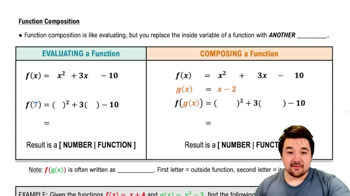
Function Composition
Function composition involves combining two functions, where the output of one function becomes the input of another. In this case, (f o g)(x) means applying g first and then applying f to the result. Understanding how to correctly perform this operation is essential for solving the problem.
Recommended video:
Function Composition
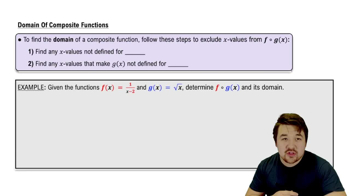
Domain of a Function
The domain of a function is the set of all possible input values (x-values) for which the function is defined. For the composition of functions, the domain must consider the restrictions of both functions involved. Identifying these restrictions is crucial to determine the overall domain of the composed function.
Recommended video:
Domain Restrictions of Composed Functions
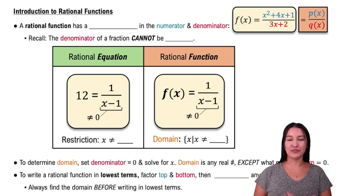
Rational Functions
Rational functions are ratios of polynomials, and they often have restrictions based on the values that make the denominator zero. In this problem, both f(x) and g(x) are rational functions, so understanding how to identify and handle these restrictions is key to finding the correct domain for the composition.
Recommended video:
Intro to Rational Functions
Watch next
Master Relations and Functions with a bite sized video explanation from Patrick
Start learningRelated Videos
Related Practice
Textbook Question
948
views