In Exercises 45-46, it is equally probable that the pointer on the spinner shown will land on any one of the eight regions, numbered 1 through 8. If the pointer lands on a borderline, spin again. Find the probability that the pointer will stop on an odd number or a number less than 6.
Table of contents
- 0. Review of Algebra4h 18m
- 1. Equations & Inequalities3h 18m
- 2. Graphs of Equations1h 43m
- 3. Functions2h 17m
- 4. Polynomial Functions1h 44m
- 5. Rational Functions1h 23m
- 6. Exponential & Logarithmic Functions2h 28m
- 7. Systems of Equations & Matrices4h 5m
- 8. Conic Sections2h 23m
- 9. Sequences, Series, & Induction1h 22m
- 10. Combinatorics & Probability1h 45m
10. Combinatorics & Probability
Probability
Problem 97
Textbook Question
What is the probability of a family having five boys born in a row? (Assume the probability of a male birth is 1/2.)
Verified step by step guidance1
Step 1: Understand the problem. The probability of a male birth is given as 1/2, and we are tasked with finding the probability of having five boys born consecutively. This involves multiplying probabilities for independent events.
Step 2: Recognize that each birth is an independent event. The probability of one boy being born does not affect the probability of the next boy being born.
Step 3: Write the probability for one boy being born as \( P(B) = \frac{1}{2} \). Since the events are independent, the probability of five boys being born consecutively is the product of the probabilities for each birth.
Step 4: Multiply the probabilities for five independent events: \( P(5 \text{ boys}) = \frac{1}{2} \times \frac{1}{2} \times \frac{1}{2} \times \frac{1}{2} \times \frac{1}{2} \).
Step 5: Simplify the expression. The result will be \( \left( \frac{1}{2} \right)^5 \), which represents the probability of having five boys born in a row.
Verified video answer for a similar problem:This video solution was recommended by our tutors as helpful for the problem above
Video duration:
3mPlay a video:
Was this helpful?
Key Concepts
Here are the essential concepts you must grasp in order to answer the question correctly.
Probability Basics
Probability is a measure of the likelihood that an event will occur, expressed as a number between 0 and 1. In this context, the probability of a single event, such as the birth of a boy, is given as 1/2. Understanding basic probability principles is essential for calculating the likelihood of multiple independent events occurring in sequence.
Recommended video:
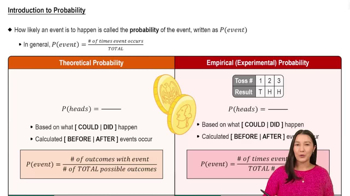
Introduction to Probability
Independent Events
Independent events are those whose outcomes do not affect each other. In this scenario, the birth of each child is independent of the others, meaning the outcome of one birth does not influence the next. This concept is crucial for calculating the overall probability of multiple births resulting in boys, as it allows us to multiply the probabilities of each individual event.
Recommended video:
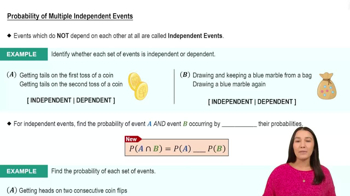
Probability of Multiple Independent Events
Multiplication Rule of Probability
The multiplication rule states that the probability of multiple independent events occurring together is the product of their individual probabilities. For this question, to find the probability of having five boys in a row, we multiply the probability of having a boy (1/2) by itself five times, resulting in (1/2)^5. This rule is fundamental for solving problems involving sequences of independent events.
Recommended video:
Probability of Multiple Independent Events
Watch next
Master Introduction to Probability with a bite sized video explanation from Patrick
Start learningRelated Videos
Related Practice
Textbook Question
950
views