Use the graph of y = f(x) to graph each function g. g(x) = f(x)+2
Table of contents
- 0. Review of Algebra4h 18m
- 1. Equations & Inequalities3h 18m
- 2. Graphs of Equations1h 43m
- 3. Functions2h 17m
- 4. Polynomial Functions1h 44m
- 5. Rational Functions1h 23m
- 6. Exponential & Logarithmic Functions2h 28m
- 7. Systems of Equations & Matrices4h 5m
- 8. Conic Sections2h 23m
- 9. Sequences, Series, & Induction1h 22m
- 10. Combinatorics & Probability1h 45m
3. Functions
Transformations
Problem 41
Textbook Question
Plot each point, and then plot the points that are symmetric to the given point with respect to the (a) x-axis, (b) y-axis, and (c) origin. (-4, -2)
Verified step by step guidance1
Identify the original point given as \((-4, -2)\). This point is located 4 units to the left of the origin on the x-axis and 2 units down on the y-axis.
To find the point symmetric with respect to the x-axis, keep the x-coordinate the same and change the sign of the y-coordinate. The symmetric point will be \((-4, 2)\).
To find the point symmetric with respect to the y-axis, keep the y-coordinate the same and change the sign of the x-coordinate. The symmetric point will be \((4, -2)\).
To find the point symmetric with respect to the origin, change the signs of both the x- and y-coordinates. The symmetric point will be \((4, 2)\).
Plot all points on the coordinate plane: the original point \((-4, -2)\), the x-axis symmetric point \((-4, 2)\), the y-axis symmetric point \((4, -2)\), and the origin symmetric point \((4, 2)\) to visualize their relationships.
Verified video answer for a similar problem:This video solution was recommended by our tutors as helpful for the problem above
Video duration:
5mPlay a video:
Was this helpful?
Key Concepts
Here are the essential concepts you must grasp in order to answer the question correctly.
Coordinate Plane and Plotting Points
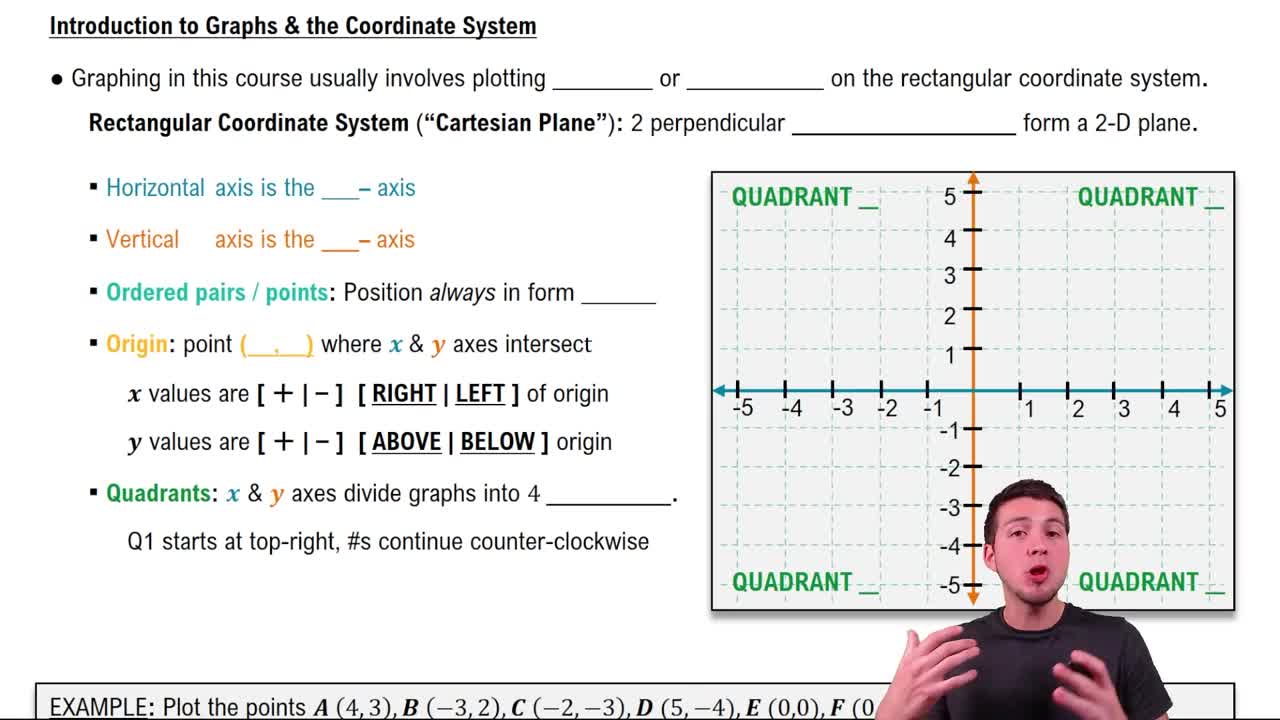
The coordinate plane is a two-dimensional surface defined by the x-axis (horizontal) and y-axis (vertical). Each point is represented by an ordered pair (x, y), where x indicates horizontal position and y indicates vertical position. Plotting a point involves locating its position based on these coordinates.
Recommended video:
Guided course
Graphs & the Rectangular Coordinate System
Symmetry with Respect to the Axes
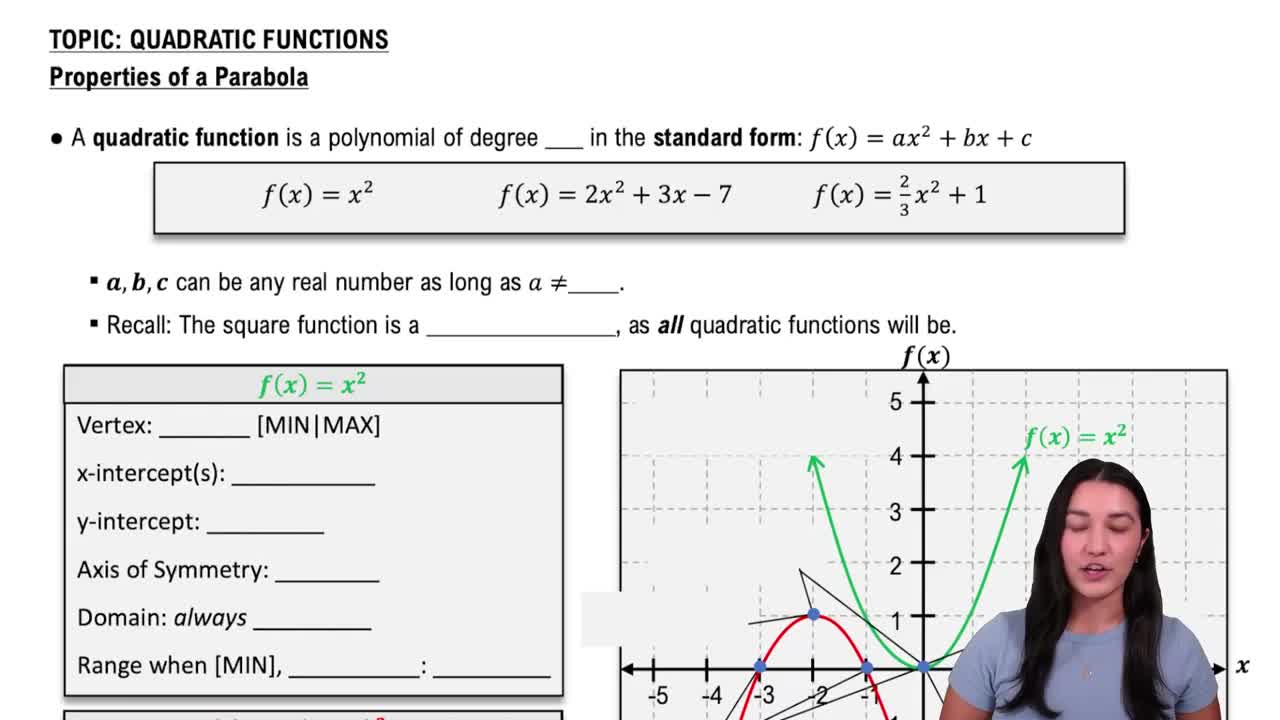
Symmetry about the x-axis means reflecting a point across the x-axis, changing the y-coordinate's sign while keeping x the same. Symmetry about the y-axis involves reflecting across the y-axis, changing the x-coordinate's sign while keeping y the same. These reflections produce points that are mirror images across the respective axes.
Recommended video:
Properties of Parabolas
Symmetry with Respect to the Origin
Symmetry about the origin reflects a point through the origin, changing the signs of both coordinates. For a point (x, y), its symmetric point with respect to the origin is (-x, -y). This transformation is equivalent to a 180-degree rotation around the origin.
Recommended video:
Graph Hyperbolas NOT at the Origin
Watch next
Master Intro to Transformations with a bite sized video explanation from Patrick
Start learningRelated Videos
Related Practice
Textbook Question
541
views