Use vertices and asymptotes to graph each hyperbola. Locate the foci and find the equations of the asymptotes. 4y2−x2=1
Table of contents
- 0. Review of Algebra4h 18m
- 1. Equations & Inequalities3h 18m
- 2. Graphs of Equations1h 43m
- 3. Functions2h 17m
- 4. Polynomial Functions1h 44m
- 5. Rational Functions1h 23m
- 6. Exponential & Logarithmic Functions2h 28m
- 7. Systems of Equations & Matrices4h 5m
- 8. Conic Sections2h 23m
- 9. Sequences, Series, & Induction1h 22m
- 10. Combinatorics & Probability1h 45m
8. Conic Sections
Hyperbolas NOT at the Origin
Problem 31
Textbook Question
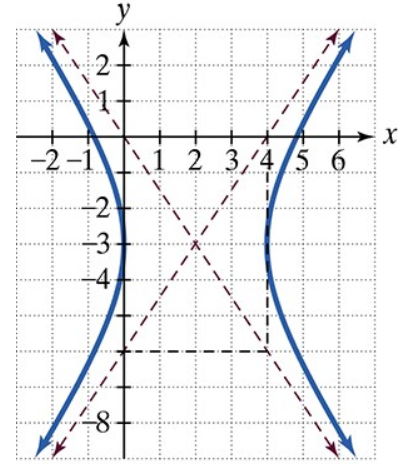
Find the standard form of the equation of each hyperbola.

Verified step by step guidance1
Identify the center of the hyperbola by finding the intersection point of the asymptotes. From the graph, the asymptotes intersect at the point (2, -3), so the center is (h, k) = (2, -3).
Determine the orientation of the hyperbola. Since the branches open left and right (horizontally), the standard form will be \( \frac{(x - h)^2}{a^2} - \frac{(y - k)^2}{b^2} = 1 \).
Find the slopes of the asymptotes. The asymptotes are lines passing through the center with slopes \( \pm \frac{b}{a} \). From the graph, estimate the slopes by choosing points on the asymptotes and calculating rise over run.
Use the slopes to find the ratio \( \frac{b}{a} \). Then, find the values of \( a \) and \( b \) by measuring the distance from the center to the vertices (which is \( a \)) and using the slope ratio to find \( b \).
Write the equation of the hyperbola in standard form using the center (h, k), and the values of \( a^2 \) and \( b^2 \) as \( \frac{(x - 2)^2}{a^2} - \frac{(y + 3)^2}{b^2} = 1 \).
Was this helpful?
Key Concepts
Here are the essential concepts you must grasp in order to answer the question correctly.
Standard Form of a Hyperbola
The standard form of a hyperbola's equation depends on its orientation and center. For a hyperbola centered at (h, k) with a horizontal transverse axis, the form is ((x - h)^2 / a^2) - ((y - k)^2 / b^2) = 1. For a vertical transverse axis, it is ((y - k)^2 / a^2) - ((x - h)^2 / b^2) = 1. Identifying the center and orientation is crucial to writing the correct equation.
Recommended video:
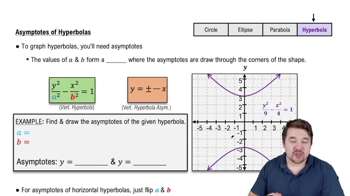
Asymptotes of Hyperbolas
Center and Transverse Axis of the Hyperbola
The center of the hyperbola is the midpoint between its vertices and the intersection of its asymptotes. The transverse axis is the line segment that passes through the vertices and determines the hyperbola's orientation (horizontal or vertical). In the graph, the center is at (2, -3), and the hyperbola opens left and right, indicating a horizontal transverse axis.
Recommended video:
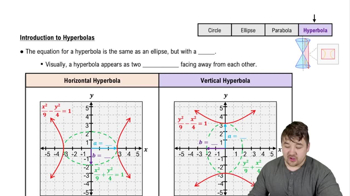
Introduction to Hyperbolas
Asymptotes and Their Slopes
Asymptotes are lines that the hyperbola approaches but never touches. Their slopes help determine the values of a and b in the standard form. For a hyperbola centered at (h, k) with a horizontal transverse axis, the asymptotes have equations y - k = ±(b/a)(x - h). Using the slopes of the asymptotes from the graph allows calculation of a and b, essential for forming the equation.
Recommended video:
Introduction to Asymptotes
Watch next
Master Graph Hyperbolas NOT at the Origin with a bite sized video explanation from Patrick
Start learningRelated Videos
Related Practice
Textbook Question
559
views