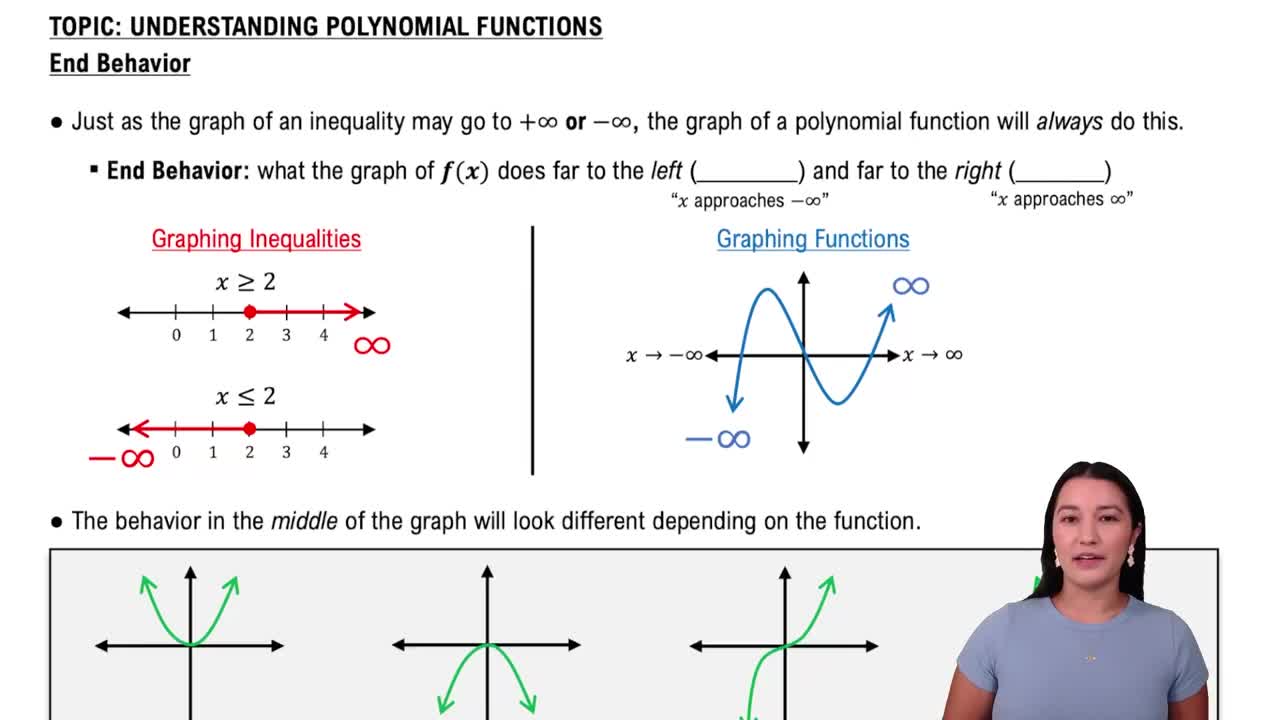
Determine whether each graph is the graph of an even function, an odd function, or a function that is neither even nor odd.
Verified step by step guidance
1
Observe the graph and note that the curve is present in the first and fourth quadrants, and it does not touch or cross the origin.
To determine if the function is even, check if the graph is symmetric about the y-axis. This means that for every point (x, y) on the graph, the point (-x, y) must also be on the graph. In this case, the graph is not symmetric about the y-axis.
To determine if the function is odd, check if the graph is symmetric about the origin. This means that for every point (x, y) on the graph, the point (-x, -y) must also be on the graph. In this case, the graph is not symmetric about the origin.
Since the graph is neither symmetric about the y-axis nor the origin, the function is neither even nor odd.
Conclude that the function represented by the graph is neither even nor odd based on the symmetry analysis.
Verified video answer for a similar problem:
This video solution was recommended by our tutors as helpful for the problem above
Video duration:
1m
Play a video:
0 Comments
Key Concepts
Here are the essential concepts you must grasp in order to answer the question correctly.
Even Functions
An even function is defined by the property that f(x) = f(-x) for all x in its domain. This means that the graph of an even function is symmetric with respect to the y-axis. A common example of an even function is f(x) = x², where the values of the function are the same for both positive and negative inputs.
An odd function satisfies the condition f(-x) = -f(x) for all x in its domain. This indicates that the graph of an odd function is symmetric with respect to the origin. A classic example of an odd function is f(x) = x³, where the function values for positive and negative inputs are equal in magnitude but opposite in sign.
A function is classified as neither even nor odd if it does not meet the criteria for either category. This means that the function does not exhibit symmetry about the y-axis or the origin. An example of such a function could be f(x) = x + 1, where the graph does not reflect any of the properties of even or odd functions.

 1:20 minutes
 Verified step by step guidance
 6:13
6:13