In Exercises 85–90, find the x-intercepts of the graph of each equation. Then use the x-intercepts to match the equation with its graph. [The graphs are labeled (a) through (f).] y = 2(x + 2)^2 + 5(x + 2) - 3
Table of contents
- 0. Review of Algebra4h 18m
- 1. Equations & Inequalities3h 18m
- 2. Graphs of Equations1h 43m
- 3. Functions2h 17m
- 4. Polynomial Functions1h 44m
- 5. Rational Functions1h 23m
- 6. Exponential & Logarithmic Functions2h 28m
- 7. Systems of Equations & Matrices4h 5m
- 8. Conic Sections2h 23m
- 9. Sequences, Series, & Induction1h 22m
- 10. Combinatorics & Probability1h 45m
2. Graphs of Equations
Graphs and Coordinates
Problem 14a
Textbook Question
Graph each equation in Exercises 13 - 28. Let x = - 3, - 2, - 1, 0, 1, 2, 3
y = x2 + 2
Verified step by step guidance1
Step 1: Understand the equation y = x^2 + 2. This is a quadratic equation, which represents a parabola that opens upwards because the coefficient of x^2 is positive.
Step 2: Create a table of values for x and y. Use the given x-values (-3, -2, -1, 0, 1, 2, 3). For each x-value, substitute it into the equation y = x^2 + 2 to calculate the corresponding y-value.
Step 3: For example, when x = -3, substitute into the equation: y = (-3)^2 + 2. Similarly, calculate y for all other x-values (-2, -1, 0, 1, 2, 3).
Step 4: Plot the points (x, y) on a coordinate plane. Each point corresponds to an x-value and its calculated y-value. For example, if x = -3 and y = 11, plot the point (-3, 11). Repeat for all other points.
Step 5: Connect the plotted points with a smooth curve to form the graph of the parabola. Ensure the curve is symmetric about the y-axis, as the equation y = x^2 + 2 is symmetric.
Verified video answer for a similar problem:This video solution was recommended by our tutors as helpful for the problem above
Video duration:
3mPlay a video:
Was this helpful?
Key Concepts
Here are the essential concepts you must grasp in order to answer the question correctly.
Quadratic Functions
A quadratic function is a polynomial function of degree two, typically expressed in the form y = ax^2 + bx + c. The graph of a quadratic function is a parabola, which can open upwards or downwards depending on the sign of the coefficient 'a'. Understanding the shape and properties of parabolas is essential for graphing quadratic equations.
Recommended video:
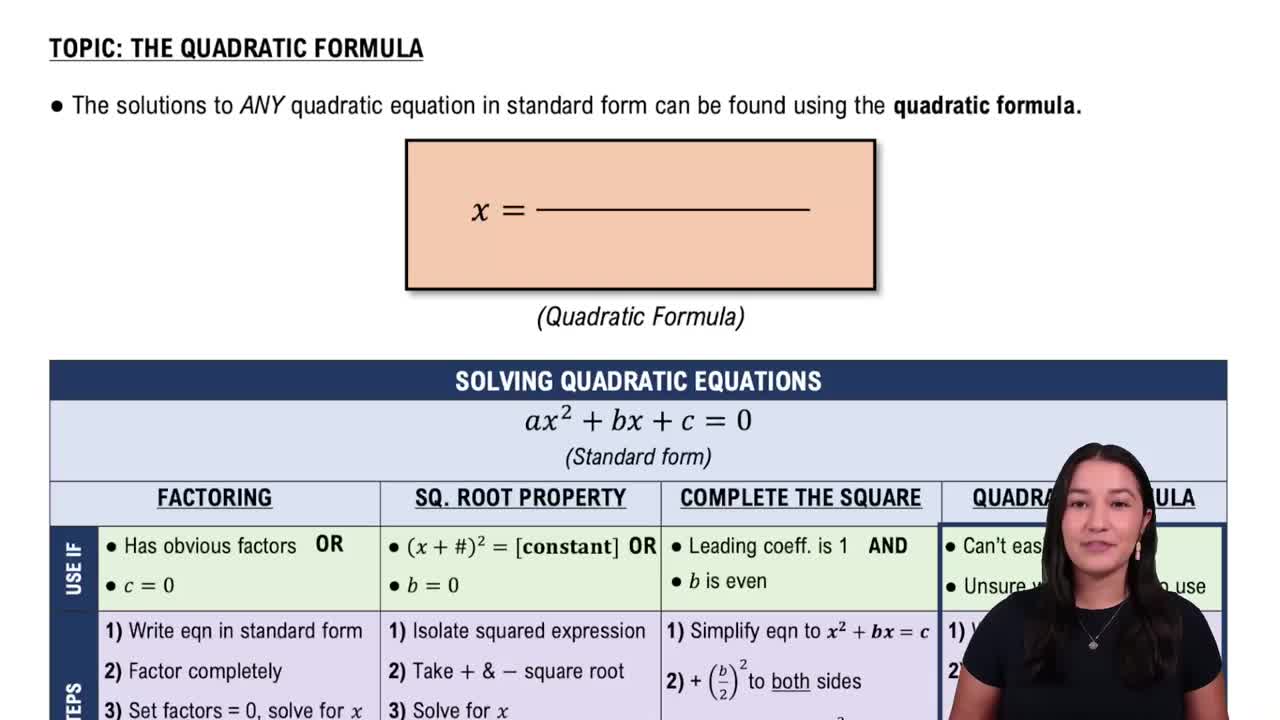
Solving Quadratic Equations Using The Quadratic Formula
Graphing Points
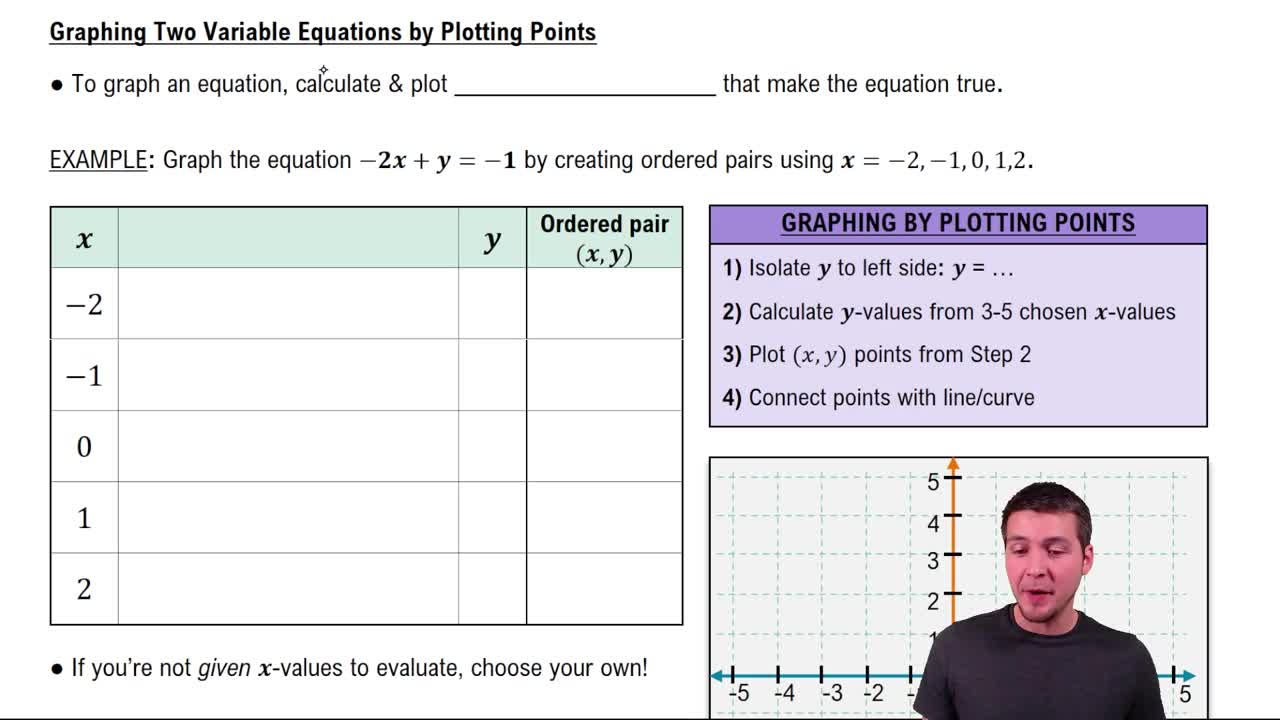
Graphing points involves plotting specific coordinates on a Cartesian plane. For the equation y = x^2 + 2, you will substitute the given x-values (-3, -2, -1, 0, 1, 2, 3) into the equation to find the corresponding y-values. This process helps visualize the relationship between x and y, forming the curve of the quadratic function.
Recommended video:
Guided course
Graphing Equations of Two Variables by Plotting Points
Vertex and Axis of Symmetry
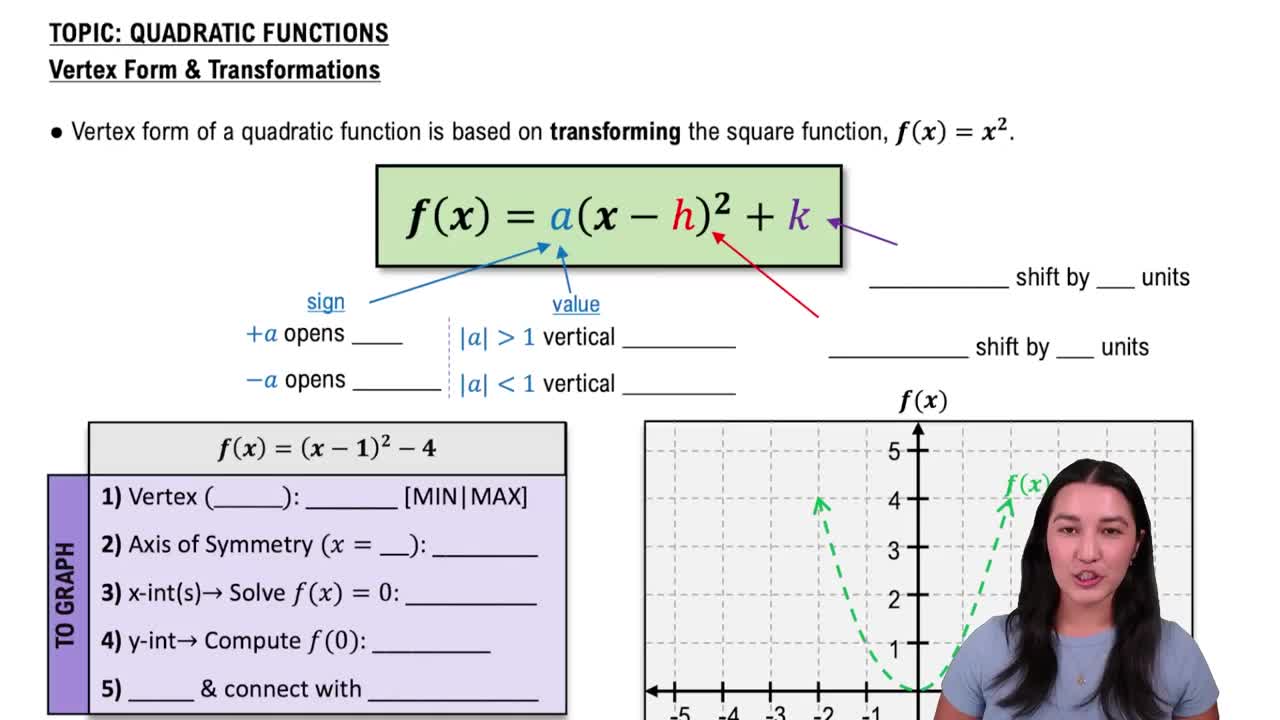
The vertex of a parabola is the highest or lowest point on the graph, depending on its orientation. The axis of symmetry is a vertical line that divides the parabola into two mirror-image halves, passing through the vertex. For the function y = x^2 + 2, the vertex can be found at the point (0, 2), which is crucial for accurately sketching the graph.
Recommended video:
Vertex Form
Watch next
Master Graphs & the Rectangular Coordinate System with a bite sized video explanation from Patrick
Start learningRelated Videos
Related Practice
Textbook Question
434
views