Determine whether each function graphed or defined is one-to-one.
Verified step by step guidance
1
Step 1: Understand the definition of a one-to-one function. A function is one-to-one if and only if each output (y-value) corresponds to exactly one input (x-value). In other words, no horizontal line intersects the graph more than once.
Step 2: Apply the Horizontal Line Test to the graph. Imagine drawing horizontal lines across the graph and observe how many times each line intersects the curve.
Step 3: Observe the graph provided. Notice that for any horizontal line drawn, it intersects the curve at most once, indicating that each y-value has a unique x-value.
Step 4: Conclude that since the graph passes the Horizontal Line Test, the function is one-to-one.
Step 5: Remember that one-to-one functions have inverses that are also functions, which is an important property in algebra.
Verified video answer for a similar problem:
This video solution was recommended by our tutors as helpful for the problem above
Video duration:
2m
Play a video:
0 Comments
Key Concepts
Here are the essential concepts you must grasp in order to answer the question correctly.
One-to-One Function
A function is one-to-one if each output value corresponds to exactly one input value. This means no two different inputs produce the same output. One-to-one functions have an inverse that is also a function.
The horizontal line test is a visual method to determine if a function is one-to-one. If any horizontal line intersects the graph more than once, the function is not one-to-one. If every horizontal line intersects at most once, the function is one-to-one.
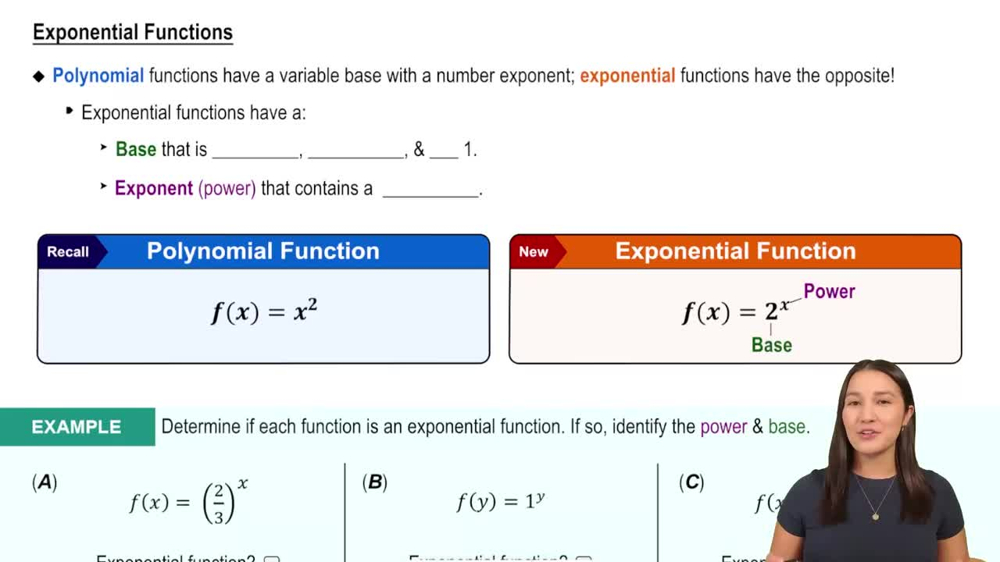
An exponential function has the form f(x) = a^x, where a > 0 and a ≠ 1. These functions are always one-to-one because they are strictly increasing or decreasing, meaning they pass the horizontal line test.

 2:23 minutes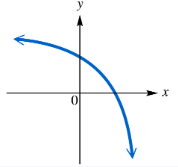
 Verified step by step guidance
 4:07
4:07