
Textbook Question
Indicate which statements are true. Correct all false statements by changing the underlined words.
__________ Lysosomes fuse with phagosomes to form peroxisomes.
765
views

 Verified step by step guidance
 01:38
01:38
 03:57 03:57
Indicate which statements are true. Correct all false statements by changing the underlined words.
__________ Lysosomes fuse with phagosomes to form peroxisomes.
Which of the following binds iron?
a. Lactoferrin
b. Siderophores
c. Transferrin
d. All of the above
Indicate which statements are true. Correct all false statements by changing the underlined words.
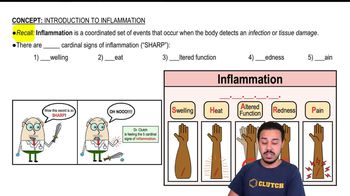
__________ Acute and chronic inflammation exhibit similar signs and symptoms.
Indicate which statements are true. Correct all false statements by changing the underlined words.
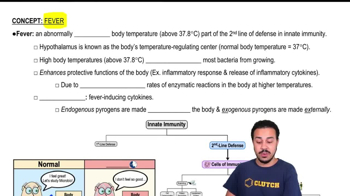
__________ The hypothalamus of the brain controls body temperature.
Indicate which statements are true. Correct all false statements by changing the underlined words.
__________ Defensins are phagocytic parts of the first line of defense.
Indicate which statements are true. Correct all false statements by changing the underlined words.
__________ A membrane attack complex drills circular holes in a macrophage.