
Ch. 15 - Innate Immunity
Bauman - Microbiology with Diseases by Taxonomy 6th Edition
Bauman6th EditionMicrobiology with Diseases by TaxonomyISBN: 9780134832302Not the one you use?Change textbook
Chapter 15, Problem 6

Indicate which statements are true. Correct all false statements by changing the underlined words.
__________ Phagocytes exhibit chemotaxis toward a pathogen.

Verified step by step guidance
1
Understand the key terms in the statement: 'Phagocytes exhibit chemotaxis toward a pathogen.' Chemotaxis refers to the movement of cells toward or away from a chemical stimulus.
Recall that phagocytes are immune cells that move toward pathogens by detecting chemical signals released by the pathogens or damaged tissues.
Evaluate the statement: Phagocytes do indeed exhibit chemotaxis toward pathogens, meaning they move in response to chemical signals to reach the site of infection.
Since the statement is true, no correction is needed for the underlined words.
Summarize that phagocytes use chemotaxis as a mechanism to locate and migrate toward pathogens for immune defense.

Verified video answer for a similar problem:

This video solution was recommended by our tutors as helpful for the problem above.
Video duration:
2m
Was this helpful?

Key Concepts

Here are the essential concepts you must grasp in order to answer the question correctly.

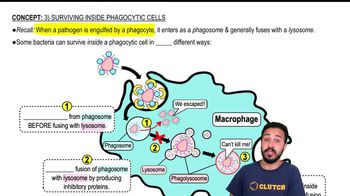
Phagocytes

Phagocytes are immune cells that engulf and digest pathogens and debris. They play a crucial role in the innate immune response by identifying, ingesting, and destroying harmful microorganisms.
Recommended video:
Guided course
04:18
Surviving Inside Phagocytic Cells

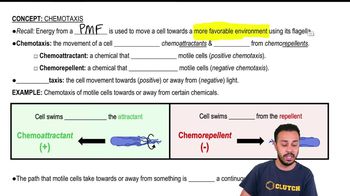
Chemotaxis

Chemotaxis is the movement of cells toward or away from chemical signals. In immunology, phagocytes move toward higher concentrations of chemical signals released by pathogens or damaged tissues to locate infection sites.
Recommended video:

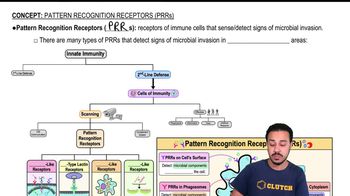
Pathogen Recognition

Pathogen recognition involves detecting molecules unique to pathogens, triggering immune responses. Phagocytes recognize these signals, which guide their chemotactic movement and activation to eliminate the threat.
Recommended video:
Guided course
04:24
Pattern Recognition Receptors