Ch. 4 - Microscopy, Staining, and Classification
Bauman - Microbiology with Diseases by Taxonomy 6th Edition
Bauman6th EditionMicrobiology with Diseases by TaxonomyISBN: 9780134832302Not the one you use?Change textbook
Chapter 4, Problem 6

Which of the following is different between light microscopy and transmission electron microscopy?
a. Magnification
b. Resolution
c. Wavelengths
d. All of the above

Verified step by step guidance
1
Step 1: Understand the key differences between light microscopy and transmission electron microscopy (TEM). Light microscopy uses visible light to illuminate the sample, while TEM uses a beam of electrons.
Step 2: Consider magnification. Light microscopes typically magnify up to around 1000-2000 times, whereas TEM can magnify up to 1,000,000 times or more, so magnification differs between the two.
Step 3: Consider resolution. Resolution is the ability to distinguish two points as separate. TEM has much higher resolution than light microscopy because electrons have much shorter wavelengths than visible light.
Step 4: Consider wavelengths. The wavelength of visible light used in light microscopy is much longer (about 400-700 nm) compared to the wavelength of electrons used in TEM, which is much shorter, allowing for higher resolution.
Step 5: Since magnification, resolution, and wavelengths all differ between light microscopy and TEM, the correct answer is that all of the above are different.

Verified video answer for a similar problem:

This video solution was recommended by our tutors as helpful for the problem above.
Video duration:
2m
Was this helpful?

Key Concepts

Here are the essential concepts you must grasp in order to answer the question correctly.

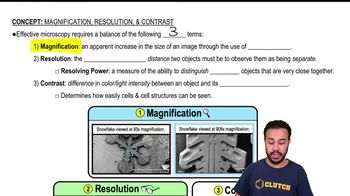
Magnification

Magnification refers to the ability of a microscope to enlarge the image of a specimen. Light microscopes typically magnify up to 1000-2000 times, while transmission electron microscopes (TEM) can magnify images up to 1,000,000 times, allowing much finer details to be observed.
Recommended video:
Guided course
07:29
Magnification, Resolution, & Contrast

Resolution

Resolution is the microscope's ability to distinguish two close points as separate. TEM has a much higher resolution (about 0.1 nm) compared to light microscopy (about 200 nm) because it uses electrons with shorter wavelengths, enabling visualization of much smaller structures.
Recommended video:
Guided course
07:29
Magnification, Resolution, & Contrast

Wavelengths

The wavelength of the illumination source affects both magnification and resolution. Light microscopes use visible light with wavelengths around 400-700 nm, whereas TEM uses electron beams with wavelengths much shorter than visible light, which is why TEM achieves higher resolution and magnification.
Recommended video:
Guided course
05:58
Pigments of Photosynthesis